Showing posts with label 1960s. Show all posts

Friday, 20 February 2026

Nuria Vinas


Nuria in 1968

Nuria Viñas Panades was a double winner of the Spanish women’s rally championship, in 1972 and 1973. She also won the Catalan women's championship in 1969, 1971, 1973 and 1975.

Born in Barcelona, she was from a motorsport family. Her brother Jordi was a rally driver who competed as "Jorge Chi" from the mid-1960s onwards. 

Her first steps in motorsport were apparently in 1962, when she entered the Rally Femina, which was based around Barcelona. Jordi encouraged her, according to an interview in Mundo Deportivo in 1968. The results for this all-female event are elusive, but her car was a Fiat 850, and she competed in the rally several times, possibly winning in 1963 and almost certainly winning in 1971. The rally was organised by Club 600, a Catalan motorsports club of which Nuria was a member. 

Her first rally looks to have been the Rally Invierno in 1963, where she and the SEAT were 36th. Returning to the event, she was 45th in 1964, this time in a BMW. Among her other cars was a Simca 1000, which she used for the Gerona Rally in 1965. She continued to switch between the SEAT, BMW and Fiat in 1966, with the Fiat being the quickest; she was twelfth in that year's Rally de las Tres Cuestas in it. She concentrated on smaller cars in 1967, changing between the SEAT and the Fiat. The Fiat was once again the best car for her, giving her a season's best of 18th in the Rallye Costa Brava.  In the same car, she was 23rd in the Rallye de Invierno, 19th in the Rallye Gerona and first lady in the Trofeo Maite Trepat and the Barcelona-Andorra Rally. She returned to the Barcelona-Andorra event in 1968. With the BMW and her regular co-driver Immaculada Juncosa, she won the Circuito de Llobregat Rally that year. 

At the same time, she appears in hillclimbs in Catalonia. Her first notable event was the 1964 Circuito Garraf, a hillclimb outside Barcelona. She drove a SEAT 600 and won both the novices' and the women's class. 

She and her brother sometimes entered the same events, althought they never shared a car. Both took part in the 1966 Puig Major hillclimb, both in Fiat-Abarth 850s, but in different classes.

The siblings competed against each other again in the 1967 Montseny climb. Nuria, in a Fiat-Abarth 850TC, was 40th overall, and Jordi was unplaced in his 1000cc Abarth. The following year, he had the upper hand, finishing 28th to Nuria's 43rd. She was driving a SEAT 600 again this time. 

The following year, she was the Catalan ladies' champion in hillclimbs and 32nd in the main championship.

As well as rallies and hillclimbs, she also raced on circuits, and was the first woman to participate in the Barcelona 6 Hours race, held at the Montjuich Park street circuit. Although she never raced single-seaters, she did compete at a Grand Prix weekend at least once, driving a little SEAT in the one-make Copa SEAT that ran as a support in the early 1970s.

She is most associated with a BMW 2002 Ti, and was especially effective in the women-only rallies organised in Spain in the early 1970s, but she first appears in the Spanish Touring Car Championship in it in 1970. She won her class in it in the Puig Major hillclimb, then a round of the championship. She is recorded as the winner of the 1971 Rally Femina in the BMW, and the same year, she did at least two rounds of the Sapnish Touring Car championship, finishing 16th at Montjuich and ninth at Guadalope. Her car was a Group 1-spec machine. She entered the Barcelona 3 Hours and was fifth in class. Hillclimbs were very much still a priority too, and she won her class in the La Rabassada event, after finishing second in Group 1 at Puig Major.

Her first Spanish women's championship win was also in this car. Nuria won the 1972 Rallye Femenina Saibil and the Rallye Primavera, with Maria Angeles Pujol, her regular co-driver in the middle part of her career. 

Her second women's championship in 1973 came off the back of six wins in all-female events, co-driven in the BMW by Ana Maria Garreta. She was more than twenty points ahead of her nearest rival, Marisol Rodriguez Mesa, who had only picked up one class win in the Rally of Spain, in her SEAT. Nuria's only non-win was her eighth place in the Rally Primavera-Las Palmas, which must have been a disappointment after her 1972 victory. As well as rallying, she continued to campaign her Group 1 BMW in Spanish Touring Cars, racing at Montjuich for the 2-Hour National event and finishing tenth.

The women's championship was in something of a decline in 1974, with smaller entry lists and more events running as a class in mixed rallies. Nuria only entered her BMW in one, the Jerez women's rally, which she won in the BMW, ahead of that year's champion, Yolanda. Nuria had to make do with another Catalan women's motorsport championship, which she claimed ahead of hillclimb driver Beverley Pugh.

Hers was a lengthy career, and she was still active in motorsport in the late 1970s, driving a Ford Escort in hillclimbs in Catalunya. She was 22nd in the 1978 Montseny hillclimb, returning to one of her earliest regular events. The following year, she made a last visit to Puig Major, finishing 51st.

She won a final women's rally, the Rallye Femenino Adosinda, in 1979. Her car was the Escort and she was navigated by Ana Maria Garreta, who had sat alongside her for several years. 

She died in 1998. 

(Image copyright Mundo Deportivo)

Friday, 13 February 2026

Helga Heinrich (Steudel)


Helga Heinrich, formerly known as Helga Steudel, is a German driver and motorcyclist, originally from East Germany. 

She started out in motorcycle racing in 1959, aged 20, having learned to ride at thirteen. Six years later, she became the first female rider to win a major race, at the Sachsenring. To this day, she remains the only woman to win there on two wheels. She continued to win at other circuits, usually on a 125cc MZ RE. Despite her obvious talent, women found it very difficult to be granted licenses for international racing by the FIM, so she had to stay within club competition. Her two-wheeled career ended in 1967. 

After her marriage to Dieter Heinrich, she switched to cars in 1970, using a DDR-made Melkus RS 1000 sports racer to begin with. Without a major sponsor, she took on three jobs to affford her racing, including working in a paint factory and on her family's farm.

Being an Eastern Bloc sportsperson, she competed within the Communist countries almost exclusively. Schleizer Dreieck, in East Germany, was her commonest haunt. She achieved many top-ten finishes throughout the 1970s, in the RS 1000, and later, a Spyder and a Formel Easter single-seater. As well as races, she competed frequently in hillclimbs. 

Schleiz was the scene of her first major race result, a fifth in the 1971 Bernauer Schleife race for Melkus RS 1000 cars. Ulli Melkus, from the family who had created the cars, was the winner. The following year, she seems to have competed outside Germany for the first time, taking the Melkus to Most in modern Czechia, then the Soviet Republic of Czechoslovakia. She was eighth at Most and then seventh at Piestany, in modern Slovakia, before returning home to come sixth at Schleiz.

For 1974, she switched to the Spyder Krug, another sports prototype made in the GDR. She continued to race in Czechoslovakia, although she does not appear to have visited other Eastern Bloc countries to compete. The Spyder does not seem to have been the most reliable of cars and she rarely finished this year. It was more successful in hillclimbs, with a best result of fifth at Bautzen in the GDR. That said, she had her fair share of non-finishes in speed events as well.

Another season in the Krug was mostly spent in hillclimbs. Her best result was fifth again, this time at Torun in Poland. By now, she had a sponsor, Malimo knitwear. She only used the Krug for half of the season in 1976, switching between it and a Spyder Scharfe. The Scharfe was the better car and she was third at the Annaberg hillclimb in the GDR in it. It was a car she would return to over and over again until 1980, although she did score two more third places in a Spyder Tschernoster in 1977, at Annaberg and Schwarzenberg. In hillclimbs, she also used a Lada and a later Melkus MT77 on occasion.

Her circuit racing appearances became more sporadic towards the end of the 1970s. In 1979, she was twelfth in a race at Ostrava in Czechoslovakia, driving the Spyder Scharfe. 

She first retired in 1984, only making one more appearance in 1992. However, in 2007, she came out of retirement again, initially for historic events, but more recently, in modern single-seaters. 

In 2013, she raced a Formula Renault in the ESET Eastern European championship, at the age of 75. Prior to this, she had won a hillclimb championship in 2010. The year before, she competed in a GDR-built Formel Easter Estonia 25 in the GLP Pro Series. She had raced in this Soviet single-seater championship more than 20 years earlier, when she was the only woman to take part.

Although she does not appear to have raced since 2016, she still remains Germany’s oldest female racing driver, having been active until the age of 75. Her last races were in the Carbonia Cup at the Slovakiaring, driving a Formula Renault.

(Image copyright Helga Henirich)

Thursday, 24 July 2025

Barbara Johansson


Barbara Johansson was a Swedish race and rally driver most active in the 1960s. She usually drove small cars and is most associated with the Mini. She was nicknamed "Bra-Bra" by the Swedish press, with "bra" translating here as "good".

Barbara was born in the USA to Swedish parents, although she lived her entire adult life in Sweden. She had always been interested in cars and enjoyed driving fast in her parent's Ford V8 when going to and from the stables where she kept her horses. After her marriage, she began her motorsport career in speedboats, sharing a vessel with her husband. Her husband worked for a Peugeot dealership and it was at the suggestion of his boss that she tried out motor racing. She won her first event, driving a Peugeot 203.

She was highly successful in the Swedish Touring Car Championship and won a Group 2 race outright, at Knutstorp in 1964. Her car was a Mini Cooper run by the works BMC team. She was also second at Falkenberg and fourth at Skarpnack, and would have been Group 2 champion without a couple of non-finishes. According to a story, DKW driver Sigurd Isaakson said that if she beat him in a race, he would withdraw from the championship. She did defeat him in 1964, albeit in a different class, and he did go home.

Her first STCC appearance was in 1960, at Karlskoga, where she drove a Peugeot 403 and finished tenth, eight laps down. Sharing the same car with Jan Englund and Carl-Erik Linn, she was 21st in the end-of-season enduro at Skarpnack. 

In 1961, she appeared in the same race, driving a Renault Dauphine this time. Her co-drivers were Gunnar Friberg and Lars-Erik Tisell and they were 17th overall. This was as part of a Renault dealer team who were trying to gain attention by employing a female driver.

She then disappears from the STCC entry lists until 1964. She did two rounds of the championship in 1965, finishing one, at Karlskoga, in fifth place. Again, she was driving a Mini.

The 1966 STCC featured Barbara and her Mini racing in its mid-season events. She was tenth at Skarpnack, eighth at Karlskoga and twelfth at Falmarksbanen. After this, BMC began to scale back its motorsport activities and could no longer support her.

After touring cars, she also raced single-seaters. Photos exist of her competing in Formula Vee in 1967, although results are not readily available. Her car was a German-designed Dolling. By this time, she had separated from her husband and was combining her competition career with bringing up two children, helped by a nanny. She went back to racing boats, continuing to compete on and off until the early '70s.

Alongside her racing career, she competed in rallies. When BMC Sweden's representative Bosse Elmhorn saw her competing in local ice races and rallies, it was their rally team she was originally signed up for. Her team-mate was Harry Kallstrom, In a reflection of her track activitiy, she had already entered the Swedish Midnight Sun Rally in 1960, in a Peugeot 403, and the same event in 1961, in a works-supported Renault Gordini. She was also on the entry list for the Malarallyt.

In 1963, she was part of the BMC set-up. She was assigned a Mini Cooper for the Midnight Sun Rally, but then switched to an MG 1100 for three more Swedish events. At the end of the year, she did her first overseas rally, the RAC Rally in the UK, driving the Mini with Sheila Taylor. Sadly, the suspension failed when they were in fifth place.

A regular partnership with Margot Bradhe formed for 1964. Apparently, Margot was a calming influence on Barbara's aggressive driving style; she did not believe in lifting off the throttle. They drove the Mini Cooper almost exclusively and entered the Monte Carlo Rally for the first time, although they do not seem to have finished. Barbara's best finish was a 24th place in the Midnight Sun event, There were 138 finishers that year and many more starters. Later in the year, she won the Ladies' prize in the Jamt Rally.

Her last year as a rally driver was in 1965. BMC were already scaling back by then and she was back in a Renault 8 Gordini. She and Inga-Lill Edenring entered the Midnight Sun Rally, but do not appear to have finished.

She died in 2013, aged 80.

(For reference, Tommy Lyngborn's 2014 article provided a lot of the additional information here.)

Image copyright Upplands Museum, Sweden.

Thursday, 10 July 2025

Liliana de Menna

Liliana de Menna was a stalwart of the Italian touring car scene who was active between 1963 and 1994. 

Her first efforts were in races for small-engined saloons, when she competed under the name of "Liliana" in the hope that she wouldn't worry her family. She had got into motorsport after visiting the Vallelunga circuit with friends who raced; throughout her career, Vallelunga would remain her favourite circuit. She had seen world karting champion Susy Raganelli testing with her father and decided to try it for herself.

She won a saloon championship in her first year of racing, winning nine races outright. Her car was a 600cc Fiat 500 Montecarlo. 

The following year she won Class 2 of the Coppa Carotti hillclimb. She did several hillclimbs during her career; the Italian touring car championship was a combination of hillclimbs and circuit races at the time. In 1968, she finished the Cesano-Sestriere climb, in the middle of a group of Giannini Fiat 500s, as well as winning her class in the Bolzano-Mendola event.

She was the Italian ladies' champion in 1968. Her marriage to Italo Cantera did not slow her down and the pair even raced together in the Vallelunga 2 Hours one year. 

Some time at the end of the '60s, she had a daughter and took a lengthy hiatus from motorsport. She stopped attending race meetings because she didn't enjoy them without being able to compete herself. It wasn't until the late '70s that she came back. According to her, Giancarlo Naddeo asked her to join the Renault 5 one-make series, and she agreed. She also raced in single-make series for the Fiat 127 and MG Metro. This was the car she shared with her husband.

One-make racing led back to the Italian Touring Car Championship in the 1980s. In 1989, she raced at Pergusa in a Renault 5, coming 11th. She was then tenth at Vallelunga. For the second Vallelunga round, she shared an Audi Europa-run VW Golf with Michele Rayneri, but did not finish. 

She even raced for Lella Lombardi's team in the Italian Supertouring series in 1991, using a Ford Escort for the Pergusa 2 Hour race. Her team-mate was Walter Santus and they finished 18th. Earlier in the season, she had raced a Toyota Corolla in the Trofeo Mario Angiolini at Monza. 

Later in her career, she raced sportscars, including a Nissan 300ZX in 1992, which she used for that year's Vallelunga 6 Hours. She and Francesco Ramacciotti were 2st overall. In 1994, she entered the Italian Supercar GT championship in a Mazda RX-7, driving solo.  She was disqualified from the first meeting at Monza, but won her class twice at the next round, held at Magione. Her overall results were a fifth and fourth place. The next race she appeared in was round 5, at Varano, but she could only manage one twelfth place.

She raced in America for the first time in 1999, more than 30 years after she made her debut, when she did some rounds of the all-female Women's Global GT series, driving a Panoz Esperante. Her programme consisted of two guest appearances. 

She died in 2021.

(Image from Il Messaggero)

Monday, 30 June 2025

Anita Liden


Anita Lidén is a Swedish driver who is most famous for attempting to build a career in NASCAR in 1970.

She tried to enter the Motor Trend 500 at Riverside, but never made the start, having no car and no backers. She had shown up at Riverside and hung around the gates in the week before the 500, handing out business cards in the rain and attempting to persuade car owners to take a chance on her.

Despite her chutzpah, the enterprise did not work. Her complete lack of stock car experience, apart from some slow testing laps, and general lack of American racing experience, worked against her. Her husband Lasse, another racer who was with her, was also unsuccessful in launching a US competition career.

Anita and Lasse lived near the Anderstorp circuit, where he raced both cars and motorbikes. She was formerly a model and got into motorsport through her husband.

She had raced in Formula Ford in Sweden in 1969, in her first year of competition. She usually used the name "Anita Snabb", which translates to "Fast Anita". Her car was a Merlyn. In 1969, she entered the Junior race at the Hyllingeloppet event at Knutstorp, finishing second.

After her trip to America, she returned to Sweden and quickly went back to single-seaters. She continued to race in Formula Ford, then in the Swedish and European Formula Vee championships. She took part in the Swedish series in 1970 and 1971 and the European championship between 1970 and 1072.

Much later, in 1976, she raced in the Lee Cooper Mini Lady Cup, a Swedish all-female racing series, and won at least one race, although not the championship, which went to Birgitta Uppling. Her car was advertised for sale in 1978, so her career appears to end there.

(Image copyright Autosprint, 1971)

Tuesday, 10 June 2025

Jean Aley


Jean at the Brands Hatch ladies' race. She is fourth from the right, turning away from the camera

Jean Aley drove saloon cars in the 1960s, and also competed in rallies.

She was born into a motor racing family. Her father Anthony Curtis was one of the founding directors of HRG sportscars and both he and her mother Nancy were regular visitors to Brooklands. Jean's first practical involvement was through working for motor clubs, including the BARC and BRSCC. Between 1958 and 1960, she sprinted a Cooper sportscar and was second in class in the 1958 Brighton Speed Trials. 

Jean married John Aley in 1960, and he encouraged her to race again from 1961 onwards, usually in a Mini. She had taken some time out after an accident at Silverstone in the Cooper.

Her best year for saloons was 1962, when she drove a Mini in the Nürburgring 6 Hours and 500km races. She and Daphne Freeman did not finish the 500km, but she was fifth in class in the 6 Hours, driving with her husband John. Their Mini was described as "very standard". 

She was also one of nine women who entered a ladies' race at Brands Hatch, organised by the fledgling British Women Racing Drivers' Club. She was third, driving a Mini, behind two Lotus Sevens driven by Liz Osborn and Wendy Hamblin. Talking to the Daily Express, she said that the race had been a warm-up for the Nürburgring, and that John had lent Daphne their other Mini, a "shopping car", for the race. 

A second run in the Nürburgring 6 Hours followed in 1965, driving a little Fiat Abarth with John and Tim Lalonde. Their finishing position is unclear. Her year had begun inasupiciously, with John taking over her Mini for a round of the British Saloon Car Championship at Snetterton. His team had entered two DKWs for German drivers, but John's own car was out of action, so he took Jean's. 

Competing against each other apparently caused some friction between the Aleys, and Jean concentrated on sprints and hillclimbs after that.

Plans were discussed for an endurance trial in a smaller Fiat-Abarth in February 1967. John, Jean and drivers from the Cambridge University Automobile Club aimed to run the car day and night at Snetterton for a week, covering 1000 miles per day. It is not clear whether this ever took place.

In rallies, she occasionally navigated. She sat alongside Sheleagh Aldersmith for the 1963 Monte Carlo Rally. Unfortunately, their rally ended before they had even got on a ferry to the Continent; the radiator exploded within a few miles of Jean's house. John took some responsibility, claiming he should have checked it. 

Both of the Aleys were now involved in motorsport outside of active competition. John sometimes served as Clerk of the Course at Snetterton, with Jean as Secretary of the Meeting. Later, they managed the circuit and founded the BRSCC East Anglian branch.

Her career seems to have ended after a road accident in 1967, when a tanker sideswiped her car at a junction. She and her female passenger were both injured. After this, she continued with her administrative work, organsising two European Touring Car Championships with John.

The couple ended up divorcing. Jean remarried.

(Image copyright Daily Mirror)

Thursday, 8 May 2025

Sheleagh Aldersmith


Sheleagh before the 1963 Monte

Sheleagh Aldersmith was a British driver and navigator in the 1960s. She competed in the Monte Carlo Rally many times between 1960 and 1970.

The first success she had at the wheel seems to have been a win in the Cowley & Wilson Trophy in 1957, a navigational event with driving tests and a quiz element organised by the Buckingham and District Motor Club. This had followed a second place in their "Spring Sprints" navigational rally. Her car is not recorded.

Some time between then and 1960, she started competing in stage rallies. A 1962 Worthing Herald news article from 1962 has her as "rally driving for the past two years".

Her first international event was in 1960. She teamed up with the multiple French champion, Claudine Trautmann (then Vanson) for the RAC Rally, driving a Citroen ID19. This was despite There was some confusion over whether they had actually started, but they made progress in Scotland until rolled, having stopped to help Claudine's future husband, Rene Trautmann. Sheleagh continued as a driver of the team's chase car. At the time, some said this was her second RAC Rally. 

As co-driver to Rosemary Seers in 1961, she entered an Triumph Herald in the Tulip Rally, held in the Netherlands. They were 73d overall, seventh in class, from 113 finishers.  Rosemary then switched to an MG Midget for the car-destroying Liege-Sofia-Liege Rally, which had eight finishers. The Seers/Aldersmith car was not among them. It had lost its exhaust system on the Resia Pass going into Italy, then gradually lost power until it expired at Sofia. The lack of an exhaust meant the the car's floor pan got very hot, particularly under the co-driver's feet. Both Sheleagh and Rosemary burnt through the soles of their shoes and had to jump out of the car at time controls. To add insult to injury, they received a speeding ticket in Yugoslavia.

They also drove an MG together on the 1961 RAC Rally and the 1962 Monte, although they did not finish either event. The Midget's gearbox broke on the RAC Rally.

In April, she came to the rescue of Irish driver Pat Barr, who found herself without a navigator for the Circuit of Ireland. Sheleagh answered an advert in the motoring press and cancelled another rally in England the help Pat out. They drove a Mini, but finished over the time limit and were not classified.

She did her first international rally as a driver in 1962, taking on the Tulip Rally, driving an Austin Seven wiht David Howick. She seemed equally happy working with male and female team-mates and was aiming for the mixed team award this time. On the way, she took her friend, Mrs Stromwall, as an additional, unofficial navigator; Mrs Stromwall wanted to visit her daughter in Bruges. Sheleagh was 88th overall.

Teaming up with Pat Barr again, but switching seats, she tackled the Tulip Rally again in 1963. This followed an ignominious exit from that year's Monte, when her road car broke down as she tried to get to the airport on her way to Ostend, the radiator bursting on co-driver Jean Aley's driveway. Later, she tried the Spa-Sofia-Liege event again, driving a Mini for the first time. She and co-driver Michael Nesbitt, a racing mechanic who owned the car, did not finish. The Mini's suspension, brakes and clutch were defeated by poor Yugoslavian roads near Titograd, now Podgorica in modern Montenegro.

Another Monte in 1964 began in Minsk, where she spent some time visiting local hospitals to compare conditions with the UK. She used the a Mini from the same garage as the one she shared with Michael Nesbitt, but had Elizabeth Jones as her co-driver this time. They got as far as the Alps without too much trouble, despite snow and bad Czech fuel, but the Mini was ailing and they went over the time limit trying to finish a special stage on an icy road.

Switching seats with Nesbitt again, she entered the Spa-Sofia-Liege again, but it continued to beat the, the car's radiator giving out this time. 

Another navigating job that year was helping Bill West on his first international rally, that year's RAC Rally. His Mini was a production model, as opposed to the Nerus-engined Hares Garage car Sheleagh was used to. They finished, in spite of changeable weather, including blizzards and fog in Scotland and northern England. The car's suspension had problems and the fan belt came off twice.

1965 was a quieter year. Sheleagh and Pat Walton had another go at the Tulip Rally in a Mini, but did not finish. This was a new car for her; she had elected not to enter the Monte to allow time for it to be prepared.

1966 was also relatively quiet. Sheleagh had been down to co-drive for a garage owner, John Barnes, but a bout of sciatica meant she had to drop out. It was also suggested that the Mini they were hoping to use had too many spotlights to be legal as well.

Another co-driving job came in in May, when she sat beside ED Jenkins for the Austrian Alpine Rally in a Mini. Their finishing position is unknown. 

The Mini was her chosen car in 1967 as well: she and Carolyn Tyler entered the Monte Carlo Rally, described as Sheleagh's sixth attempt. The car was hers, and she and Carolyn had tried it out on the Isle of Wight in October 1966, in a local rally. They won the Coupe des Dames. Unfortunately, they were non-finishers in the Monte itself.

She was set to drive in the RAC Rally with Susan Porch, until it was cancelled due to foot and mouth disease. Susan just wanted to get to the finish, in order to be eligible for the 1968 Monte. 

As a navigator, she entered two more rallies in 1967, in two separate Minis. She partnered Australian Lyndon McLeod for the Tulip Rally and Christopher Coburn for the Alpine Rally, although neither team finished.

Her partnership with Christopher Coburn continued for another two seasons, always with her in the navigator's seat. In 1968, they drove a Mini on the Monte, her seventh edition and his first. Their rally ended stuck in a bramble bush, going over the time limit in order to free themselves.

Their final event together was Sheleagh's last international rally. It was the 1969 Monte, driving a Vauxhall Viva. The alternator became faulty shortly after the start and they did not finish.

A hospital doctor and consultant in physical medicine, she was usually referred to as “Dr. S Aldersmith”, and has been described as "formidable". That said, she told the Worthing Herald in 1962 that her parents would not allow her to learn to drive, and she had to wait until she had qualified until she began "eight years ago". She had been practising medicine since at least 1954, when she worked in Nottingham. This was after she contracted polio in 1952, which must have necessitated time off work and sporting activity. She later lived in the south of England, at Rustington. She was sometimes a member of the circuit medical team at Goodwood, Silverstone and Brands Hatch, and the first woman to serve as a medical officer at the British Grand Prix.

As well as motorsport, she took an interest in flying and gliding and was one of the donors towards the 1954 World Championship Appeal Fund.

She died in 2002, aged 78. Her given name appears to have been "Sheila" on her birth certificate, but she used the spelling "Sheleagh" to refer to herself.

(Image copyright Worthing Herald)

Friday, 2 May 2025

Stephanie Ruys de Perez


Stephanie Ruys de Perez raced saloons in Canada in the 1960s and 1970s. Although born in the USA, she lived in Canada for most of her adult life.

She first comes to the attention of the media in 1966, when she was interviewed for McLeans magazine for a feature about women in motorsport. She was racing a Sunbeam Imp at the Players 200 meeting and it broke down on the third lap. The writer, Alan Edmonds, was very taken with her blond hair and slim figure, and wrote a lot about how she enjoyed racing as a "sensual" thing. Her husband had taken up the sport that year and it is likely that this was her first season too, although a 1969 newspaper article says that she had been racing for five years by then, "the last two in a full-sized sedan". She is quoted as saying that she would be "very depressed" if she thought she was better than men, and hoped her husband was better than her.

In 1970, she had moved on to a more powerful car and entered the Can-Am Challenge Race for the Labatts Blue Trophy, driving a Chevrolet Camaro. It is unclear whether she qualified. She later raced this car at the Harewood Grand Finale meeting at Harewood Acres, finishing ninth in her race. In July, she did at least one round of the Canadian Touring Car Championship at Mosport, finishing fourth. The first mention of this car was in a June 1969 Ottawa Journal report, where she raced in a support event to the Can-Am Challenge Cup. The car itself is sometimes described as being purple.

In 1972, she was fourteenth in the Sanair Trans-Am race, in a Mini Cooper, driving for the Fossman racing tem. Her name is sometimes associated with works Ford team Comstock, who helped start the careers of many Canadian drivers of the time, but it isn't clear whether she raced for them.

One of her more famous exploits was a Battle of the Sexes match race she undertook against Bob Tullius in November 1973. Tullius had previously said that her Mini could be driven faster by a man, encouraging her to challenge him to the race. The event was a support for the American Road Race of Champions at Road Atlanta, with both drivers in identical Triumph Spitfires prepared to Showroom Sports Car spec.

Stephanie, who had never competed at Road Atlanta before, led for three of the five laps, but was caught on the back straight by her rival, who won by 1.8 seconds. A group of women apparently mobbed officials and tried to claim that there were five more minutes left on the clock. Tullius won a silver pig trophy for his victory in the "Chauvinist Match Race".

Not long before, in October, she had wrecked her Mini in a spectcular accident at Mosport, flipping it over during qualifying.

More detailed information about her career is not forthcoming, although she was quite famous at the time, appearing in TV and print adverts. One of these was for Shell unleaded petrol in 1971. In 1974, she appeared in a TV series called Food for Thought, presenting a fitness segment.

She died "at an early age" from cancer.

(Image copyright McLeans magazine)

Saturday, 12 April 2025

Jenny Tudor-Owen


Jenny Tudor-Owen raced and rallied, mostly in Europe, during the 1960s. She normally drove British cars.

Her first car, lent to her in 1962 by John Coombs, was a Mini, which she crashed. Her then-boyfriend Mike Parkes built her another Mini, in which she qualified on pole for her first race at Brands Hatch, only to over-rev on the startline due to valve bounce. 

She quickly moved on to an MGB. This particular car is the one most associated with her, and she raced several different versions. The first of these was run by Barwells in 1963. 

In 1964, she was fourth in the Copenhagen Cup at the Roskildering. Her MGB was the first one to race in Denmark.

Tracking down her race results has proved difficult, but she did enter at least some of the Freddie Dixon Challenge Trophy and other club meetings organised by the BARC and BRSCC. The MGB was often up against much more powerful cars, such as Ferrari 250s and Jaguar E-Types. Among her rivals were Jackie Stewart, Bernard Unett and Alan Minshaw. Her best result in the MG, in the UK at least, was a fifth place at Oulton Park in June. Later in the year, she tried out a Lotus Elan for a couple of races, and she was third at Mallory Park in a 1600cc GT race. 

The Elan was her main focus in 1965, although it looks to have been a much shorter season for her. The biggest event on her calendar was an early-season race at Goodwood for small-engined sportscars, in which she was eleventh. She also tried out single-seaters, in the shape of a Formula Vee. 

After another spell in the MGB, which included an entry in a BWRDC ladies' race at Oulton Park in 1967, she acquired a Jaguar E-Type, which she used in 1967 and 1968, winning the 1968 BWRDC Racing championship following an outright second place at Thruxton. She had been leading the race on a wet track and recovered from a spin to hold on to the runner-up spot.

Racing a Bamford MGB at Oulton Park in October 1968, she managed to crash during practice and write off the car at Cascades. Her accident was overshadowed by James Hunt famously throwing an Alexis Formula Ford in the lake at the same meeting. That year, she also raced an E-Type for Warren Pearce's team. 

On the rallying side, she is best known for her Coupe des Dames in the 1968 London-Sydney Marathon, driving a Volvo 145. She was part of a four-woman team with Elsie Gadd, Anthea Castell and Sheila Kemp. The car belonged to Elsie Gadd, who had no rallying experience, so she hired Jenny and Sheila as her lead drivers. They were 41st overall, just in front of Jean Denton’s MGB, which had been the favourite for the Ladies’ prize. They had their share of troubles, including a fire in the car's battery in the closing stages in Australia, and large cracks in the car's bodywork, which needed to be welded, after crossing the gravel roads of Turkey and the Middle East.

After the London-Sydney, Jenny disappears from the entry lists. Her marriage ended and she seemed to retire from motorsport completely, although she occasionally popped up in the papers. One such appearance was in the Kent Evening Post in 1970, where the "really expert driver" opined that other women drivers "don't concentrate enough".

She moved to America and then South Africa, where she used her skills at the wheel as a film stunt performer. She also bred Pekinese dogs successfully.

(Image courtesy of Greening Australia)

Wednesday, 22 November 2023

Helene Bittner


Helene Bittner was an Australian driver who raced single-seaters in Formula Libre events in the 1960s. 

She began in 1961, at her home track of Mallala which had opened recently. Her car was a 1200cc Vitesse-Ford. In her first year, she entered the Australian Grand Prix, which was then run as a Formula Libre race. Sadly, she retired after only one lap, with a broken gear lever. 

She raced the car on and off for the next couple of seasons, finishing eighth in the Australian Gold Star championship round at Mallala in 1963. In 1966, the Vitesse was replaced by the 1500cc “Rebelle” special, also Ford-engined. 

Helene was the only woman racing at the level she did and that in itself attracted attention, but she was also known for her glamour in the car and the paddock. She favoured open-face helmets and always wore red lipstick. According to Wayne Wilson in the Historic Sports & Racing Car Association newsletter, a rumour abounded that scrutineers objected to the lipstick in case it proved flammable. Another commenter, Wes Dayton, remembers her using a cigarette holder in the paddock.

Mallala was one of her favourite circuits. She entered a round of the 1966 Australian Gold Star series there in the Rebelle, finishing seventh. In 1968, she qualified for the same race but did not finish.

She continued to race this car until the 1970s. Her best major result in 1970 was a fifth place in the Advertiser Trophy at Mallala, although she continued to finish strongly in club races. She was second at Mallala in a short race for racing cars held at the SCC Trophy, then won the handicap race at the same meeting.

She competed in three more Australian Grands Prix, and finished one, in 1970, in thirteenth place. These races were part of the Tasman series.

In 1972 she was second in another club race at the Adelaide International circuit. This was a race on scratch, supporting a round of the Australian Sports Car Championship. She followed this up with another second at the next ASSC meeting. 

Later, she raced historics, still in the Rebelle, until 2011. She died in 2012.  

(Image copyright Peter Schell)

Thursday, 21 September 2023

Louisette Texier


Louisette (right) with Annie Soisbault and Germaine Rouault

Louisette Texier was an Armenian-French driver and rally navigator in the 1950s and ‘60s. 

Her ten-year driving career began when she was in her mid-forties and running her own clothes shop. She had been born in central Turkey to Armenian parents and her birth name was Arpine Hovanessian. Evacuated to Greece and then to Marseille, she escaped the 1915 Armenian genocide which claimed her father. Her mother also survived, but the two did not meet one another again until Arpine was an adult. At the age of 15, she left school and became a showgirl in Paris. This may well have been when she changed her name. She would have been a contemporary to the likes of Helle Nice and perhaps saw her compete in the Coupe des Artistes. A much later meeting with Grand Prix driver Jean Behra during a visit to Montlhery in 1955 is said to have been her inspiration to take up motorsport herself.

An ambitious competitor nicknamed the Bulldozer, her first major rally was the 1958 Acropolis, which she tackled in a Simca Aronde Montlhery model. This was a car she was already familiar with, having co-driven for Germaine Rouault in one for the 1956 Monte Carlo Rally. She had raced a slightly different model on track during the same season, finishing sixth in class in the Coupes de Vitesse at Montlhery. Later in the year, she was thirteenth in the Coupe de Salon, held at the same circuit.

The 1956 races were the only times she took to the circuits for dedicated races, but she got more experience of the French tracks during the Tour de France. She entered four times between 1961 and 1964, as both co-driver to Annie Soisbault and named driver. In 1961, she drove an Alfa Romeo Giulietta, and in 1964, a Jaguar MkII. Her co-driver both times was Marie-Louise Mermod of Switzerland. On the other two occasions she navigated for Annie Soisbault, also in a Jaguar. 

The Monte Carlo Rally was another favourite. She first entered in 1959, still driving a Simca Aronde. Louisette and co-driver Francoise Archambault narrowly missed the cut to enter the final leg and finished 106th overall. She switched to a Renault Dauphine in 1960, but she and Helene Cherret did not finish. Driving an Alfa Romeo Giulietta and Renault 8 respectively, she entered again in 1961 and 1964. 

As well as events, Louisette was quite loyal to team-mates. Between 1960 and 1963, she co-drove for Annie Soisbault in the Tour de France and in French rallies such as the 1960 Stuttgart-Charbonnieres event, where they shared an Alfa Romeo. Marie-Louise (or Mary Lou) Mermod was another regular colleague; she navigated for Louisette in the 1962 Monte and the 1964 Tour de France, then Louisette returned the favour for the Geneva Rally in 1964. They were 30th in an Alfa Romeo.

Louisette was also a participant in the Paris-St. Raphaël womens' rally, in which she used a Renault Dauphine in 1962.

Her last rally was the Rallye du Maroc in 1968. She drove a Renault 8 Gordini but joined a lengthy list of non-finishers.

She died aged 108 in 2021. In her final years, she achieved some fame in France due to her great age, adventurous life and wartime heroics in the French resistance, helping to hide Jewish families. She worked in womenswear retail until she was 92 and enjoyed karting with her grandchildren and great-grandchildren when she was even older.

For an interview with Louisette as an old lady, click here.

Image copyright Le Monde

Wednesday, 2 November 2022

Judy Ganley (Kondratieff)


Judy Kondratieff, also known as Judy Ganley, raced sportscars and saloons in the USA, between 1965 and 1972. 

She was born Judith Ann Wood in 1939. Her racing career began after her marriage to her first husband, Serguey Kondratieff, whom she had met at Stanford University. By 1965, they had separated. 

That year, Judy ran a Brabham BT8 with another racer called Bart Martin. Both of them drove it on occasion, although it was Judy who had bought it from Robs Lamplough. The car came without its original engine, so she had it fitted with a Ford V8. Only a year before, she had attended her first motor race. She would later claim that the smell of Castrol R drew her back.

Sadly, Bart died in June that year, following a serious accident at Candlestick Park.

Later in 1965, she returned to the circuits and drove an Austin-Healey Sprite in the Cotati 4 Hours. The car belonged to Judy and she shared it with Al Auger. Their finishing result has been lost.

For most of her career, she raced a Sprite, or after 1968, a Mini Cooper. In a 1970 newspaper interview, she admitted that “the big cars are too fast for me”. This was a touch disingenuous, as she was capable of going very fast in a small car. She was a regular at race meetings held by the San Francisco SCCA, and considered Laguna Seca her favourite circuit. 

In 1968, she took part in the American Road Race of Champions, driving the Mini. 

In 1970, she raced at the Sebring 12 Hours for the Ring Free Oil "Motor Maids" team, with Janet Guthrie and Rosemary Smith. She was back in a Sprite, this time in Sebring trim. The car was familiar, but this was her first experience of racing at night. She was also a lot shorter than Janet and Rosemary and found the car awkward to start with. Its right-hand drive did not help. The “Motor Maids” were 19th overall and first in class. Judy was part of the team again the following year, but car troubles intervened before it was time for her stint. The Chevron B16’s engine blew up on the second lap of the race.

At the same time as her Sebring adventures, Judy continued to race her Mini. She also married Formula One driver and former engineer, Howden Ganley, in 1971.

After her marriage to Howden Ganley and retirement in 1972, she worked in motorsport management and administration extensively. Since her early racing days, she had got involved in running her local SCCA chapter, so this was a logical extension of her skills. She worked for the McLaren Formula One team and earned a reputation as one of the best timekeepers in the business. Stories exist of her managing to time twenty cars with a single stopwatch. 

She was soon branching out into other management tasks, although these could sometimes be unorthodox. When working for the McLaren Can Am team, she instituted a routine for their drivers called “The Reading”. She would read out the letters page of Penthouse magazine in the team caravan for their benefit, as a way of helping them relax before a race.

Her achievements were not just in the areas of timing and morale-boosting, although she was adept at that. The “Doghouse Club” for Grand Prix ladies was often entertained by Judy’s singing and dancing at their fundraising events. Much later, she shared her piri-piri chicken recipe for “Racey Recipes”, a charity cookbook.

On the serious side, she provided administrative and management support to at least two Formula One teams and two major teams at Le Mans, including Matra. She even worked as an aerodynamicist in sportscar racing. When Howden Ganley and Tim Schenken founded the Tiga racing car company in 1976, Judy was there alongside them.

She died in 2007, after a long battle with cancer.

(Image copyright Judy Ganley/Erin Kondratieff)

Tuesday, 13 September 2022

Female Rally Drivers Around the World: the Netherlands


Most of the entries in this post were previously part of other posts relating to European rally drivers. Anna van Vredenburch Limburg-Stirum has her own post.

Angelique Aufderhaar (pictured) - usually rallies a Ford Escort RS2000 in the Netherlands, with frequent outings in Germany. She has been active since at least 2008 and for the first couple of seasons, she used a MkI Escort. Her best results have been on different versions of the Hellendoorn Rally, with a twelfth place in the 2019 Hellendoorn Historic event her highest finish. In 2013, she was also thirteenth in the Hellendoorn Short Rally. Other cars she has rallied include a Mitsubishi Lancer Evo IV, which she used on and off between 2018 and 2021. In 2022, she concentrated on German events, in the RS2000. She did two Dutch rallies and one German event in 2023, finishing the Rallye Ostwestfalen in 38th place. In 2024, she finished one rally in the Escort, finishing 46th in the Legend Boucles a Bastogne event in Belgium. The following year, she finished all three of the rallies she entered, with a best finish of fourteenth, with a class win, in the NED GTC Historic Rally.

Lieke Bouman (Dautzenberg) - driver and co-driver active since at least 2001, when she co-drove for her brother, Bob Dautzenberg. Since then, she has won rallies as a navigator with different drivers. As a driver, she favours small cars, most recently a Renault Clio but also a Renault 5 and a Nissan Sunny. She specialises in shorter sprint rallies, usually in the Netherlands or Belgium, but often in Germany as well. Her best result has been an eighth place in the 2017 Twente Short Rally, driving a Honda Civic. This helped her to the Dutch ladies’ title that year. More recently, she was ninth in the 2019 JUMBO Short Rally, driving a Clio. She returned to competition in 2022 after a break and was 26th in the GTC Rally, in the Clio. After another break, she did a couple of rallies in 2025, using the Clio and a Peugeot 205. She did not finish either.

Louk Heidendahl – Dutch driver who was active in the 1960s. She was a regular on the Tulip Rally, and first entered in 1960, driving a DKW Junior with Ida de Fouw. The same pairing were 29th in 1961, this time driving a Saab 96. In 1962, she was fourth in the Ladies’ standings, and 59th overall, in the Saab, with erstwhile driver, Diana van Strien, on the maps. It was back to the DKW in 1963, but a change to an Alfa Romeo Sprint Veloce in 1964 brought her a pleasing 25th place. In 1965, she moved over to the co-driver’s seat, with Joop Heidendahl, in a Mercedes. She seems to have stopped rallying after that.

Marieke van Kamperdijk (Rietveld) - rallied a Peugeot 206 in the Netherlands in 2017. She was runner-up in a Dutch ladies’ championship held that year and got her season off to a strong start with an eighth overall in the Zeebodem Short Rally. She was also thirteenth in the Centraal Nederlands Short Rally. Her only rally outside the Netherlands was the Gronegau event in Germany. Despite her relatively strong debut year, she does not appear to have competed again. 

Diana van Strien – Dutch driver who competed in the Tulip Rally on at least three occasions, between 1960 and 1962. The first two rallies were as a driver, in a Renault Gordini, and she was co-driven by Truus van der Voorst Vader. In 1962, she was the co-driver to Louk Heidendahl, another Dutchwoman, in a Saab 96. Diana was from a motorsport family, and the 1960 Tulip Rally was not her first involvement with the sport. She is recorded in 1957 as taking part in the Vaals hillclimb, a round of the Dutch Touring Car Championship, in a Ford Taunus. She was second in class, and defeated her mother, whose name is not given. Diana may well have co-driven for her mother in rallies at about this time.

Titia Westerhof - Dutch driver active in the 1970s and early 1980s. She almost always drove an Opel Kadett, although she did try out an Opel Ascona and a  Renault 5 towards the end of her career in 1980. She entered the Tulip Rally three times, beginning as a works Opel entry in 1977. Her best year was 1978, when she won the Netherlands National class and finished 23rd overall. Her best outright finish came during the same year: she was eleventh in the AMAC International Rally. Mainly, she competed in the Netherlands, although she also entered some Belgian rallies, including the 1979 Condroz event, and one Swedish rally. The Sjuharadsnatta Opel Rally Jamboree was held on snow, as opposed to her favoured asphalt.


(Image copyright Lars Smook/tubantia.nl)

Wednesday, 7 September 2022

Jenny Dell


Jenny Dell raced sportscars and saloons in the 1960s and ‘70s. She drove in the fore-runner to the British Touring Car Championship in 1972.

Her first car was an Elva Courier which she first raced in 1967, when she was 22. 


She was most associated with the Nathan GT, which she used between 1969 and 1970. This was a Hillman Imp-engined special built by Frank Costin and Roger Nathan. Her car was formerly used by the factory Nathan team and had a BMW engine. She won at least one race outright in it, a GT event at Brands Hatch in April 1970.


The Nathan replaced a similar GT car, a 1100cc Diva. This was not the most reliable of cars, although she did manage a sixth place in it in the Brands Hatch STP round in 1969. She later sold it to Wendy Hamblin, another British driver.


Her car for the British Saloon championship was a Ford Escort, which she also tried to qualify for the 1971 Spa 24 Hours. She also drove a Mini Clubman in Special Saloons.


She did at least some rounds of the 1972 BSCC in a Vauxhall Firenza, as a team-mate to Gerry Marshall and Denis Thorne. Her best result seems to have been a class win in the final round at Oulton.


A fellow saloon car racer, Wendy Markey, had Jenny as her co-driver in the 1973 Avon Tour of Britain. Their car was a BMW 2002 and they won the ladies’ award, finishing 19th overall.


She carried on racing until at least 1975, when she is recorded as entering one of the BWRDC’s Shellsport Ladies’ Escort races. She had won a round of the first Shellsport Escort championship in 1974. Jenny was an enthusiastic member of the BWRDC from early on, winning the club’s Goodwin Trophy in 1969 as its highest-performing member. In 1972, she entered the one-make “Fast Girls” Ford Consul Challenge, mostly contested by club members, and finished eleventh.


Jenny’s sister was dating motorcycle racer Bill Ivy when he died in 1969. Jenny herself died young of cancer at some time in the 1980s, having been ill for some time.


(Image copyright Phillip Jackson/Shutterstock)


Friday, 11 February 2022

Kirsti Airikkala


Kirsti Airikkala rallied in Finland from 1968 and throughout most of the 1970s. She was twice runner-up in the Finnish ladies’ championship.

One of her first cars was an Isuzu Bellett, which she used in her first attempt at the 1000 Lakes Rally in 1968.  Her navigator for her early rallies was multiple Finnish ladies’ champion Eeva Heinonen. They were 24th in the 1000 Lakes, having already scored a 21st place in the Itaralli that year. Both Kirsti and her more famous husband, Pentti Airikkala, drove Isuzu cars at the time.

Her second 1000 Lakes Rally was in 1969, driving a Renault Gordini with Ulla Mäkelä. She drove in the event four more times, in 1971, 1972, 1975 and 1976. In 1970 she took time out from rallying to have her son, Niko Airikkala.

Her best result was a 24th place in 1972 and she also won her class in 1975, both times driving Opel cars with Tarja Takanen. Her 1972 car was a Kadett, which was updated to an Ascona in 1975.

She also scored a class win in the Arctic Rally in 1972, and was a career-best 18th overall in a European championship event, driving an Opel Kadett. In Finnish rallies, she bettered this, also in 1972, finishing fourteenth overall in the Tott-Porrassalmi Rally.

Her most frequent navigator was Tarja Tarkanen, but she also had Ritva Rossi sitting beside her at different times. For the 1976 Mantta 200-ajo Rally, she was co-driven by Marianne Avomeri, another Finnish woman better known as a driver with a famous partner, like Kirsti herself. She would later marry Markku Alen.

In 1974, she also tried her hand at co-driving, partnering Jill Robinson in the 1000 Lakes Rally, in an Alfa Romeo. 

Kirsti never competed outside Finland, but she did settle in England with Pentti after her retirement. She stayed in the UK after her divorce from Pentti.

From a rallying family, Kirsti’s younger brother is Timo Jouhki.


(Image copyright LAT Images)

Tuesday, 4 January 2022

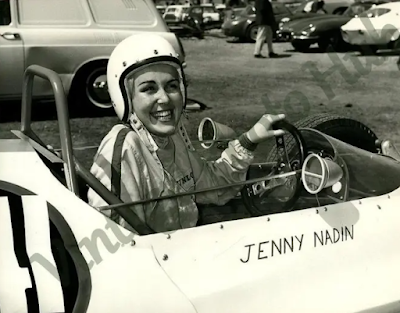
Jenny Birrell (Nadin)


Jennifer Birrell raced sports and saloon cars in the 1960s and 1970s, competing in the fore-runner of the BTCC and the Sebring 12 Hours.

As Jenny Nadin, she started motorsport through rally navigation, chiefly for Pat Moss. She sat beside Pat for a season with Ford, driving a Cortina GT, in 1963. Their best results together were a seventh place in the RAC Rally and sixth in the Acropolis. She and Pat had met in showjumping competitions, both of them having an equestrian background.

Not long after, she took the wheel in rallies herself, encouraged by Pat’s husband, Erik Carlsson. She started out with a Mini in the British championship, then branched out. Her international outings included a run in the RAC Rally in 1966, driving a Hillman Imp, and a trip to the 1967 Monte in a Ford. 

Rallying brought her into contact with racer, journalist and event organiser Nick Brittan, who became her manager. In 1967, he persuaded her to enter the British Formula Vee championship, which was making its UK debut that year. She surprised everyone by putting her car on pole and then winning at Silverstone. Nick Brittan had overtaken her on the line and led for most of the race, but a late spin put her ahead. 

There were accusations at the time that the Volkswagen team had orchestrated Jenny’s win for publicity. Formula Vee had launched a week after Formula Ford and a first win for a woman was a valuable talking point. Some claimed that Nick had planned to pull over and let Jenny through. Others claimed that both of the official Volkswagen cars had illegally-tuned engines. No wrong-doing was discovered and the win stood.

Still, she was second in the 1967 Formula Vee Championship in her first season of racing, weathering a crash at Silverstone and scoring more podium finishes. She continued to race in the series in 1968, but she did not do as well and had two rather serious crashes, at Mallory and Thruxton.

By 1970, she had married Scottish driver Graham Birrell and was racing a Ford Escort as Jenny Birrell. She won at least one race at a club meeting at Croft and made her British Saloon Car Championship (the precursor to the BTCC) debut. Her first race was in the wet at Silverstone in 1971 and she finished tenth, despite a puncture at the start.

Later, she drove in America for the first time. She was part of the all-female Ring Free Oil Team for the 1971 Sebring 12 Hours, with Rosemary Smith and Janet Guthrie, driving a Chevron B16. Jenny practiced in the car but did not actually race. Rosemary and Janet did not finish. 

For 1973, she was competing in the Castrol Production Saloon championship, driving a Simca Rallye. It was in this car that she made her next BSCC appearance in 1974, finishing eighth at Mallory. Later in the season, she did several more races in a Chrysler Avenger, earning a ninth place at Ingliston.


In 1975, she joined another all-female team and finished the Spa 24 Hours in a Triumph Dolomite, with Christine Beckers and Marianne Hoepfner. They were 24th, eighth in class. The car was sponsored by “Butch Tailor”, a Belgian menswear fashion brand. Back in the UK, she was team-mate to Bernard Unett for the BSCC, driving an Avenger. The pair often battled for class honours. Jenny’s best overall finish was fifth, at Oulton Park. The Halesfield Motors team also ran Jenny in that year’s Avon Tour of Britain, with another Avenger.

Rallies then became the focus of her career. She had been competing in British and Irish events on and off alongside her circuit-based activities, but she rallied more intensively later.

She was still entered British rallies between 1973 and 1974, using a Simca. In 1977, she was sponsored by Century Oils and drove a Triumph TR7 in the British championship. Her best finish was a 28th place in the Burmah Rally.

After a lengthy break from the stages, she reappeared for the 1983 Ulster Rally in a Talbot Sunbeam, co-driven by Gabriel Konig. She was 47th. Another Talbot, a Samba, was her preferred car for a season in Ireland in 1984, taking in events in both Eire and Northern Ireland, as well as the Manx Rally. Later, she switched to a Peugeot 205 and scored her best result of the season, a thirteenth place in the Killarney Rally of the Lakes.

The 205 took her through another season in the UK in 1985, and also her first trip to Turkey. She was third in the Rothmans Bravo Rally. This in turn led to a part-season in the 1986 Turkish championship, which yielded a fifth place in that year’s Bravo event.

For the next two seasons, she took part in the Maestro Challenge in the UK, driving an MG Maestro. After that, her career begins to wind down; she drove a 205 on the 1990 Ardennes Rally and then had a final run in the Manx Rally in 1992, driving a Lancia Delta Integrale.

The later part of her competition career coincided with a successful period in motorsport administration, working for the British Touring Car Championship and the National Formula Ford series, among others.


(Image from racingteamvee.com)