Showing posts with label 1940s. Show all posts

Monday, 25 May 2026

Anna van Vredenburch Limburg-Stirum


Anna on the 1950 Monte

Anna von Vredenburch Limburg-Stirum was a Dutch rally driver who competed under her birth name, and as the Countess Limburg-Stirum. She won the Coupe des Dames in the 1949 Monte Carlo Rally and entered the classic alpine event six times.

Born in 1914, she first competed in rallying before and after the Second World War, starting when she was in her twenties. Her first attempt at the Monte Carlo Rally seems to have been in 1937, co-driving a Ford as Miss van Vredenburgh. The Countess Limburg-Stirum was recorded as her navigator and was probably a relative of her future husband. They were fourth in the Coupe des Dames rankings. Two years later, in the last pre-war Monte, she and the Ford were 25th overall, tied with Mrs AC Lace. In between, still in a Ford, Anna had come 85th in the 1938 Monte.

Anna married Frans Willem Van Limburg Stirum in 1946. He also competed in the Monte at least twice, driving Ford cars.

On her return to rallying, she was twelfth in the 1949 Monte, and won the Coupe des Dames, still in a Ford. Her navigator was Miss Van Vredenburch, who may have been her younger sister, Elisabeth. Their start point was Monte Carlo itself.

The Ford was brought out again for the 1950 Monte. The Countess got to the finish in 131st place, assisted by Mrs. Stahl Wytema. In April of that year, she was part of a Dutch four-woman team in a big American-styled Ford Vedette, in the Tulip Rally. One of the other drivers was Miss Vredenburch, possibly Elisabeth, who had been part of the team the year before.

She had one more go at the Monte in 1951 with Mrs Stahl-Wytema, but their Ford didn't make it to the end.

Anna was part of two major Dutch aristocratic families. Research into her personal life is made difficult by the number of "Countess Limburg Stirums" who existed at roughly the same time. They include ladies in waiting to the Dutch queen and cookbook writers. Some of the Limburg Stirum family was related, by marriage, to Audrey Hepburn, through her mother.

She died in 1999.

(Image copyright Alamy)

Wednesday, 11 October 2023

Dorothy Patten


 Dorothy Patten was a British driver who mainly competed in rallies, but also raced before and after the war. 

Her origins are rather obscure and “Dorothy” was not her real given name. It is likely that she was originally named Alice Minnie Patten and had come from a working-class background. Both of her parents died before she was ten and she and one of her sisters were sent to St Mark’s Home for Girls, a domestic science school where Minnie trained as a maid. 


A 1939 summons for speeding close to Brooklands in the name of Dorothy Minnie Patten, in her car, seems to prove her identity. 


Alice Minnie Patten was born in 1906 in Flintshire. As a teenager, she worked as a housemaid in a surgeon’s house, but at some point in the 1920s or early 1930s, she seems to have come into some money and moved to the south of England.


She got her start in motorsport very early, in 1933. Her first car seems to have been an Alvis, which she drove in that year’s Alpine Rally, finishing fourteenth in class and 53rd overall. She tried again on the 1934 Alpine but does not seem to have finished. 


Starting from John O’Groats, she tackled her first Monte Carlo Rally in 1935, still with the Alvis. She was 79th overall.


Another of her early cars was a British Salmson, which was the first she used for circuit racing. She was second in the Unlimited Standard Sports Car class for women in the 1936 Brighton Speed Trials in it, narrowly beaten by Kay Petre in a Frazer Nash. The following year, she raced it at the Crystal Palace circuit, finishing third in an Unlimited Sports Car handicap at the United Hospitals and University Motor Club meeting.


She drove the Salmson in the 1936 RAC Rally and the 1937 Monte Carlo Rally. The same, or a similar, car, also finished the 1938 Monte. This car belonged to Rainer Dorndorf. It took her to a 43rd place in the 1937 Monte, from 81 finishers. Some results lists have Dorothy entered as a co-driver to Rainer Dorndorf in a Salmson in the 1938 Monte and crashing out, but this sounds unlikely given her own entry.


She was named as a car entrant for R.E. Dorndorf's special-bodied Darl’mat Peugeot in the 1939 Sydenham Plate. This was a car that Dorothy didn’t race much herself at the time, although she used it in rallies. Her first major result in it was probably an eleventh place in the 1939 Paris-St. Raphael Rally. She was fourth in Class B, for drivers with no previous podium finishes.


Later, she married Rainer Dorndorf, a German based in Ireland, and began styling herself “Baroness von Dorndorf”, although her husband does not appear to have held such a title. As a British national married to a German, she was briefly interned during the war, although she was soon cleared of being any risk and released. By 1942, the pair had divorced and Dorothy was apparently engaged to Captain Anthony Ryan. They never actually married. It was claimed in the Tatler that Rainer Dorndorf had died in a hunting accident in 1938, but this was untrue. In 1947, she did remarry, to David Treherne. 


Unlike many of her contemporaries, Dorothy was able to resume her career after the war. She entered the speed trials held at Elstree Aerodrome in April 1946, taking the Peugeot to a class win. She covered the quarter-mile course in 22.8s.

The following year, she went back to the Brighton Speed Trials, but could only manage 17th in class and sixth-fastest lady. Her only circuit race in this car seems to have been a three-lap contest at Goodwood in 1948, although her finishing position is not recorded.


She died in 1975, aged 68.


Thanks to Adam Ferrington for information.


Thursday, 3 August 2023

Claire Descollas


Claire Descollas was a French rally driver who enjoyed a long career in the 1930s and 40s. 

Born in 1905 as Claire Mancis, she began competing very young, and was driving an Amilcar in French hillclimbs from at least 1923, when she was seventeen. She normally raced in the Marseilles area where her family lived and her father worked in the motor trade. Earlier, he had been an agent for Le Gui and Zebre cars in modern Vietnam, where Claire was probably born.

Claire continued to race after her marriage to Gaston Descollas, the brother of a childhood friend. Her car at the time was an Amilcar, described as white with a 5hp engine. her first major result as Madame Descollas was a sixth place in the 1932 Paris-St.Raphael Rally. Claire was second in her class and the first Amilcar finisher. That year, she ran in her first major open rally, the first running of the Rallye des Alpes Francaises. She did not finish and also did not finish in 1934, when Gaston Descollas won.

With Gaston, she won several class awards and rallies, often in a distinctive and quite famous Bugatti Type 57 Atalante with aerodynamic bodywork. She entered the 1935 Paris-St. Raphael in this car, but retired with mechanical problems. In 1936, she used it again for the Alpes Francaises event, and in 1937, for another Paris-St. Raphael, but she could not get it to the finish. As a consolation, she did win the Mont Ventoux hillclimb section in the Alpine rally and was third in her class.

The Amilcar was still very much in evidence. She won her class in the 1936 Chamonix Rally and was ninth overall in the Rallye de Lyon.

In the later part of her career, particularly after World War II, she favoured Lancia cars. She won her class award and finished without penalties in the 1939 Rally des Alpes Francaises, driving an Aprilia. She was 17th in the same event in 1947. One of her best Paris-St.Raphael showings was in this car in 1938; she was third and won the 1500cc class.

She does not appear to have driven in any more rallies after 1947, although she co-drove for Gaston in an Aprilia in 1948. The couple divorced in 1953.

As well as rallying, Claire was part of the Yacco speed trial team in 1937, although she withdrew after the first runs. Her team-mates for the Montlhery record attempt were Helle Nice, Simone des Forest and Odette Siko. Claire may have clashed with Helle Nice. Despite her departure, the Matford car itself was named Claire, possibly after her.

Claire died in 1985, aged 80.


For more information, see this Zebre site.

Image from Wikimedia Commons

Monday, 24 October 2022

Marie-Jeanne Marinovitch


Madame Marinovitch with Louise Lamberjack in 1935

Marie-Jeanne Marinovitch, always credited as “Madame Marinovitch” and sometimes named as Jane, was a Serbian-French rally driver living in France who was active in the 1930s and 1940s. 

She was part of a prominent Serbian family living in France, probably by marriage, which included a World War I flying ace, Pierre Marinovitch, and a prime minister of Serbia.

One of the earliest mentions of her as a driver comes from June 1927, when Le Journal covered the first Journee Feminine de l’Automobile. She drove a 7hp Fiat and came fifth in a heat for the major race, then fourth in a repechage. This did not qualify her for the final and the paper described this as a shame.

Many of the women who raced in the Journee went on to compete in the all-female Paris-St. Raphaël Rally. Her first entry was in 1931 and she drove a 13hp Voisin. This was the car she used for four editions of the rally between then and 1934, scoring a best finish of third in 1933. A further outing in 1935, driving a Ford, gave her a 27th place.

In  June 1931, she took part in the Aero Club’s Rallye-Parachutes, driving the Voisin. This event involved following other competitors in aircraft and retrieving as many parachutes dropped by them as possible. In the write-up for this event, she was described as an experienced rally driver, and named as the “baronne Marinovitch”.

The Monte Carlo Rally was one of her favourite events and she entered on four occasions, beginning as a navigator to Marcelle Leblanc in 1934. They were 42nd overall in a Peugeot 301.

She won the Monte Carlo Coupe des Dames in a Ford in 1935 and a Matford in 1936, with Louise Lamberjack and Hellé-Nice as her navigators. The Matford entry with Hellé-Nice also gained them a “Challenge Officiel de la Couture” award for style. The car was an Alsace V8 model which had previously been raced by Ford France head Maurice Dollfus. Their starting point was Tallinn. Her 1935 Coupe began with a Palermo start.

A third Monte as a driver occurred in 1938. She shared the Matford with Odette Siko and finished 32nd, fifth in the ladies’ standings.

After 1934, Fords and Ford-powered cars were her usual choice for rallies. Occasionally, she drove other cars, such as the Mercedes she used for the 1935 Grand Circuit de Vosges (resulting in a non-finish) or the Delahaye she shared with Odette Siko for that year’s Liege-Rome-Liege Rally.

Another rally she returned to over and over again was the Criterium Paris-Nice, which she entered four times between 1932 and 1936. Her best result was a 16th place in 1933, driving the Voisin. 

She was one of the drivers who contested the 1939 ladies’ championship which was held in France, using Renault Juvaquatres. She crashed out of the second race at Comminges on the sixth lap, rolling her car and breaking her collarbone, but was fourth in the first.

The Second World War broke out shortly afterwards so there was plenty of time for her to recover. Her final event seems to have been the Rallye International Feminin de Paris, a continuation of the Paris-St. Raphaël. She drove a Citroen.


(Image copyright L’Eclaireur du dimanche illustre)

Tuesday, 23 August 2022

Louise Smith


Louise after a crash at Occoneechee in 1949

Louise Smith was a successful NASCAR driver from its earliest days, who has become part of the legend of the series. 

Born in Greenville, South Carolina, 1916, she made her NASCAR debut at Daytona in 1949, although had driven in some local, informal races before that.

Her driving style was aggressive and she often crashed, endearing her to spectators. Her nickname was “The Good Ol’ Gal” and she became the subject of NASCAR legends; it has proved impossible to work out which stories about her are true. For example, she is supposed to have come third in her first race, but failed to stop at the chequered flag, because the team owner had told her only to stop in the event of a red flag. She may also have destroyed her husband’s car in a beach race during her first competition. Neither of these was the 1949 Daytona event, although some reports say that she did flip her car during that race, only to be helped by spectators and carry on. Some sources suggest that this happened in 1946.

Other rumours abounded about her background, with some claiming that she was a moonshine runner who could drive faster than all of the local police.

A newspaper report from May 1950 claims that she “became a driver only last winter”. Searches of newspaper archives bring up nothing from before 1949, so this could be the truth. Other reports suggest that she started racing a little earlier, perhaps in 1948. 

Evidence comes from before Daytona in 1949, she was recorded as entering a ladies-only race at Greenville Speedway with her “student” Barbara Peigler in two cars. Barbara had apparently been taught to drive by Louise and was having her first race. This does suggest that Louise had been driving for longer than a couple of months.

 She won 38 races during her seven-year career, taking in most of the NASCAR categories, including Grand Nationals (now the Sprint Cup). Most of her wins (28 of them) came in the Modified class. She did eleven Grand National races between 1949 and 1952, with a best finish of 16th at Langhorne in 1949. Langhorne was later described as her favourite track. This was one of three races she entered that year, normally competing against either Sara Christian or Ethel Flock Mobley as well as the male drivers of the time. Both of these women were also present at Greenville when Louise and Barbara raced there, along with Sara Christian’s sister, Mildred Williams. NASCAR’s founder, Bill France, was keen for the three women to race as it was good publicity for his fledgling series.

She never ran even close to a full Grand National season, with 1950 being her biggest campaign. She entered six rounds, qualifying for all except Darlington and finishing two. Both of these were 19th places, at Dayton and Hillsboro. Her second Daytona start ended in a first-lap crash. 

After not racing in 1951, she did three races in 1952, but did not finish any of them, two due to mechanical problems and one due to her falling ill early in the race itself at Morristown.

Among the other drivers she raced were Buckshot Morris, Lee Petty, Curtis Turner and Bob and Fonty Flock, Ethel Flock Mobley’s brothers.

As well as mixed events, she often raced against other women. In 1954, she travelled to Knoxville, Tennessee and took on local drivers Mildred Beets and Joyce Gunter, among others. At the time, she was described as “the 1953 Southeastern States women’s stock car champion.” She travelled widely during her career, racing in the northern and eastern states.

This part of her racing life is not particularly well-documented, as her novelty value had worn off somewhat by now and Bill France was no longer promoting her.

Her career ended very suddenly in 1956. She had just finished a race at Bronx, New York and was on her way to Daytona when her husband decided to “rededicate himself to the Lord” with the help of a local preacher. After speaking to her husband and the preacher, Louise decided to follow suit and pulled out of the Daytona event.

After a long period away from motorsport completely, she returned as a car owner in 1971, continuing for some years. She also oversaw the beauty contest attached to the Southern 500 race. The drivers who used her car included Ronnie Thomas in 1978, the year he won Rookie of the Year. While she was racing, she often ran a car for another driver at the same time.


She died of cancer in 2006, aged 89.

Tuesday, 8 June 2021

Lady Mary Grosvenor


Lady Mary Grosvenor was a British driver in the mid-20th century who could have been the first woman to race in Formula One.

Blessed with a huge family fortune as the youngest daughter of the Duke of Westminster, she was able to afford a series of increasingly powerful cars. Her father was, at the time, one of the richest men in the world.

She most often competed in hillclimbs and sprints, but did both circuit racing and rallying before and after World War II. 

It was in rallies that she first came to prominence. She entered the 1936 RAC Rally in a Riley, starting from Buxton. She is recorded as having finished 156th in the 1938 event. She also rallied in Scotland early in her career.

She first appears on the circuit racing entry lists in 1937, as a member of the Lancs & Cheshire Car Club’s relay team for a race at Donington. Her team-mates were AC Molyneux (Lea Francis) and Hugh Cocker, who drove a Riley like Mary. They were fourth.

Her second major race was a Short Handicap at Crystal Palace in 1939, and she was second, in a Riley Sprite. This was the first of her racing cars; she favoured the Sprite in the early part of her career and owned several. 

The same year, and in the same car, she was second in a two-lap Scratch Race at Donington, held by the Cambridge University Auto Club. She also entered a three-lap relay with Midge Wilby (Atalanta) and a T Winstanley in a Bentley, finishing second. 

After the war, she raced a Riley and an Allard, which she used for hillclimbs and sprints, sometimes driving both cars in a single meeting. 

She was third in a sportscar race at Gransden Lodge in 1946, in the Riley, and continued to compete strongly in hillclimbs until 1949, using a 1929 Bugatti T37A and an Alta as well as the Allard. The Bugatti was a particularly strong car for her and she set a ladies’ record at Prescott in 1947 that stood for more than 30 years.

The Alta, once it had been fitted with a 1500cc engine, would have been eligible for Formula One, but despite having the means, Lady Mary declined to pursue this. She preferred to use the car in speed events. Throughout her motorsport career, Lady Mary was always very independent, choosing her own path. She does not appear to have competed outside the UK, although she travelled extensively in Europe and Africa, and was never part of any of the women-only rallies that took place on the continent.

She had bought her first Alta, a 69IS in 1939 but never got the chance to race it and sold it after the war. Later, she ran a different Alta in both 1500cc and 2000cc guises. As a 1500cc Grand Prix car, it took her to sixth place in class in a hillclimb at Prescott in 1949. That summer, she used the Alta at another Prescott climb, at Shelsley Walsh and the Chester Motor Club’s sprint, where she was second in class.

Later, she raced a Frazer Nash Le Mans Replica at Silverstone and Goodwood, finishing third in a handicap at Goodwood in 1951. 

She retired from motorsport in 1953, after the death of her father, the Duke of Westminster, and devoted her time to running the family estates. Only once did she come out of retirement, in 1955, when she entered a Bentley Drivers’ Club event at Oulton Park driving a Triumph TR2.

The Westminster title could only pass to a male heir, so neither Mary nor her sister Ursula could inherit. It passed to Mary’s second cousin William. Mary herself never married, although she was suggested as a potential bride for The Prince of Wales, later briefly Edward VIII, as a young woman.

She died in 2000, aged 89.

(Image copyright Tips Editorial)

Friday, 20 July 2018

Lia Comirato Dumas


Lia Comirato Dumas was the undisputed queen of the Mille Miglia, having entered the Italian classic eight times between 1936 and 1949.

Her best finish was second in 1948, driving a Fiat with her husband, Alberto. It was one of her last attempts at the race. They were also fourth in that year's Coppa d'Oro delle Dolomiti, in a Stanguellini.

The Comirato-Dumas’ first car was a Fiat Balilla 508C with berlinetta bodywork, built in 1935. It was a fairly modest car with a one-litre side-valve engine and 34 bhp. In their first Mille Miglia, they were fourteenth overall and second in the 1100cc class, behind the similar Fiat of Milton Biagini and Arcangelo Periccioli. The car was likely tuned and prepared by Fioravante Zanussi.


It was probably Alberto’s second Mille Miglia in the car, but Lia’s first time.

The same car and driver combination tackled the 1937 Miglia, but they did not finish for reasons unrecorded.

Lia’s next car was a modified Fiat 1100, called the “Fiat Comirato 1100”. This car was not successful in the Miglia either; it failed to finish in 1938 and 1940. Heavily customised with a narrower profile and less bodywork than a standard 1100; it was the subject of complaints by rival drivers who tried to claim it was illegal.

After the war, Alberto was the first to resume his motorsport career. He raced a Fiat 1100 in 1946, but Lia did not take the wheel herself. She returned in 1948 for another Mille Miglia, finishing eighth in another Comirato-built Fiat referred to as the “Fiat-Comirato Speciale.”

This new special was Lia’s car the 1949 Miglia, which she did not finish. The car was entered for the 1950 event, but did not make it to the start.

Her last Mille Miglia was the 1952 edition. She and Alberto drove a Siata Daina Gran Sport, another Fiat derivative. They were 66th and fifth in the 1500cc class.

Lia sometimes participated in other races in Italy, still driving with her husband. Between 1948 and 1950, the couple entered three editions of the Coppa d’Oro delle Dolomiti. The first two times, they drove the Stanguellini, in which they recorded a fourth place in 1948. In 1950, their car was another “Comirato Speciale”, based on an OSCA this time. It was entered by the OSCA team and they were seventh overall.

Earlier, in 1938, she may have driven with Alberto in the Targa Abruzzi, in a Fiat 1100.

The only time that Lia competed outside Italy was in the Litoranea Libica, a 1000km road race held in the Italian territory of Libya. She and Alberto were 16th in the first running of this event in 1937, driving a Fiat 500. The race was run a second time in 1939 and the couple entered again in a Fiat, but their finishing position is not known.

Much about Lia’s life and career is not known. Even her dates of birth and death are obscure. Alberto, although a more prolific racer, is scarcely better documented. He is known to have come from Treviso so it is likely that Lia was also from there, although “Dumas” as a name suggests French ancestry.

It is possible that Lia entered some of the women-only rallies and hillclimbs that seem to proliferate in Italy at the end of her career, but entry lists are hard to come by. She did not compete outside of Italian territory, so it is unlikely that she took part in the Paris-St. Raphaël Rally.

(Portrait from http://www.automotivemasterpieces.com,  car image copyright Peter Kappeler)  

Friday, 27 October 2017

Eleanor Allard


Eleanor Allard competed in trials, sprints and hillclimbs from the 1930s onwards, with some success, but she is best known for rallying during the early 1950s.


Married to Sydney Allard, she had access to works Allard cars. The couple met through Eleanor’s brother, Alan May, who was a fellow car owner and racing colleague. They were all members of Berkhamstead Motor Club.


Before the war, she was mainly active in trials. She and Sydney sometimes drove together. In 1936, they had a lucky escape on the Colley Experts’ Trial; their Allard-built CLK5 overturned and trapped them underneath.


It was not until the late 1940s that she began to compete seriously. Starting in 1947, she made a name for herself in sprints and hillclimbs. Her first major result was a second place in the ladies’ class for unlimited sportscars in the 1947 Brighton Speed Trials, in an Allard. She came second to Betty Haig. The following year, she was ninth in the class for standard sportscars over 2000cc.


In 1949, she won the ladies’ award in the Blandford hillclimb, in a 3622cc Allard. The same year, she entered the RAC British hillclimb championship and was third in class at Prescott, behind Sydney, who won. The couple competed against each other again at Craignantlet, with Eleanor in a J2. Her third Brighton Speed Trial resulted in an overall ladies’ class win, seven seconds faster than Mrs Treen in her Riley.


She improved even more in the 1950 Speed Trials, finishing seventh overall. Her car was a Cadillac-engined Allard. Once more, she was just behind Betty Haig.


Her first big rally was Monte Carlo, in 1950, which she did not finish after starting at Glasgow. She was driving a 4400cc Allard P1, and had her sister, Edna Wood, as navigator.


In 1951, she drove in the Paris-St. Raphaël Rally, and was one of the fastest on the hillclimb and sprint stages. Unfortunately, she managed to get lost in the Alps after winning the Lausanne hillclimb. She had telephoned her husband to say that she had had to retire her Allard P1 owing to engine trouble, and that she was on her way to Geneva to find a suitable garage. Only a short time later, she turned up in St. Raphaël. By the time the story of her disappearance had hit the British papers, she had reappeared again, with Edna in tow.


In 1952, she drove an Allard P1 on the Monte, the year Sydney won, although her own efforts were seriously affected by an off-road excursion. She and her navigator knew that Sydney was due to pass them on the road, and hoped that he would stop to help. When he did pass, however, he did not stop. Having seen that the crew were unhurt, he passed on his way, apparently shouting “see you in Monte Carlo” out of the window.


Later, she won the Coupe des Dames in the Daily Express Rally. This event had a huge entry list of over 400 cars, but it is proving very difficult to find a complete results list.


Her navigators were always one, or both, of her sisters, Edna (Wood) and Hilda (Johnson).


She died in 2001, aged 88.


(Image from http://www.allardownersclub.org)

Tuesday, 4 April 2017

Sara Christian


Sara Christian was the first woman to race in NASCAR, in 1949, at the Charlotte Speedway. She was from the NASCAR heartland of Atlanta, Georgia.

Her first NASCAR race was actually the first official NASCAR race. The series was then known as Strictly Stock. She drove a 1947 Ford and finished fourteenth, possibly sharing in the car with Bob Flock.

Sara was married to Frank Christian, who raced himself, and was involved in NASCAR as a car owner until 1955. She got into racing in 1948, and one of her earliest races was a “powder puff derby” at the newly constructed New Atlanta Speedway. She raced against two other women: her sister Mildred Williams, and Ethel Flock Mobley, who had taken up the sport a few years before. Frank Christian was one of the founders of the track, alongside Bob Flock (Ethel’s brother) and Charlie Mobley (Ethel’s husband).

She took part in six races in 1949, with a best finish of fifth, at Heidelberg Speedway in Pittsburgh. She was also sixth at Langhorn Speedway. For this race, and the North Wilkesboro event, she used an Oldsmobile, instead of the Ford. Out of the six races, she finished five, only crashing out once, at Hillsboro. Her second-ever race, at Daytona, was noteworthy, because it was the only time in NASCAR history that three female drivers were on track at the same time. The other two were Ethel Flock Mobley, who was twelfth, and Louise Smith, who was 20th. Sara was 18th. At the end of the season, she was thirteenth overall. That season, Sara also became part of the first married couple to race against each other in a NASCAR-sanctioned event, when she and Frank took the track together.

In 1950, she competed in one more NASCAR event at Hamburg, New York, but did not improve on her best result, finishing fourteenth. This was her last track outing. After her retirement, she may have helped Frank with some of his other business concerns, which included a motel and a farm. She was the most successful of the early female NASCAR racers, but her reputation was eclipsed by the more colourful Louise Smith in later years.

She died in 1980, at the age of 62.


Friday, 3 March 2017

Women in NASCAR: the results


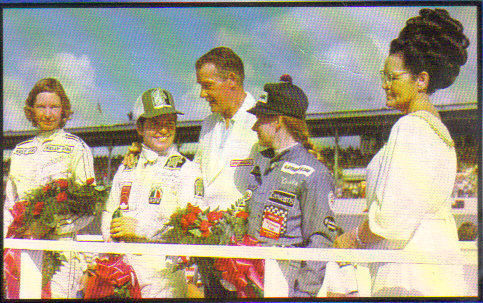
The 1977 Firecracker 400: l-r, Janet Guthrie, Lella Lombardi, Lee Petty, Christine Beckers, Louise Smith

Below is a list of all of the female drivers who have competed in NASCAR’s top-level competition of its time, currently known as the Sprint Cup. Read more about women in NASCAR here and here.

1949 (Strictly Stock, 8 races)

Sara Christian (Ford/Oldsmobile) - 13th (6 races)
Ethel Flock Mobley (Cadillac) - 52nd (2 races)
Louise Smith (Ford) - 63rd (3 races)

1950 (Grand National, 19 races)

Sara Christian (Ford) - 107th (1 race)
Louise Smith (Ford/Nash) - 109th (3 races)
Ann Bunselmeyer (Packard) - 126th (1 race)
Ann Chester (Plymouth) - unplaced (2 races)
Ann Slaasted (Lincoln) - unplaced (1 race)

1954 (Grand National, 37 races)

Marian “Mopsy” Pagan (Plymouth) - unplaced (1 race)

1965 (Grand National, 55 races)

Goldie Parsons (Oldsmobile) - unplaced (1 race)

1976 (Winston Cup, 30 races)

Janet Guthrie (Chevrolet) - unplaced (5 races)

1977 (Winston Cup, 30 races)

Janet Guthrie (Chevrolet) - 23rd (19 races)
Lella Lombardi (Chevrolet) - unplaced (1 race)
Christine Beckers (Ford) - unplaced (1 race)

1978 (Winston Cup, 30 races)

Janet Guthrie (Chevrolet/Buick) - 41st (7 races)

1980 (Winston Cup, 31 races)

Janet Guthrie (Chevrolet/Ford) - 69th (2 races)

1982 (Winston Cup, 30 races)

Robin McCall (Buick) - 74th (2 races)

1987 (Winston Cup, 29 races)

Patty Moise (Chevrolet) - 96th (1 race)

1988 (Winston Cup, 29 races)

Patty Moise (Buick) - 59th (2 races)

1989 (Winston Cup, 29 races)

Patty Moise (Buick) - 69th (2 races)

2001 (Winston Cup, 36 races)

Shawna Robinson (Ford) - 66th (1 race)

2002 (Winston Cup, 36 races)

Shawna Robinson (Dodge) - 52nd (7 races)

2012 (Sprint Cup, 36 races)

Danica Patrick (Chevrolet) - unplaced (10 races)

2013 (Sprint Cup, 36 races)

Danica Patrick (Chevrolet) - 27th (36 races)

2014 (Sprint Cup, 36 races)

Danica Patrick (Chevrolet) - 28th (36 races)

2015 (Sprint Cup, 36 races)

Danica Patrick (Chevrolet) - 24th (36 races)

2016 (Sprint Cup, 36 races)

Danica Patrick (Chevrolet) - 24th (36 races)

2017 (Monster Energy Cup, 35 races)

Danica Patrick (Ford) - 28th (35 races)

2018

Danica Patrick (Ford) - 1 race

(Image source unknown)