Showing posts with label Formula Atlantic. Show all posts

Thursday, 13 May 2021

Amanda Whitaker


Amanda Whitaker is a multiple champion in British and European club racing. She is one of the most successful women drivers in a single-seater.

She was a leading driver in the  Monoposto championship, having won the championship three times, between 1997 and 1999. She drove a 2000cc Formula Vauxhall car which she had previously used in the B class of the British championship.

Her first car was a single-seater, a 1979 Hawke Formula Ford which she raced in the Formula E class of the 1991 FF1600 championship. The car was her father’s; he raced for many years and introduced his teenage daughter to karting.

The Hawke was upgraded to a 1987 Swift which earned her three outright wins in regional series.

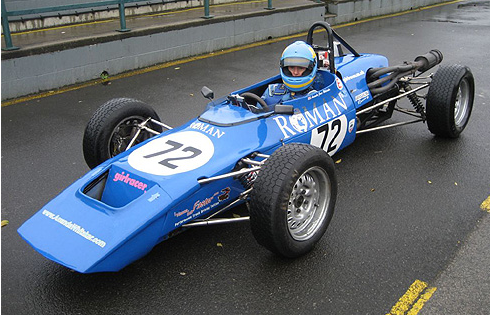
After a long break caused by a lack of sponsorship, she returned to historic competition in 2005, driving in European Historic Formula 2. She soon returned to winning ways, claiming the European Formula Atlantic title in 2006. This ran as a class within F2 and she won seven times in her Chevron B34.

In 2008, she raced Historic and Classic Formula Fords in the UK, using a 1971 Elden Mk8. She was third in the final Historic standings and won Class B four times in the Classic championship.

She combined historic and modern club Formula Ford competition in 2009 and added seven further wins to her tally. She was second in the Historic championship, driving the Elden, and was fifth in another in a 1993 Swift. This was all in spite of a frightening accident at Mallory, during a Historic race. Her view was impaired by previous crash damage and she did not see a red flag, causing her to collide with a slowing Westie Mitchell. 

At the end of the year she entered the Walter Hayes Trophy, driving a Swift.

2010 was not as successful, with only three wins, but she still managed to race three different cars effectively. One of these was a Tiga FF2000 car. 

In 2011, she took a break from motorsport to have a baby. Her daughter Scarlett and son Harrison now race karts. On her website, Amanda does not say she has retired.

(Image from femaleracingnews.com)

Thursday, 13 October 2016

Female Single-Seater Drivers Around the World: Canada


Female drivers have been a feature of the Canadian single-seater scene since the 1970s. Formula Ford has been particularly popular. Louise Roberge and Megan Gilkes now have their own posts.

Amy Castell – began racing Formula Ford 1600 in Canada in 2012, at the age of sixteen. She was the youngest driver on the grid, and she was instantly competitive, despite driving a 40-year-old Zink Z10 car. Her best finish of the season was third, at Calabogie Motorsports Park. Later that season, she had a big accident and had to take some time off, but she came back in 2013, about half-way through the season. Since then, she has raced a 1990 Reynard SF90. In 2014, she won her first race, at Honda Indy, and was third in the Toyo Tires FF1600 championship. In 2015, she competed in the B Class of the Canadian F1600 Championship Series. She managed four podium finishes – one second and three third – and was third in the championship. 

Molly Elliott – Canadian driver who raced single-seaters in her home country in 1986. She competed in both Formula Ford and Formula Vee. Formula Ford 2000 was her most successful series, and she was ninth in the Canadian championship. Molly’s later activities are not well-documented, but she was still racing in Formula Ford in Canada in 1991. She was 20th in the championship, with a best finish of eighth, at Mosport. 

Caitlin Johnston – races in Formula Ford 1600 in Canada. Her first season was in 2007, after she won a senior karting championship.Her best year has probably been 2010, when she was third outright in the Formula Ford Ontario Championship, with two runner-up spots at Mosport as her best finishes. That year, she also competed in three rounds of the NASCAR Canadian Tyre Series. Periodically, she has raced in the US as well as Canada, and has tried 2000cc Formula Ford as well as 1600. After a couple of quieter years, she was fourth in the 2014 F1600 championship, earning one podium position and a start from pole. She has been much less active since then. 

Patricia Smith – raced in Formula B in Canada for a part-season in 1973. Her car was a Ford-engined March. She was a rival of Linda Wilson. That year, she was 23rd in the championship. She scored at least one finish, a seventeenth place at the Sanair circuit in Quebec. Patricia was from Montreal herself, and was sponsored by PS Transport, which looks to have been a family firm.

Carol Soucy - Canadian driver from Quebec, who raced in Toyota Formula Atlantic in 1997. She was 33rd overall in the championship, having entered three races. Her best finish was thirteenth, at Trois-Rivieres. She did not finish the other two races. In 2002, she did at least a part-season in Formula Ford in Canada. Prior to her Atlantic exploits, she had also raced in Formula Ford in 1996.

Linda Wilson – Canadian driver who raced in single-seaters in the 1970s. She took part in Formula B in 1972 and 1973, driving for the Fergusson-Wilson team. Her car was a Chevron B20. She scored at least one fifteenth place at the Sanair circuit in 1973, one of six races in Formula B that she did that year. She was seventeenth in the championship.

(Image from http://www.motorsport.com/)

Tuesday, 11 October 2016

Monique Proulx


Monique with the BMW 2002

Monique Proulx was a Québécois driver who raced mostly in Canada in the 1970s.

She was born in 1947, and had a rather shaky start in life, contracting polio at the age of three, which meant that she had difficulty walking until she was a teenager. Initially, she worked as a teacher. This came to a temporary halt at the end of 1965, when she found herself with a baby son, Stéphane. As a single mother, she continued to work, but now as a model and actress. In 1971, she appeared in several Canadian TV adverts, including one for tights. She also owned a local chain of beauty salons.

She began racing in 1971, after becoming romantically involved with Jacques Fortin, who raced at club level. They shared a BMW 2002, and Monique also raced a Datsun 240Z. She started out in novice races, and often made the podium. She finished as runner-up in a Canadian Production endurance championship in the Datsun. Her start in motorsport apparently followed a court battle with the Canadian Auto Sports Club, which had vetoed her international license being awarded. Early in her career, she had a female rival, Louise Roberge. The press were keen to publicise their apparent dislike of one another.

In 1972, she bought her first single-seater, a second-hand 1600cc Formula Ford. This car was far more expensive to run than the BMW, so she continued to share her boyfriend’s car, making only a few appearances. In the BMW, she was eighth in the Sanair Trans-Am race.

Another run in the Sanair Trans-Am race in 1973, in the same car, led to a fourteenth place. She was the top Canadian finisher.

After some Formula Ford and Formula Vee races, she raised her single-seater game in 1974, and took the step up to Formula Atlantic. In her first season, she became the first woman to qualify for a race at the US Grand Prix at Watkins Glen, although it was a support race, rather than Formula One. This year, she raced Alan Karlberg’s car, with sponsorship from Kimberly-Clark.

Back in a saloon, she was the first, and still the only, woman to win a mixed race at Catamount Speedway. She was racing in Ministocks.

She competed in Formula Atlantic between 1974 and 1979, once scoring a pole position in 1976. Due to sponsorship pressures, she did not complete as full season during this time. In 1975, she was sponsored by New Freedom, a new brand of sanitary towels, which was somewhat shocking in the male-dominated world of motor racing. Driver and commentator David Hobbs is meant to have joked, “I’m only worried it will rain and the damn car will swell and not get between the guardrails!” 

Monique was quite successful in getting innovative sponsorship deals, albeit short-term ones. She was apparently the first female driver to be sponsored by a tobacco company, although the details of this are proving hard to find. This was probably due to her TV work, which included acting, stunts and being a “traffic girl” in a helicopter. In 1976, she appeared on the Canadian version of “Superstars”, but was not among the leading sportswomen.

Later, she also raced a Chevrolet Camaro. In 1979, she did at least one race in Trans-Am, at Trois-Rivières, finishing eighteenth.

Her son, Stéphane, was also a racing driver. She retired from the circuits in 1980, in order to support him in his own racing activities. He was a contemporary of Jacques Villeneuve and was tipped as one to watch. He died in 1993, from head injuries complicated by advanced HIV.

Monique died in 2012, aged 65.

(Image from http://www.catamountstadium.com/mini_stock_competitors.htm)