Showing posts with label Lotus. Show all posts

Saturday, 12 April 2025

Jenny Tudor-Owen


Jenny Tudor-Owen raced and rallied, mostly in Europe, during the 1960s. She normally drove British cars.

Her first car, lent to her in 1962 by John Coombs, was a Mini, which she crashed. Her then-boyfriend Mike Parkes built her another Mini, in which she qualified on pole for her first race at Brands Hatch, only to over-rev on the startline due to valve bounce. 

She quickly moved on to an MGB. This particular car is the one most associated with her, and she raced several different versions. The first of these was run by Barwells in 1963. 

In 1964, she was fourth in the Copenhagen Cup at the Roskildering. Her MGB was the first one to race in Denmark.

Tracking down her race results has proved difficult, but she did enter at least some of the Freddie Dixon Challenge Trophy and other club meetings organised by the BARC and BRSCC. The MGB was often up against much more powerful cars, such as Ferrari 250s and Jaguar E-Types. Among her rivals were Jackie Stewart, Bernard Unett and Alan Minshaw. Her best result in the MG, in the UK at least, was a fifth place at Oulton Park in June. Later in the year, she tried out a Lotus Elan for a couple of races, and she was third at Mallory Park in a 1600cc GT race. 

The Elan was her main focus in 1965, although it looks to have been a much shorter season for her. The biggest event on her calendar was an early-season race at Goodwood for small-engined sportscars, in which she was eleventh. She also tried out single-seaters, in the shape of a Formula Vee. 

After another spell in the MGB, which included an entry in a BWRDC ladies' race at Oulton Park in 1967, she acquired a Jaguar E-Type, which she used in 1967 and 1968, winning the 1968 BWRDC Racing championship following an outright second place at Thruxton. She had been leading the race on a wet track and recovered from a spin to hold on to the runner-up spot.

Racing a Bamford MGB at Oulton Park in October 1968, she managed to crash during practice and write off the car at Cascades. Her accident was overshadowed by James Hunt famously throwing an Alexis Formula Ford in the lake at the same meeting. That year, she also raced an E-Type for Warren Pearce's team. 

On the rallying side, she is best known for her Coupe des Dames in the 1968 London-Sydney Marathon, driving a Volvo 145. She was part of a four-woman team with Elsie Gadd, Anthea Castell and Sheila Kemp. The car belonged to Elsie Gadd, who had no rallying experience, so she hired Jenny and Sheila as her lead drivers. They were 41st overall, just in front of Jean Denton’s MGB, which had been the favourite for the Ladies’ prize. They had their share of troubles, including a fire in the car's battery in the closing stages in Australia, and large cracks in the car's bodywork, which needed to be welded, after crossing the gravel roads of Turkey and the Middle East.

After the London-Sydney, Jenny disappears from the entry lists. Her marriage ended and she seemed to retire from motorsport completely, although she occasionally popped up in the papers. One such appearance was in the Kent Evening Post in 1970, where the "really expert driver" opined that other women drivers "don't concentrate enough".

She moved to America and then South Africa, where she used her skills at the wheel as a film stunt performer. She also bred Pekinese dogs successfully.

(Image courtesy of Greening Australia)

Sunday, 21 November 2021

Marion Lowe


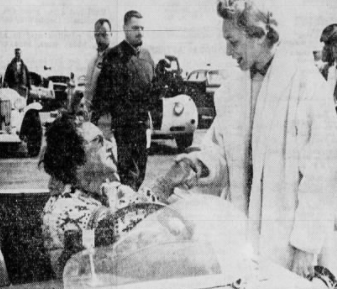
Marion Lowe raced on both the East and West coast of the USA in the 1950s. She was one of several women drivers who got their start in the ladies’ races that were common at the time, but moved into mixed competition.

Her first car was an MG TD, bought for her as a birthday present by her British husband, Jim. The couple often raced together, with Marion, who was younger than Jim, often being the faster driver. Unlike many other couples, they preferred to compete against one another, rather than share cars. They lived in California where they ran a timber firm, but their considerable wealth allowed them to travel extensively in order to compete.

She was second in her first race, a ladies’ event at Torrey Pines in California, in 1952. Josie von Neumann was the winner. Marion was one of the older novices on the scene at 44; Josie was 18 at the time.

She continued to race the MG the following year, entering her first open event, the SCCA Nationals held at March airfield in Riverside. Competing against the likes of Masten Gregory and Briggs Cunningham, she was 17th overall and third in her class. Jim had paid for significant upgrades to the MG in the off-season.

The MG was exchanged for another British car for the start of the 1954 season. Her first race win came at her first meeting of the year, driving a Frazer Nash Le Mans Replica. She beat ten other women and five male drivers competing in a different class at Bakersfield. Later in the year, she was seventh in an SCCA National race held at Seattle Seafair.

Marion and Jim owned both the Le Mans Replica and a Targa Florio Frazer Nash, taking turns to drive both. The Seafair race was her first major event in the Targa Florio and she continued to use it throughout 1955. In it, she won ladies’ races at Stockton and Santa Rosa. In mixed competition, she was eighth in a National preliminary race at Seafair and ninth in another race at the Sacramento Nationals. At the end of the year, she made her first trip to compete abroad, travelling to the Bahamas for Speed Week with the Targa Florio. She entered the Governor’s Trophy, racing against such luminaries as Phil Hill, Stirling Moss and Alfonso de Portago, and was 31st, from 42 finishers.

Lou Brero, who had raced against her at Nassau in 1955, offered her a drive in his D-Type Jaguar for the ladies’ races of the 1956 Nassau Speed Week. She was ninth in the first heat but won the second. For the open events, she drove the Targa Florio, finishing 29th in the Nassau Trophy and 31st again in the Governor’s Trophy. On the mainland, she won ladies’ races at Santa Barbara and Palm Springs, this time in the Le Mans Replica.

She did not go to Nassau in 1957, although she did debut a new car at the inaugural Hawaii Sports Car Week in April. She was fourth in a preliminary race in an Alfa Romeo Giulietta, then sixth in the corresponding main race. Her next event was the Luther Burbank Rose Festival Sports Car Road Races, held at the Cotati airfield course. She was disqualified from her heat for receiving a push start in the Alfa, but she got to start the main six-hour race alongside Al Coppel in his Renault Spyder Le Mans. They did not finish due to a broken valve.

The Alfa was her preferred car for the 1958 sportscar season and earned her podium finishes in ladies’ races at Laguna Seca and Vaca Valley. She and Jim had also bought themselves his and hers Lotus Elevens, and Marion used hers to good effect. She was fourth in an SCCA Regional race at Laguna Seca, just behind Jim in his Eleven.

The Lotus starred in Marion’s return to Nassau. She won both heats of the ladies’ race, ahead of Evelyn Mull’s Eleven. Teaming up with Denise McCluggage in the car, she was ninth in the Nassau Trophy. The team won their class, with Jim’s Lotus second and 17th overall.

Her final year in sportscar racing began with a win in a ladies’ race at Laguna Seca, followed by another at Riverside a week later. In mixed competition, she was fourth in a November race at Hourglass Field. What would be her final Nassau appearance began with a DNF in the Governor’s Trophy, having finished 17th in the preliminary race. She was second in the ladies’ event, winning one of the heats and finishing second to fellow Eleven driver Prudence Baxter in the other. Both she and Jim failed to finish the Governor’s Trophy.

She was still competing in 1960 and even moved into single-seater racing in the form of Formula Junior. Her car was a BMC Mk1, built by Joe Huffaker from British BMC A-series parts. This year’s calendar included the Stockton Road Races, in which she was sixth. 

Jim’s health began to fail in 1961 and both retired from motorsport that year. Their relationship broke down in the following years and they divorced in 1965.


(Image copyright Santa Cruz Sentinel)

Monday, 9 September 2019

Louise Roberge


Louise Roberge was a Canadian racer of the late 1960s and early 1970s, most famous for her exploits in a Formula Ford car. She was a contemporary and rival of Monique Proulx. 

According to a newspaper interview she gave in she began racing in a Mini in 1968, and was fifth in her first race. She did at least three rounds of the same championship in 1969, scoring a fourth, fifth and sixth place in the Class A series for cars up to 1300cc. All three races took place at the Mont-Tremblant circuit. In the same interview, with the Winnipeg Free Press, she claimed to have done some rallies at high school, which would have been shortly before her early marriage to Matthieu Roberge when she was 18. Unusually, Louise was a married mother of three when her career began and she always described her husband as supportive, even when she crashed the Mini in the early part of her career. 

Few other details of her early career are readily available, although she is said to have picked up her love of cars from her father. According to another 1971 interview in the Brandon Sun, the fifth place was in a racing school event and she did four further novice races in 1969, in order to upgrade her license. Among her rivals in the Mini was Louis Germain, her partner in the design firm she managed, Caractera Limited. The pair often raced together and Louis acted as her mechanic. Louise’s husband Matthieu had no involvement in motorsport at all, other than helping to bankroll her career.

Away from the circuits, Louise was also said to be a skilled driver on ice. The Ottawa Citizen in January 1969 reports that she had run as high as fourth in an Ottawa Winter Carnival Grand Prix, driving a Mini. She did not finish after the exhaust came off. A ninth place in an ice race across the Plains of Abraham is detailed in a 1970 Winnipeg Free Press article and is said to have occurred in 1969. Louise was one of the organisers of the same event in 1970. She must have done more ice races in the early part of her career, as she talks of crashing out of one of them.

In 1970, she began racing single-seaters, after taking more tuition at the Jim Russell Racing Drivers’ School. Her first single-seater car was a Lotus 61, which was replaced by a Lotus 69 later in the season. She did five rounds of the Molson Quebec championship in this car, scoring a best finish of sixteenth at Trois-Rivieres, in the 61. She had some sponsorship from a tobacco company and her car was apparently white with a rainbow stripe detail.

In 1971, driving the 69 in Quebec Formula B, she was sixth at Mont Tremblant in May. Her other known results are two non-finishes. Louis Germain was also active in the series this year, as was Gilles Villeneuve, who finished below Louise in the final standings. She was sixteenth, which suggests that she did finish some other races that year.

It was this year that another female driver, Monique Proulx, appeared on the scene. She and Louise did not race each other directly as Monique was in saloons at this point, but the press was keen to play up any rivalry between the two. In a 1972 interview with the Calgary Herald, Monique stated that Louise “did not like her” and refused to be in a photograph with her. “She’s a good driver, Louise, but she does not push. Me, I push,” she is quoted as saying.

Louise may also have owned or raced a Lotus 51, although further race results have proved very hard to track down. Any results from 1972 are proving equally difficult to find; Monique Proulx’s comments suggest that she was still racing that year.

The 69 was sold in 1973 and she seems to stop competing around that time. Earlier, in the 1971 Winnipeg Free Press interview, she said that she expected to stop racing when she was 30, although she did not elaborate on this. In the same piece, she made a cryptic comment that one of her three children was destined for motorsport fame, but declined to say which one.

In addition to racing cars, Louise was said to be an enthusiast of adventure sports in general, including canoeing, skating and sky-diving. She may also have worked as a model at some point.

She fades into obscurity after 1973.

(Image copyright Ottawa Citizen)

Friday, 17 May 2019

Sharon Scolari


Sharon Scolari is a Swiss driver who races in the Formula 3 Regional European Championship.

Most of her racing career has been in the Lotus Cup in Europe.

She began her career in Legends in Italy, in 2011. As there is no legal petrol-powered motorsport in Switzerland and Sharon is an Italian speaker, this was a logical choice. She was fifteen years old, and won the Rookie class. Legends would be her racing home for three seasons. Her best finish in the overall championship was fourth.

Between 2014 and 2017, she raced a Lotus Elise, initially in the Italian Lotus championship. She was fifth overall. After a year’s break, she stepped up to the European Cup, and was thirteenth overall, third in the Open class. Her best results were three seconds and a third, and she secured her first class win in the last round at Le Mans. This was the end product of a difficult learning year that began with a non-classified finish at Hockenheim, through a first top-ten at Paul Ricard, a penalty at Brands Hatch for an incorrect start behind a safety car and her first class victory in the last race of the season.

In 2017, she raced in the Lotus Cup again, and was ninth, second in the Open class. She came close to an Open class championship, winning nine times, but had to settle for second behind David Harvey.

She raced in the Formula Renault Northern European Cup in 2018, for a part-season, and managed a best finish of second at the Nurburgring. She was eleventh in the championship; her results were better in the second part of her season. The year was interrupted by a crash at Spa, which put her out of the second Spa race and the Hungaroring rounds. It does not seem to have deterred her in any way and she came back stronger. Her team, ScoRace, was run by her family and was described by an onlooker as “her and a mechanic”.

At the end of 2018, Sharon applied to take part in the all-female W Series and was selected for the first assessments in January 2019. She did not progress beyond the initial stages and expressed her frustration on social media, claiming that she had been one of the fastest drivers on the final “Race of Champions” test and had not gone through. She also claimed that participants were prevented from knowing or sharing the reasons for their rejection.

Not long after, she put her W Series woes behind her and signed up for the Formula Regional European Championship, which uses the same Tatuus Formula 3 car. Her ScoRace team was partnered by the Italian Viola Formula organisation.

It was a tough learning experience, but Sharon posted her first top-ten finish at Paul Ricard, the first round. Her best finish, sixth, was also achieved at Paul Ricard. A couple of races sat out due to car damage did not help, but she remained hopeful and determined. She was 18th overall.

Due to both the coronavirus crisis and funding problems, she was not able to race in 2020.

(Image copyright Sharon Scolari)

Friday, 30 November 2018

Paige Bellerby


Paige Bellerby is a racewinning rallycross driver in the UK at both junior and senior level.

She began racing in the BTRDA Junior Rallycross Championship in the winter of 2009, when she was fourteen. This was not even her first motorsport experience; she had been racing a Junior Special in autograss for two years. She learned to drive at the age of seven in a Nissan Micra.

The 2009 winter season was just practice before tackling the full championship in 2010. She scored one win at Blyton, and four second places. At the end of the season, she won the title, due to her consistent presence in finals.

In 2011, she moved up to the Swift Sport junior rallycross series, and was third overall, with a best finish of third, achieved twice at Mondello Park and Knockhill.

She moved on to senior competition in 2012, in the form of the Swift Sport Cup, which uses a similar Suzuki Swift to the junior class. Her best finish was fourth, at Pembrey, and she was eighth overall.

Her second season in the Swift series ended up being very much a part-season. She only managed to compete in the last round, at Croft, her home circuit, finishing eighth.

After sitting out much of 2014 as well, Paige returned to action at Pembrey, driving a Lotus Exige in the SuperNational class of the British championship. Her best finish in the new car was fifth, in her last race of the season.

In 2015, she raced in the British Supernational championship, in a Lotus Exige. At Croft, the final round, she became the first female driver to win an "A" Final in the class. Her final championship position was third.

The Exige became her regular car and her “A” Final win was far from being a one-off.

In 2016, she won two "A" Finals, at Croft and Mondello Park, on her way to another Supernational third.

She improved this to second in 2017, winning three rounds outright including two at her favoured circuit of Croft, at the beginning and end of the season. The Round One victory was against Ash Simpson, who has won the Supernational title twice.

Her opposition upped their game in 2018 and she did not manage a win that year, but she was still fourth in the championship with three second places, at Lydden and Croft.

In 2019, she was unable to defeat Tristan Ovendon, who won every single round, but she did manage to keep herself in second place, with two runner-up spots and one third in Supernational. Lydden was one of her happiest hunting grounds and she also ran strongly at Pembrey.

She competed in the 5 Nations British Rallycross championship in 2020. Only two rounds from six ended up being held, both at Lydden Hill. Paige was the Super National champion in her overhauled Exige, winning two of the three races.

The disrupted 2021 season featured another win for her at Lydden Hill, but she had to settle for third in the championship. She managed another win and six second places to finish second in the 2022 championship.

She did the first two rounds of the Swift class in the 2023 British championship, finishing fifth and second.

Paige is the daughter of multiple rallycross champion Dave Bellerby. Her sister Drew also races in rallycross, as does her cousin Matilda Procter. Away from motorsport, she serves in the REME in the British Army.


(Image copyright Paige Bellerby)

Saturday, 1 July 2017

Pat Coundley


Pat Coundley raced sports and touring cars in the 1960s, in the UK.

She was always quite sporty and her first love was horses, in common with several other speedqueens, such as Pat Moss and her contemporary, Jean Aley.

She started her motor racing career in 1959, in speed events, driving a Jaguar D-Type belonging to her husband, John, another racer who was a Jaguar specialist. It was he who persuaded her to enter her first event, the North Weald hillclimb, in which she won the ladies’ award. She drove another of John’s cars, a Lister-Jaguar, in 1960, winning the sportscar class in sprints at Castle Combe and Long Marsden Airfield.

After some years in club races and sprints, often using Jaguar sportscars, she made her debut in the British Saloon Car Championship in 1964, driving a Lotus Cortina run by John Coundley Racing Partnership, her husband’s team. She was not overly competitive. Her first race was the second round at Goodwood, where she was seventeenth overall. She is recorded as a finisher at Oulton Park, but her position is not forthcoming. At Aintree, she may have shared the car with John. The Coundley Cortina was 22nd. The team disappears from the BSCC grids after that.

The same year, she drove a single-seater Lotus Climax 19 in the Brighton Speed Trials.
The year before, she used a D-Type, entering the 1600cc+ sportscar class, and the Ladies’ class.

At the Antwerp Speed Trials in 1964, she drove a long-nose Jaguar D-Type, and set a European women's speed record of 161.278 mph. This made the front page of at least one British newspaper. Pat was described as a “housewife”.

The Coundley Racing Partnership Lotus Cortina made some appearances in the 1965 BSCC, but it was not driven by Pat.

At some point in the early 1960s, Pat also raced a Lotus Elite, including a Ladies’ Handicap at Brands Hatch. In Motor Sport in 1962, she likened driving the Elite to “handling a beautiful horse”.

(Image copyright Getty Images)


Friday, 30 September 2016

Gabriel Konig


Gabriel with her Modsports MG

Gabriel Konig (not Gabrielle) was a much-travelled Irish driver who competed off and on from 1962. She was most successful in MG Midgets and a Chevrolet Camaro, winning 18 races in different series, at club and National level mostly.

Living at her mother’s Beaulieu House near Drogheda, she learned to drive very young; at ten, she was able to drive a tractor. She was a regular spectator at motor races with her mother, attending events at Dundrod and Curragh. She earned her driving license at seventeen, then four years later, began racing. By this time, she was married to Mark Konig, another racing driver and car builder, and living in London. Her first racing car was a Lotus Elite. A Lotus Elan soon followed. She rarely raced in her home country, but was a regular face on the scene in England, and also in continental Europe. In 1964, she was twelfth in the Tourist Trophy at Goodwood, in the Elan. The following year, she shared the Elan with Mark for the Nürburgring 1000km, driving for the WJ Moss team. They did not finish due to gearbox problems. That year, 1965, she entered the Autosport Championship in the Elan. Later in the year, she raced a much more powerful Ferrari 250 GTO at Silverstone, but crashed out.

In 1966, she took her first race win, driving a Hillman Imp. This was a National-level race at Mallory Park. This year, she returned to smaller cars, and was rewarded with results that went with her level of experience.

After a quiet 1967, during which she may have raced an Austin-Healey Sebring Sprite, she was taken on by John Brittan’s team in 1968. The car she was given was an MG Midget, and she raced in the Modsports series. This style of competition suited her well, and she ended the year with fifteen class wins. One of her best overall results was fourth at Mallory Park, with a win in the 1150cc class. The year before, she had been a member of the Ring Free Oil “Motor Maids” team in the USA, and had travelled to America for the Daytona and Sebring sportscar races. However, she seems to have been a reserve driver, and did not get to race. Her winning year in 1968 must have gone some way to making up for that.

Her first international win came in 1969. She was first at Fassberg in Germany, driving an Austin-Healey Sprite. The Brittan MG was still competitive, and she travelled to Italy to race in the Mugello Grand Prix, with Garo Nigogosian. They were 31st, fifth in class, from 65 finishers. Also in Italy, Gabriel and Mark did the Targa Florio together, in the Nomad MkII. This car had been designed and built by Mark, and was powered by a BRM F1 engine. Sadly, an accident caused by a puncture put them out of the event on their third lap.

1970 was another year affected by accidents. Gabriel did not do much racing at all this year, as she suffered broken vertebrae in an accident in Brazil. She had been driving in a Formula Ford race at Sao Paulo, and crashed when the steering on her car failed. She was not permanently injured, but had to take almost a year out to recover.

Early in the following year, she returned to UK club racing as part of the “Carmen Curls”, an all-female team who raced a Royale in Formula F100. They were sponsored by Carmen hairstyling products, and Tina Lanfranchi was the team manager. Formula F100 was a poorly-supported series which folded at the end of the year and the Carmen Curls disappeared with it.

In 1972 her career went international again, with her first attempt at the Spa 24 Hours. She drove a Chevrolet Camaro with Marie-Claude Beaumont, a driver with considerable experience of both Chevrolet power and endurance racing. Sadly, they did not finish, due to a loss of oil pressure.

Despite her experience, Gabriel liked the car, and bought it to race for the 1972 season. She competed in the Irish Group 2 championship, now that motor racing had grown in her home country. At the end of 1972, she had it shipped to Guyana, where she would live and race for the next twenty years.

One of her first sporting appointments was joining the BOAC Speedbird team, which took British-based racers to the Caribbean, in partnership with the Guyana Motor Racing Club. Gordon Spice was one of her team-mates. She won at least two races in the Camaro at the South Dakota track in Guyana, and was second at Bushy Park in Barbados.

Among the cars that she raced during her Caribbean years was a Byldenstein Vauxhall Viva, built as a sister car to Gerry Marshall’s famous “Old Nail”. In this car, she won at least one race at Waller Field in Trinidad, in 1976.

During her time in Guyana, she raced again in Barbados. She was part of the group of enthusiasts initially responsible for bringing UK-based drivers to Barbados for its annual rally, something which continues to this day.

Gabriel was one of the founder members of the British Women Racing Drivers’ Club, one of the first group of drivers to be invited to join. In 1968 and 1972, she received awards from the BWRDC for being the highest-achieving female driver in the British Isles.

She also rallied in the UK more recently, doing some classic events in a Ford Escort, among other cars, including a Hillman Imp and an Austin A40. In 1997, she entered the Tour Auto in France, driving a Vauxhall GT. Latterly, she owned her own motor museum at Beaulieu, based around a collection of her own racing cars.

She died in January 2013.

(Image from http://www.backroads.ie/forums)

Thursday, 25 August 2016

Natalie Goodwin


Natalie in the Lotus 7/20

Natalie Goodwin is most famous for racing in Formula 3 in the 1960s. The British Women Racing Drivers’ Club’s annual racing trophy is named after her.

Natalie was from a background that was both privileged and sporty. Her mother, Marjorie, was a member of the Cussons family, and the Marketing Director of the Cussons toiletry firm in the 1970s. She played hockey for England. Natalie’s cousin, Nick Cussons, started racing GT cars in 1959. However, her initial first love was music; she played piano to concert standard, and performed in a jazz band with her brother. After losing a fingertip in an accident involving a door, she had to stop playing professionally and seek other things to do.

She bought her first racing car in 1961, when she was twenty-one years old. It was a boyfriend, rather than any of her relatives, that stirred her interest in motorsport. Her racing career started very badly, reversing into a pit wall at Silverstone, but she carried on and finished the race, not even in last place. Among her first cars were a Mini Cooper, Mini Marcos and an Austin-Healey 3000. Soon, she was winning club races.

For the first few years of her racing career, she often drove Lotus cars. The 7, initially painted black, carried her through her many of her early days in British club racing. Between 1962 and 1964, she raced the car both as a self-entry, and as part of the Ashley Smithy Garage team, which necessitated a change of paintwork to a McLaren-esque orange. The three drivers used custom number plates for racing, reading “NAT1” (Natalie), NIT1 and NUT1. As well as racing for Ashley Smithy, she worked for them, handling paperwork.

In 1964, she bought a Lotus 7/20, one of only two built, although at least four replicas were produced. It was a Lotus 7 with independent rear suspension and the brakes from a Lotus 20 Formula Junior.  Hers had previously been owned and raced by Colin Chapman, David Porter and Wendy Hamblin. She sold her original 7 to the team, and kept the 7/20 for three seasons, before selling it to an American collector.

1965 was the year that she switched her attention to single-seater racing, acquiring the first of her Brabham Formula 3 cars. Not stopping there, she purchased two more, and set up her own three-driver team to take on the European Formula 3 circuit, along with her brother. John Cardwell and Dave Rees were her other drivers. Managing the paperwork at Ashley Smithy had proved to be useful training.

Her first outing on the European stage appears to have been the Pau Grand Prix, which she entered in a Brabham BT15, but did not qualify for. Her first Formula 3 finish was at Magny-Cours, where she was twelfth. The best of the Goodwin Racing Brabhams was driven by John Cardwell, who was third. Goodwin Racing then took three cars to Zolder, and Dave Rees was third, in a BT9. Natalie had planned to race, but did not. The team had its best race of the year at Chimay, the Grand Prix des Frontières: John Cardwell won, Natalie was seventh and Dave Rees, ninth. At Caserta, John Cardwell was second. Natalie did not finish, despite coming third in her heat. It was a similar story at Monza, although Natalie did not qualify this time. None of the Goodwin cars finished at Rouen, and the team then pulled out of the Ville Nevers Grand Prix, at Magny Cours. A few more entries for John Cardwell followed, but Natalie did not race herself.

As well as its European forays, the team competed on and off in F3 in Britain. Natalie’s best finishes were a pair of second places, at Oulton Park and Aintree, which she earned in 750MC and BARC races. She was also seventh in a BARC event at Aintree.

Goodwin Racing went even more international in 1966, starting the year with a race in Buenos Aires for John Cardwell. He contested the Argentine F3 series in a BT15, with some top-five finishes. After this, he parted ways with Natalie and her team.

At Pau, a Brabham BT18, driven by Charles Crichton-Stuart, was added to the team. He had moved over from Stirling Moss’s SMART team. Natalie, driving a similar car, made her first appearance at the Barcelona GP, but did not finish. Monza in May was a similar scenario. Natalie’s first finish of the year was at Chimay again, where she was thirteenth. She did not qualify at La Châtre, after not finishing her heat, and lost out at Vallelunga, too. At Caserta, Charles Crichton-Stuart broke into the top ten, but Natalie struggled again. Neither BT18 qualified at Monza in June. Driving solo, Natalie entered the 1900 F3 championship in France, and finished fifteenth at Rouen. After another couple of DNQs, she was tenth at Hockenheim, in the Touring Car Grand Prix support race. After another couple of disappointments, Natalie earned another finish at Zolder, a fifteenth place. This was during a spell of competition in Belgium with Charles Crichton-Stuart, and it was her last finish of the year.

As well as the European calendar, Goodwin Racing was a semi-regular presence in British Formula 3, with either Natalie or Charles Crichton-Stuart as driver. Natalie’s British season did not really get going until late on, and she managed a best result of fifth, in the Louth Trophy at Cadwell Park. She was also eighth at Silverstone and Mallory Park.

The following year, she proved she could cut it as a driver as well as a team owner, and apparently won her first major F3 race. Unfortunately, the details of where this win happened are proving hard to find.

In the UK, Goodwin Racing was mostly represented by Natalie, as a single-car entry. She was particularly effective at the more northerly circuits, such as Oulton Park and Rufforth, close to her Cheshire home, and particularly after she swapped the BT18 for a newer BT21. Her best result was third, at Oulton Park.

In Europe, she dismissed the BT18 and made her debut in May, at her favoured circuit of Chimay, in her new car. She was fourteenth overall. At the Prix de Paris at Montlhéry, she was third in the “B” race, which left her classified 21st in the main standings. A fifth followed at La Châtre, at the beginning of June. A run in the Coupe de Paris gave her an eleventh place in September.

After running a car in the Argentine championship the previous year, Natalie got to drive there herself in 1967. Her best result was seventh, at Mar del Plata.

The same year, she tried her hand at endurance racing, and entered the Spa 24 Hours. She drove a Goodwin Racing Ford Lotus Cortina with Cyril Williams. They finished, but were unclassified. A second Goodwin Racing Lotus Cortina did not get to the end.

In 1968, she had another go at endurance racing, sharing Jean Denton’s MGB at the Nürburgring 1000km. They did not finish. Jean and Natalie had previously raced against each other in Formula 3, in 1965.

For much of the year, she was still campaigning the BT21 for Goodwin Racing. In the UK, they entered the MCD Lombank Championship, with principal driver, Cyd Williams. Williams served the team well, winning some races, but Natalie was no slouch behind the wheel either, earning herself a second and third at Oulton Park, her favourite British circuit, and a fourth at Rufforth.

During the early part of the season, she raced in Spain, but struggled to qualify or finish her races there. In April, accepting a drive from the Paul Watson Racing Organisation, she was fourth in the Sprite Cup, at Jyllandsring. She was also eleventh at Roskilde, driving a BT21 for Tony Birchenough’s team. As a Goodwin Racing entry, she was eighth and seventh in the Prix de Paris races at Montlhéry. A couple of weeks later, she was fourth again at Jyllandsring. At the start of June, she was sixth at Chimay, another circuit at which she usually ran well. During the year, she also raced in Portugal and Finland, although she did not do as well there.

Natalie and Cyd Williams continued as a two-car Goodwin team for the 1969 season. Driving the BT21, Natalie was ninth at Barcelona in May. Later in the month, Chimay gave her a seventh place, and she was ninth at Reims in June. She did enter more races, in France and Sweden, but either did not finish, or did not qualify. That year, she competed at Monaco, and was almost prevented from starting by police, who refused to believe she was a genuine driver. Graham Hill ended up vouching for her.

British F3 was not her major priority in 1969, although her team remained a regular presence. A Chevron had been added to the Goodwin stable, which was driven by Alan Rollinson, among others. Natalie declined to race herself for most of the season, although she put in an appearance at the Oulton Park BARC race, and was sixth overall.

1969 was her last season of active competition. During her time in F3, she had raced against the likes of Piers Courage, François Cevert, Patrick Depailler and Jean-Pierre Jaussaud, sometimes getting the better of them.

Between 1964 and 1967, she was Britain’s highest-performing female driver, and won many awards from the British Women Racing Drivers’ Club, of which she was a founder member, alongside Mary Wheeler. In recognition of her success, the BWRDC awarded their original racing trophy to her in perpetuity. Natalie responded by donating three silver trophies to the club, which are still named the Goodwin Trophies, and are awarded to this day. She was also a Vice-Chairman of the club for many years.

Natalie died suddenly in August 2019.

(Image copyright Ferret Fotografics)

Thursday, 21 July 2016

Anett György


Anett in 2016

Anett György is a Hungarian driver who races a Lotus Elise in the Hankook Racer Cup in Hungary.

She began her racing career in 2013, in the Lotus Ladies’ Cup, which was based in Eastern Europe. She was seventeen years old, and the youngest driver on the grid. It took her a few races to get into her stride, but she was soon fairly competitive, and averaging fourth or fifth place. Her first podium was at the Hungaroring, behind Adrienn Bende and Liesette Braams. She was fifth in the championship.

Anett returned to the Ladies’ Cup in 2014, and was soon one of the front-runners. By the time the series was cancelled in August, due to a dispute with the Hungarian motorsport authorities, she had scored three third places from six races, and had started from pole at the first round at Oschersleben. Unfortunately, she did not finish that race. She was fourth overall.

Later in the season, she joined the RCM Swift Cup for the last three races, at the Hungaroring. It proved a tough initiation, and her best results were two fourteenth places.

In 2015, she did the full series, and was a much improved driver. In her first race at the Hungaroring, she broke into the top ten, finishing ninth. During the season, she averaged tenth place, with a pair of sixths, at the Slovakiaring and the Hungaroring, as her best results. She was tenth in the championship.

In 2016, she went back to racing a Lotus Elise, but now in mixed competition. She entered the Hankook Racer Cup, and started the season in the best way possible, with a maiden win. This was followed by a second and third win at the same meeting. The wins kept on coming, and she was never lower than fifth in the final classification. She won the championship.

Her championship win allowed her to progress up the European ladder and pick up a drive in the European Touring Car Cup. She drove a SEAT Leon for Zengo Motorsport for most of the season, in the ETCC1 class. It was a challenging season, but she was 14th overall, and a consistent top-ten finisher when she was able to get to the end of races. She also did a couple of guest races in the TCR International Series at the Hungaroring, but was not among the frontrunners. 

During her first Lotus season, Anett became one of a tiny handful of father/daughter racing pairs to compete in FIA-sanctioned series at the same meeting. Her father, Gábor, also competes in the RCM Cup, and they raced against one another in 2015. The same year, Anett navigated for her father on the Szilveszter Rally, in a Suzuki Swift.

(Image copyright Anett György)

Monday, 23 November 2015

"Valli" (Valerie Stack)


Valli's helmet, and portraits of her

“Valli” was the nom de course of Valerie Stack, a 1970s saloon racer, and Biba model, who managed to claim some good race finishes and a string of lap records too. She raced between 1975 and 1977, driving an MG Midget, Lotus Europa and Triumph TR7 with Biba sponsorship.

Her name first became known in motorsport circles in 1975, for reasons not related to her on-track performance. She was photographed sunbathing topless at Mallory Park, and the pictures were published in the British motoring press. Valli was already working as a model, and at that time, was in a relationship with racer and track owner, Chris Meek.  He encouraged her to drive one of his racing cars, and her first track appearance was more of a modelling assignment than a race, just doing some demonstration laps in an MG Midget. Meek saw that she took to the car quite well, and offered her some actual racing, in the Midget. Despite having few ambitions in that direction, she decided to give it a go, and entered the BRSCC Production Sports Car Championship. Her early races were hard work, and some ended in spins, but she was soon picking up class awards, including two at Croft. Biba, the fashion label for which she had modelled, was the main sponsor of her MG Midget, which carried a striking black and gold livery.

Away from motorsport, Valli’s professional life took a different direction in 1976. She moved away from modelling and into music production, working alongside her future husband, Emile Ford, and producing one of his albums. Her relationship with Chris Meek must have been over by then, but he continued to support her in her racing activities. She was active in Production Sports Cars again in 1976, and was one of the leading drivers in her class. She set lap records for production sports cars worth £2000 and under at Brands Hatch, Aintree, Castle Combe, Rufforth and Ingliston.

The BWRDC gave her their award for the most successful woman driver in 1976, as well as its Best Newcomer title.

In 1977, she raced a Triumph TR7 in Production Sports, also owned by Meek and sponsored by Biba. She came second in at least one race, at her favoured circuit of Croft. At some point, she raced a Lotus Europa, again owned by Meek, part of a two-car team with him, but no results are forthcoming.

That year, her name was linked to a Land Speed Record project, Blue Star, led by Dave Gossling. Valli was said to be considering an attempt on Lee Breedlove’s women’s record, by no less than Motor Sport magazine. Drag racer Tony Densham and Formula One driver, David Purley, were linked to the project too, but it never came to fruition, as Dave Gossling was killed in an accident before the car was even built.

Valli retired from motorsport after 1977, following her marriage to Emile Ford and subsequent pregnancy. She is rather an obscure figure now, although she is remembered fondly by some motor racing fans who saw her in action.

She died in 2018, aged 65.

(Image copyright “Sherbet Hamilton”)

Wednesday, 16 January 2013

The Lotus Ladies' Cup


In the 2010s, Lotus has been promoting itself through one-make racing series across the world. In eastern Europe, one of these series is the Lotus Ladies’ Cup.
The Cup had its first season in 2011, and was based in Hungary. The cars were 1600cc Elises. The drivers were recruited through media advertising and training sessions held at the Hungaroring. The majority of the drivers were complete novices, and several of them were known media figures, including TV presenters and beauty queens. Fourteen drivers in all took part: twelve for the whole championship, and two for guest appearances only. They were organised into teams, who ran the cars. The championship consisted of thirteen races across six rounds, in Hungary, with one race in Slovakia.

The first winner was Edina Bús, one of the only 2011 entrants with previous motorsport experience. She won ten of the races.

2011 Final Results
1. Edina Bús
2. Adrienn Walterne Dancso
3. Nora Budaházi
4. Adrienn Bende
5. Ramóna Kiss
6. Szilvia Szas
7. Anett Benik-Garami
8. Ágnes Bánki
9. Anett Köváry
10. Nóra Nánási-Ördög
11. Brigitta Nagy
12. Agnes Molnar
13. Kata Répa
14. Fanni Szentgyorgyi


In 2012, the championship returned. Eleven drivers took part this year, in six teams. Again, it was based in Hungary, with outings in Slovakia, Austria and the UK, in support of other Lotus championships. The title went down to the last round, with Edina Bús up against Adrienn Bende, a former model who was acting as the championship co-ordinator. Adrienn won the race and the title, despite a protest from Edina that the finish procedure not been followed correctly.

2012 Final Results
1. Adrienn Bende
2. Edina Bús
3. Nora Budaházi
4. Ágnes Bánki
5. Szilvia Szas
6. Anett Köváry
7. Anita Tóth
8. Brigitta Nagy
10. Zsóka Kapócs
11. Alexandra Kocsis

The Ladies’ Cup ran again in 2013. This time, it was an FIA-sanctioned championship, and attracted drivers from all over Europe, and one Puerto Rican driver. It was completely dominated by Sheila Verschuur, of the Netherlands, who won nine of the twelve races. Adrienn Bende won the other three.

The "Lotus Ladies" also travelled to India during the European off-season, to compete in the Ultima Queens Cup, a women's race, at Buddh. Sheila Verschuur was the winner.


2013 Final Results

1. Sheila Verschuur
2. Adrienn Bende
3. Szilvia Szas
4. Liesette Braams
5. Anett György
6. Veronika Vanyova
7. Dorottya Kapitány
8. Szilvia Bujdosó
9. Glory Fernandez
10. Fruzsina Marenec
11. Renate Wilschut-Sanders
12. Andrina Gugger
13. Kim Guven van den Berg

A fourth Ladies' Cup was held in 2014. There was a decent-sized grid, with some interesting guest drivers, including former pro, Catharina Felser, and ski champion, Cornelia Hütter. However, the championship was shortened to six races, due to a dispute between the organisers, and the Hungarian motorsport authorities. Adrienn Bende and Adrienn Vogel were the leading drivers, and the only ones to record wins.

2014 Final Results
1. Adrienn Bende
2. Adrienn Vogel
3. Renate Wilschut-Sanders
4. Anett György
5. Szilvia Bujdosó
6. Andrina Gugger
7. Fruzsina Marenec
8. Veronika Vanyova
9. Glory Fernandez
10. Beáta Patkó
11. Catharina Felser
12. Cornelia Hütter

(Picture from http://www.facebook.com/LotusLadiesCup/photos_stream)