Showing posts with label BTCC. Show all posts

Wednesday, 7 September 2022

Jenny Dell


Jenny Dell raced sportscars and saloons in the 1960s and ‘70s. She drove in the fore-runner to the British Touring Car Championship in 1972.

Her first car was an Elva Courier which she first raced in 1967, when she was 22. 


She was most associated with the Nathan GT, which she used between 1969 and 1970. This was a Hillman Imp-engined special built by Frank Costin and Roger Nathan. Her car was formerly used by the factory Nathan team and had a BMW engine. She won at least one race outright in it, a GT event at Brands Hatch in April 1970.


The Nathan replaced a similar GT car, a 1100cc Diva. This was not the most reliable of cars, although she did manage a sixth place in it in the Brands Hatch STP round in 1969. She later sold it to Wendy Hamblin, another British driver.


Her car for the British Saloon championship was a Ford Escort, which she also tried to qualify for the 1971 Spa 24 Hours. She also drove a Mini Clubman in Special Saloons.


She did at least some rounds of the 1972 BSCC in a Vauxhall Firenza, as a team-mate to Gerry Marshall and Denis Thorne. Her best result seems to have been a class win in the final round at Oulton.


A fellow saloon car racer, Wendy Markey, had Jenny as her co-driver in the 1973 Avon Tour of Britain. Their car was a BMW 2002 and they won the ladies’ award, finishing 19th overall.


She carried on racing until at least 1975, when she is recorded as entering one of the BWRDC’s Shellsport Ladies’ Escort races. She had won a round of the first Shellsport Escort championship in 1974. Jenny was an enthusiastic member of the BWRDC from early on, winning the club’s Goodwin Trophy in 1969 as its highest-performing member. In 1972, she entered the one-make “Fast Girls” Ford Consul Challenge, mostly contested by club members, and finished eleventh.


Jenny’s sister was dating motorcycle racer Bill Ivy when he died in 1969. Jenny herself died young of cancer at some time in the 1980s, having been ill for some time.


(Image copyright Phillip Jackson/Shutterstock)


Tuesday, 12 April 2022

Susan Tucker-Peake


Susan and Maralyn Tucker-Peake with one of their trophies

Susan Tucker-Peake raced between 1966 and 1989, starting in club saloon races in the UK and progressing as far as the European Touring Car Championship. 

She won two rallycross races in 1972, in a Ford Anglia, and was the winner of the 1975 Ladies’ Shellsport Escort Championship. 

Although she raced a wide variety of cars throughout her sporting career, she was probably most associated with saloon cars, spending some time racing in the no-limits Special Saloon championship in the ‘70s. In 1973, she raced a Ford Escort with Graham Goode, against the likes of Gerry Marshall. She continued to race in this series until at least 1975, driving an Escort.

Trying yet another discipline, she partnered Maggie Anderson in the 1975 Avon Tour of Britain. Their car was a Renault 11TS entered by Renault Elf Racing, who were running Maggie in their one-make Renault 5 series.

This was combined with regular appearances in the Ladies’ Shellsport Escort Championship. Despite not winning a race, she won the first championship in 1975, ahead of Divina Galica. Divina was the 1976 winner, with Susan in second. She was fourth in 1977.

In 1977, she drove a Renault 5 herself in most of the British Touring Car championship, which led to a works drive with Skoda in the 1978 ETCC. She and Petr Samohyl contested four rounds together in a 130 RS, with a best finish of 21st at Brno. The car was not reliable and this was their only finish. 

After her ETCC adventure, Susan bought a Brabham BT21 F3 single-seater and rebuilt it with her husband. 

During the 1980s, she raced in Formula 4, and in a number of relay races for the BWRDC.

Her earliest motorsport experiences were in trials, competing with her sister Maralyn in their father’s self-built Tucker Nipper car.

After retiring from active competition she served as the President of the British Women Racing Drivers’ Club. In 2003, as Susan TP-Jamieson she wrote Women in Motorsport from 1945 with Peter Tutthill, a book chronicling female drivers since the war.

(Image copyright classictrials.co.uk)


Tuesday, 4 January 2022

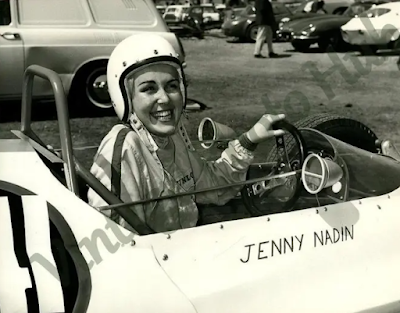
Jenny Birrell (Nadin)


Jennifer Birrell raced sports and saloon cars in the 1960s and 1970s, competing in the fore-runner of the BTCC and the Sebring 12 Hours.

As Jenny Nadin, she started motorsport through rally navigation, chiefly for Pat Moss. She sat beside Pat for a season with Ford, driving a Cortina GT, in 1963. Their best results together were a seventh place in the RAC Rally and sixth in the Acropolis. She and Pat had met in showjumping competitions, both of them having an equestrian background.

Not long after, she took the wheel in rallies herself, encouraged by Pat’s husband, Erik Carlsson. She started out with a Mini in the British championship, then branched out. Her international outings included a run in the RAC Rally in 1966, driving a Hillman Imp, and a trip to the 1967 Monte in a Ford. 

Rallying brought her into contact with racer, journalist and event organiser Nick Brittan, who became her manager. In 1967, he persuaded her to enter the British Formula Vee championship, which was making its UK debut that year. She surprised everyone by putting her car on pole and then winning at Silverstone. Nick Brittan had overtaken her on the line and led for most of the race, but a late spin put her ahead. 

There were accusations at the time that the Volkswagen team had orchestrated Jenny’s win for publicity. Formula Vee had launched a week after Formula Ford and a first win for a woman was a valuable talking point. Some claimed that Nick had planned to pull over and let Jenny through. Others claimed that both of the official Volkswagen cars had illegally-tuned engines. No wrong-doing was discovered and the win stood.

Still, she was second in the 1967 Formula Vee Championship in her first season of racing, weathering a crash at Silverstone and scoring more podium finishes. She continued to race in the series in 1968, but she did not do as well and had two rather serious crashes, at Mallory and Thruxton.

By 1970, she had married Scottish driver Graham Birrell and was racing a Ford Escort as Jenny Birrell. She won at least one race at a club meeting at Croft and made her British Saloon Car Championship (the precursor to the BTCC) debut. Her first race was in the wet at Silverstone in 1971 and she finished tenth, despite a puncture at the start.

Later, she drove in America for the first time. She was part of the all-female Ring Free Oil Team for the 1971 Sebring 12 Hours, with Rosemary Smith and Janet Guthrie, driving a Chevron B16. Jenny practiced in the car but did not actually race. Rosemary and Janet did not finish. 

For 1973, she was competing in the Castrol Production Saloon championship, driving a Simca Rallye. It was in this car that she made her next BSCC appearance in 1974, finishing eighth at Mallory. Later in the season, she did several more races in a Chrysler Avenger, earning a ninth place at Ingliston.


In 1975, she joined another all-female team and finished the Spa 24 Hours in a Triumph Dolomite, with Christine Beckers and Marianne Hoepfner. They were 24th, eighth in class. The car was sponsored by “Butch Tailor”, a Belgian menswear fashion brand. Back in the UK, she was team-mate to Bernard Unett for the BSCC, driving an Avenger. The pair often battled for class honours. Jenny’s best overall finish was fifth, at Oulton Park. The Halesfield Motors team also ran Jenny in that year’s Avon Tour of Britain, with another Avenger.

Rallies then became the focus of her career. She had been competing in British and Irish events on and off alongside her circuit-based activities, but she rallied more intensively later.

She was still entered British rallies between 1973 and 1974, using a Simca. In 1977, she was sponsored by Century Oils and drove a Triumph TR7 in the British championship. Her best finish was a 28th place in the Burmah Rally.

After a lengthy break from the stages, she reappeared for the 1983 Ulster Rally in a Talbot Sunbeam, co-driven by Gabriel Konig. She was 47th. Another Talbot, a Samba, was her preferred car for a season in Ireland in 1984, taking in events in both Eire and Northern Ireland, as well as the Manx Rally. Later, she switched to a Peugeot 205 and scored her best result of the season, a thirteenth place in the Killarney Rally of the Lakes.

The 205 took her through another season in the UK in 1985, and also her first trip to Turkey. She was third in the Rothmans Bravo Rally. This in turn led to a part-season in the 1986 Turkish championship, which yielded a fifth place in that year’s Bravo event.

For the next two seasons, she took part in the Maestro Challenge in the UK, driving an MG Maestro. After that, her career begins to wind down; she drove a 205 on the 1990 Ardennes Rally and then had a final run in the Manx Rally in 1992, driving a Lancia Delta Integrale.

The later part of her competition career coincided with a successful period in motorsport administration, working for the British Touring Car Championship and the National Formula Ford series, among others.


(Image from racingteamvee.com)

Saturday, 6 February 2021

Geunda Eadie


Geunda Eadie raced in the BTCC in 1980 and was the winner of the Fabergé Ladies' Fiesta Challenge in 1979.

The Fabergé Challenge was a female-only talent search sponsored by Faberge’s Kiku cosmetics brand and the Radio Times. It featured both racing and rallying and was open to complete novices and experienced drivers alike. Geunda fell into the latter camp.

Since 1972, English-based Scot Geunda had co-driven for Sandy Lawson, who worked in the BMC competitions department. Their first major outing together was the 1972 Scottish Rally, in a Mini. Later in the year, Sandy acquired a DAF 55 and Geunda co-drove for her in it on that year’s RAC Rally. It was the first of three RAC events they did together.

She also took part in circuit racing at club level. This included the ladies’ races organised by John Webb, under the Shellsport banner. She took part in a couple of rounds of the Shellsport Ladies’ Escort Challenge in 1975, driving a Ford Escort Mexico and achieving midfield finishes. 

Later, she entered a Shellsport women’s race at Oulton Park in 1979. The cars were racing school Talbot Sunbeam Tis and Geunda defeated future Formula hopeful Desire Wilson and six other women.

The previous year, she had entered the Fabergé Challenge and beaten almost 2000 other hopefuls in regional trials. These involved straightforward driving tasks as well as more off-the-wall challenges like driving around a quarry blindfolded. The championship itself ran through 1979. Near-standard yellow Ford Fiestas were provided by local dealerships and each driver was paired with a co-driver for the six rally rounds, either chosen herself or assigned. Geunda’s navigator was the experienced Dilys Rogers.

Geunda won through her consistency, rather than spectacular wins. She appears to have done better in the rallies than the races, although the results lists are incomplete. The rallies were BTRDA rounds, with the Challenge running as its own class. Reactions to the women were mixed, although they became known as the “Yellow Perils” due to their yellow cars and Penelope Pitstop’s “Perils of” cartoon.

She won the first rally, the Dukeries Rally in March and was second in the Lakeland Stages a fortnight later. Her second event win was in Wales in the summer, when she topped the Fiesta standings in the Rali Bro Myrddin. She was second or third in each of the other three rallies.

The first part of her prize drive was a run in the RAC Rally in a works-supported Fiesta. She was co-driven by fellow “Yellow Peril” Flip Kerr, as Dilys Rogers was competing alongside Judy Simpson. Geunda sadly did not finish as she went over the time limit.  

Her season in the BTCC was something of a trial. Although she fared well in her class at times, the car was unreliable. She endured several DNFs and withdrew from some of the rounds. Her best class finish was third, which she earned at the Brands Hatch Grand Prix support race. Her best overall finish was ninth at the start of the reason, at Mallory Park.

At the end of the year, she retired from motorsport to start a family. Although her competition career was over, she stayed involved professionally, working for the Jim Russel Racing School at Snetterton. She was the chief instructor on its skid pan from at least 1978, when she put Daily Mirror journalist Paul Hughes through his paces for an article. Among her other students is said to have been a young Ayrton Senna, to whom she taught skid control.

As Geunda Palmer, she appears to have been involved in some way in the 1985 Esso Ladies’ Formula Ford race held at Snetterton, run by the Jim Russell school.

Geunda came out of retirement in 2010 to co-drive for Conor Kelly on the TNR Tour of the Sperrins. The car was a Ford Escort and she helped Conor to 81st place.

(Image copyright projectbobcat.com)

Friday, 23 October 2020

Esmee Hawkey


Esmée Hawkey is a versatile British driver who has had her best results in the Porsche Carrera Cup.


Her motorsport career started early. After several seasons of karting she raced in Ginetta Juniors in 2014, after becoming a finalist in the Ginetta Junior Scholarship at the end of 2013. This led to a development deal with AmDTuning. As well as karting, she raced in the last three Ginetta Junior rounds of 2014, at Rockingham, Silverstone and Brands Hatch. Her best results were two 15th places, at Rockingham and Brands Hatch. She was 22nd overall. 


She also tested an AmDTuning BTCC car, driving the team’s Honda Civic during a tyre test at Snetterton.


In 2015, she drove for JHR Developments in Ginetta Juniors. Her best overall finishes were two fourteenth places, at Oulton Park, but she did well among the Rookie drivers. She was 25th in the championship. 


2016 was the year she graduated to senior competition in the form of the GT Cup, racing a Porsche Cayman for the GT Marques team.  She was runner-up in the GTA class and had a best overall finish of eighth at Donington. 


In 2017, she was nominated for the Carrera Cup GB Junior Scholarship and continued to race in the GT Cup.


She did her first full season of the Carrera Cup in 2018, still  with GT Marques, earning two podium finishes in the Pro-Am class at Monza and Brands Hatch. 


In 2019, the Carrera Cup was combined with a season in the all-female W Series, where she was fifteenth in the championship. She did better in the Carrera Cup, with three wins in the Pro-Am class at Thruxton and Oulton Park and a third on the class leaderboard. 


Her final position in the W Series standings was fifteenth and she was let go by the championship, which was cancelled in 2020 anyway. This proved to be a very minor setback in her career, as she signed with Team Parker Racing for the Carrera Cup and was instantly the Pro-Am class driver to beat. She won the class in her first four races and picked up a further five class victories later in the season. The only time she was off the Pro-Am podium was when she did not finish at Oulton. Her best overall finishes were two third places, at Donington and Brands Hatch. These were her first series podiums.


At the end of the 2019 season she was named as a test driver for the MB Motorsport BTCC team. She had her first test in the Honda Civic at Snetterton in July 2020.


At the beginning of 2021, she was announced as a driver for the Iron Dames team, but she was quickly withdrawn after her manager was found to have made an incorrect declaration regarding her FIA driver categorisation. Fortunately for her, she was quickly snapped up for a DTM race seat, driving a Lamborghini Huracan for T3 Motorsport. It was a difficult learning year, but she did manage an eleventh place at Assen and the Nurburgring, getting her first points on the DTM computer. She was 20th in the championship.


A planned second season in the DTM was limited to the first four races, as the T3 team pulled out of the championship. Her best result was an 18th place at Lausitz.


In 2023, she was announced as a driver in the British GT championship, racing a Ginetta G56 for Toro Verde. She did the first four races with Joe Wheeler, finishing two of them. They were 31st and 30th at Oulton Park.


She sat out 2024 due to pregnancy.


(Image copyright Esmee Hawkey)

Saturday, 10 June 2017

Gillian Fortescue-Thomas (Goldsmith)


Gillian Fortescue-Thomas (Goldsmith) was active in sports and touring car races in the UK and Europe between 1970 and 1975, then later in historic motorsport.

She rose to prominence in 1971, when she drove in the Ford Escort Mexico series, almost winning a race from Jody Scheckter. This was her second year as a racing driver. In 1970, she had campaigned a Formula 1200 Rejo and won one race at Lydden Hill, despite losing second gear. This car proved too expensive for her to run, as did the TVR Griffith that preceded it.

Ford were using female racing drivers to promote their cars at the time. Their competitions manager, Stuart Turner, had previously capitalised on Pat Moss’s success at BMC as a marketing tool, and was now doing the same at Ford. Gillian entered a driver search for women, organised by Ford. Rallycross featured heavily. She emerged as one of the victors, and earned a drive in the Ford Escort Mexico Challenge.

Through the Mexico series, she became involved with the Shellsport team, which usually used Mexicos. This was run out of Brands Hatch by John and Angela Webb, two more proponents of the publicity value of female racers. Her first major Shellsport event was a “Fast Girls Consul Challenge” at Brands Hatch in 1972. This race supported the Formula 5000 meeting and was highly publicised. Seventeen women took part in Ford Consul GTs. Gillian, as the winner from Jenny Birrell and Micki Vandervell, received a mink coat, presented by Graham Hill.

Gillian also travelled to Spa in 1972, to drive in the 24-Hour race in an Escort. This was one of her semi-works drives that she had won in 1971. Her team-mate was Yvette Fontaine, and they had to retire after a head gasket blew. They had qualified in eleventh spot. The pair had raced against each other in the Consuls, with Yvette finishing fourth.

In 1973, Gillian continued to appear at Shellsport events, including a “Relay Triathlon” at Brands. The traditional swimming leg was replaced by a four-lap race around the track. She was not part of the winning team, although she was one of the leading drivers. At the time, she was a popular figure in British motorsport and appeared in the likes of the Daily Express, jumping over her cars on a horse. She was usually described as a “farmer’s wife”.

At Llandow, she took part in another Ladies’ race, run by the British Women Racing Drivers’ Club. It was a handicap race, and she won in her Mexico.

As a Ford driver, she started the BSCC in an Escort. The engine failed at Brands Hatch. She did most of the rest of the season, although it is unclear whether she was driving for Ford, or her own team. The car was very unreliable, although she did manage a seventh place in the Silverstone GP support race. This was definitely a works entry.

Ford also provided a Mexico for her in the Avon Tour of Britain, as part of a works team that included Roger Clark and Prince Michael of Kent. Her co-driver was Carolyn Faulder.  

Later, in 1975, Gillian drove a Triumph Dolomite in BTCC races in the UK. Her car was run by Shellsport again, and she was sixth at Brands in her first appearance. She was then ninth in the very competitive Thruxton race. Her best finish was fourth at Silverstone, just behind her Shellsport team-mate, John Hine.

1975 was her last season for quite a while. She drifted back to her early love, horses, and became a successful amateur jockey, initially in point to point racing. In 1976, she was the first female National Hunt champion jockey.

After one retirement and a marriage, she started competing again as Gillian Goldsmith in the early 1980s. One of her first cars was an HWM-Jaguar.

She returned to the circuits in 1989 in an Aston Martin DB4. Since then, she has appeared at many major historic meetings, including the Goodwood Revival and the Le Mans Classic. She normally drives an Aston Martin, most frequently the DB4.

She still works as an ARDS instructor and races occasionally, as well as supporting her daughter, Samantha, in her own equestrian and motorsport career.

She is still fondly remembered from her BSCC days, when Gerry Marshall nicknamed her “Gillian All-Askew Thomas”.

(Image copyright Ronald Speijer)

Monday, 31 October 2016

Jacquie Bond-Smith


Jacquie in the Marcos in 1967

Jacquie Bond-Smith started in club motorsport in her father's car, a “Wavendon Wombat” special, in 1960. She was then known as Jacquie Cook. The Wombat was an 1172cc clubman’s car built by her father, Arthur Cook. Results for Jacquie in this car are proving tough to track down. Both she and her sister, Joey, raced it on occasion.

Some time in the early 1960s, she married John Bond-Smith, a racer and businessman. At the same time, she seems to have made her way up through the club racing ranks, and was awarded the Chris Bristow Trophy by the BRDC in 1964, in recognition of “the most promising performance at Silverstone.” This may well have been in a Ford Cortina, or possibly a Lotus single-seater.

She definitely did race a Cortina in 1965, a Lotus model. She drove it in some rounds of the BSCC, and secured a best finish of tenth at Snetterton, followed by seventeenth place in the St Marys Trophy at Goodwood. For the next round, she drove a Ford Galaxie, at Silverstone, but did not finish. It was her only BSCC outing of the year in that car, although she did race it in the European Touring Car Championship. In August, she was thirteenth in the Snetterton 500km, winning her class.

In club races, she used a Lotus Elan. In this car, she was third in a GT race at Silverstone in October, winning her class.

In 1966, she returned to sportscar racing, campaigning a Lotus 23 in British club races. She was twelfth in one race at Silverstone, just behind sister Joey in the Wombat.

Jacquie’s big project for 1967 was the FLIRT all-girl racing team. FLIRT stood for “First Ladies International Racing Team”, and it was made up of Jacquie and Joey, plus Jacqui Smith, another young driver who had had some success in British club events in a Hillman Imp. Their car was a Mini Marcos, supplied by the Marcos factory. The team picked up quite a lot of publicity, with a Pathé film being made of the three of them testing at Castle Combe.

FLIRT made three appearances in the World Manufacturers’ Championship in Europe. Jacquie and Joey were the chosen drivers. They did not finish the Nürburgring 1000km due to engine problems, but they got to the end of the Mugello Grand Prix, in 37th place. Later in the season, Jacquie drove the Nürburgring 500km solo, and was 21st overall, fourth in class. Joey drove a sister car, but did not finish. The FLIRT team may well have done some more British races, but the results are proving elusive.

As well as her FLIRT activities, Jacquie raced in the British Sportscar Championship. She was seventeenth in the Silverstone round, in a Porsche 904, and may also have raced a Ferrari 250LM belonging to her husband.

She disappears from the entry lists at the end of 1967. Not long after, her marriage broke up. After her racing career ended, she adopted horseriding as her sport of choice.

 (Image from www.minimarcos.org.uk)

Saturday, 24 October 2015

Barbara Cowell (Babbage)


The Kimber-Smith/Cowell Corolla in 1987


Barbara raced in the British Touring Car Championship in 1988 and 1989.

The first award she won in the world of motorsport was a first place in a fancy dress car parade at Long Eaton stock car track, in 1973. Barbara dressed up as a mermaid on a car sheeted up as rocks, next to driver Tony Allen, who was Neptune.

The Long Eaton track was the scene of her first driving exploits, too, as a junior driver in Ministox. She progressed through the junior and senior ranks, and by 1978, when she was twenty, she was the British Mini-Rod champion. Three years later, in 1981, she was British, European and World Mini-Rod champion.

As she had won almost everything she could in short-oval Mini-Rods, it was a natural progression into long circuit racing in a Mini in 1982. She entered the Mini Seven championship, and was eleventh overall in her first year. This was enough to earn her the Novices award.

In 1983, she moved steadily up the Mini racing ranks, and ended the year as the Lydden Hill Mini Seven champion. In 1984, she was second in the overall championship, winning herself the BWRDC’s Embassy Trophy, and their Racing championship trophy.

For the next few seasons, Barbara raced different cars in the Uniroyal Production Saloon championship. She received support from Gerry Marshall, who prepared her Fiat Strada in 1985, and later provided her with a Vauxhall Astra GTE. She enjoyed some success in these cars, but it was in a Suzuki Swift that she really shone, winning Class D in 1987 with five victories. This gave her second overall in the championship. One of her wins was a two-driver enduro at the end of the season, at Brands Hatch, and she shared the car with Geoff Kimber-Smith. In September, the same driver pairing tackled the Tourist Trophy at Silverstone, a round of the International Touring Car Championship. They drove a Toyota Corolla, but did not finish.

Following on from her Production Saloon wins and ITC experience, it was a logical step for Barbara to test herself further in the British Touring Car Championship.

Her 1988 BTCC season started with the two-driver enduro at Donington, sharing Geoff Kimber-Smith’s Toyota Corolla again. They were fourteenth overall, and won their class. Later in the season, she used a Ford Escort RS1600i run by the North Essex Motorsport team. She was 19th in the Brands Hatch 1000km support race, second in class, but then did not make it to the finish at Snetterton or Brands. She did not qualify for the Birmingham Superprix street race, but it was cancelled anyway, but then the same happened at Donington. In the last race of the season, at Silverstone, she was 18th overall.

That year, she also found time for some Production Saloon races, in a BMW M3. Her best result seems to have been a class win at Castle Combe.

In 1989, she renewed her partnership with Kimber-Smith and the Corolla for one race, at Donington, but did not finish due to a misfire. Illness limited her activities this year, and it was her only BTCC race.

After 1989, she raced less, but she remained competitive in Production Saloons. She took a year off in 1990 to set up a performance driving school, and to marry Peter Babbage. Now competing as Barbara Babbage, she raced the Swift again in 1991, achieving some more top-ten overall finishes.

In 1993, she raced in the Willhire 24 Hours in a Honda Civic. She was part of an all-female team with Clare Redgrave and Kirsten Kolby. They were fourth. They apparently took part in two other enduros that year, with similar success, but the results are not forthcoming.

In either 1993 or 1994, she raced a Peugeot 106 in Production Saloons, scoring at least one second place at Silverstone. 1994 was her last season; it was becoming increasingly difficult for Barbara to find the sponsorship needed to compete at a level of which she was capable. She retired and started a family. In 1994, she became one of the first women to be given full membership of the British Racing Drivers’ Club.

(Image from http://www.ae86drivingclub.com.au/forums)

Thursday, 23 July 2015

Women Drivers in the BTCC


Fiona Leggate as an MG driver, in 2007

The British Touring Car Championship’s present format began in 1987, as a renamed, streamlined version of the British Saloon Racing Championship. Although the previous championship (which will be covered in a future post) had attracted many female drivers over the years, the BTCC has been male-only for several seasons. The last female driver was Fiona Leggate, in 2007.

Below are the championship results of all female drivers in the BTCC.

1988
Barbara Cowell (Ford Escort RS1600/Toyota Corolla) – 19th

1989
Louise Aitken-Walker (Vauxhall Astra GTE 16V) – 5th
Nettan Lindgren (BMW M3) – 26th
Barbara Cowell (Toyota Corolla) – unplaced

1990
Nettan Lindgren (BMW M3) – 10th

1991
Nettan Lindgren (BMW M3) – 22nd

1998
Paula Cook (Honda Accord) – unplaced

1999
Paula Cook (Honda Accord) – 19th

2001 (Production Class)
Annie Templeton (Peugeot 306 GTi) – 19th
Joanna Clarke (Honda Integra Type R) – 26th

2002 (Production Class)
Annie Templeton (Peugeot 306 GTi) – 13th

2005
Fiona Leggate (Vauxhall Astra Coupe) – 16th

2006
Fiona Leggate (Vauxhall Astra Coupe) – 21st

2007
Fiona Leggate (MG ZS) – unplaced

2020
Jade Edwards (Vauxhall Astra) - unplaced
Jess Hawkins (Vauxhall Astra) - unplaced

2021
Jade Edwards (Honda Civic Type R) - 26th
Jess Hawkins (Ford Focus ST) - 29th

2022 
Jade Edwards (Honda Civic Type R) - 27th

2023
Jade Edwards (Honda Civic Type R/Cupra Leon) - 31st


(Image copyright Simon Murphy)

Sunday, 21 June 2015

Joanna Clarke


Joanna in the Clio

Joanna Clarke is one of a select group of female racers who have competed in the modern British Touring Car Championship.

Her first senior races were in 1998, at the wheel of a Peugeot 306, in a club meet at Silverstone. This followed several years of karting, with multiple race wins, partly achieved through a school team.

Early in her career, she w as a promising single-seater driver. During her first season, she tried her hand at Formula Ford and Formula Vauxhall Junior, coming third in a Vauxhall series. She won her class in a British Formula Ford race at Donington in 1999. This, and some other strong finishes, gave her third place overall in the First Division class. At the end of the year, she was awarded the BWRDC’s Monoposto Award, for the most successful single-seater driver.

She later ran well in the 2000 Ford Fiesta Zetec championship, with a best finish of fourth. She was racing against her fellow future BTCC drivers, Gordon Shedden and Gareth Howell. As she had been awarded a Ladies’ Cup, she received a prize drive consisting of a test in a Ford Mondeo.

The Ford test did not lead to a BTCC drive, but part-way through the season, she was signed up by eccentric millionaire, John B&Q’s team. She was deputising for John B&Q (John Batchelor) himself, driving a Honda Integra Type-R in the Production class. Her first races, at Knockhill, gave her a fourteenth and sixteenth place, from the back of the grid, and one tenth place in class. She was 18th at Snetterton, but did not finish the second race, and her final meeting, Croft, was a bit of a disaster, with a blown engine on lap one of the first race, which meant she was unable to start the next second. Her team-mate, Mark Beaumont, suffered the same fate. She was 25th in the Production drivers’ championship.

In September, Joanna also drove in the Renault Clio Cup for the Mardi Gras team, as one of their usual drivers, Duncan Vercoe, was unavailable. She was 16th in one race, at Silverstone, from 23rd on the grid.

A lack of finances kept Joanna away from motorsport for quite a long time. In 2004, she did some Legends racing, but was not really competitive.

She has not been active in motorsport since then.

(Image from http://www.redshoes-racing.com/)

Saturday, 6 December 2014

Elizabeth Jones


Liz in 1964, in Minsk

Elizabeth Jones, born Rosemary Jones, in Newbridge, Wales, raced a Mini and other cars in international saloon races in the 1960s. She always raced under her own family name, and was often referred to as “Liz” in race reports.
She graduated from the Cooper Racing School in 1960, as one of its six most promising students. She was thirty years old, and was probably one of the oldest in the group. Using a car run by the School, she entered some Formula Junior races that year, and finished eighth in a race at Silverstone.
In 1961, she moved on to GT racing, in her own Austin-Healey 3000. She raced at Snetterton twice that year, and was second and fourth in class. In September, she took part in the Autosport 3 Hours, also held at Snetterton. Her finishing position has been lost, but she was racing against Porsches and Jaguar D-Types. According to Christabel Carlisle, a rival of the time, she took part in at least one Ladies’ Handicap race at Brands Hatch that year.
In 1962, she stuck with BMC-made cars, but exchanged the powerful and brutish Healey for the first of her series of Minis. She entered some rounds of the British Saloon Car Championship, starting at Silverstone. Her Mini was a Cooper model, prepared by the Downton Engineering team, an established tuning company. She was fourth in class at Silverstone, then twelfth overall at Aintree, in the British Grand Prix support race.
She was thirteenth overall, and second in class in the 1962 Brands Hatch 6 Hours in 1962, alongside Alan Mann and Tony Hegbourne in a Ford Anglia.  This was a double drive, as she also recorded a DNF in her own Mini, which she was sharing with rally driver, Pauline Mayman.
1963 started in a similar vein. She was fourth in class in her first BSCC race, also at Silverstone, also in a Mini. Her second appearance was at Crystal Palace, for the Small Car Trophy, and she was seventh overall. Unusually, four female drivers started this race, including Christabel Carlisle, whose career took her in most of the same directions as Liz. At Silverstone, for the Grand Prix support race, she joined up with Alexander Engineering, another preparation and tuning firm, driving one of their Mini Coopers. Unfortunately, the car developed mechanical trouble, and Liz had to retire. Her second outing in the Alexander Mini, at Brands Hatch, ended in a 16th place.
In the middle of the season, she took part in the Brands Hatch Six Hours, driving for Alexander Engineering, in the Mini. Her team-mate was the Finnish rally champion, Timo Mäkinen. They were 18th overall. Early on, Liz led her class, but bad weather and hard-charging other drivers dropped them to second, behind John Aley and Rauno Aaltonen.
Liz also accepted another one-off drive in the Tour de France, in a Mini, but a works BMC Mini this time. She was sharing the car with Pauline Mayman. Christabel Carlisle was slated to be part of the team, but did not compete in the event. The engine of the Mini did not last until the end.
 For 1964, her partnership with the Alexander Engineering team continued. In the BSCC, it was something of an underwhelming year, with some non-finishes. Once again, her best race was the Small Car Trophy at Crystal Palace. Liz was fifth, in a race completely dominated by Mini Coopers, like her own. Otherwise, her strongest finish was at Brands Hatch, in the Guards Trophy meeting. She was fourteenth overall. Throughout the season, a rivalry between her and Anita Taylor, who also drove a Mini, was stirred up a little by the press. It was true that Liz and Anita were sometimes competing directly for places, but other drivers, including Anita’s brother, Trevor Taylor, were often involved.
Alexander Engineering also provided a Mini for Liz for the Brands Hatch 6 Hours, which she shared with the American driver, Denise McCluggage. They retired, due to an accident. This was not a race for the Mini; several of them fell by the wayside, or underachieved, in this wet race.
In July, Liz seems to have accepted a drive with the British Vita team for the Spa 24 Hours. She shared a Mini Cooper with Harry Ratcliffe, but engine failure on lap seven put paid to any chance of success.
She was also a rally co-driver, who sat beside several different drivers in the RAC and Monte Carlo rallies. The cars were BMC models. She began in 1962, in major rallies anyway, sitting alongside Daphne Freeman in the RAC Rally. The car was a Mini. In 1964, in another Mini, she accompanied Sheleagh Aldersmith for the Monte Carlo Rally. Sheleagh, competing alongside the BMC works drivers in a private car, joined the team in starting from Minsk, in Belarus, which was then behind the Iron Curtain. They did not finish. After her circuit career ended, Liz continued in rallying, and took the wheel herself in the 1965 Monte Carlo Rally. Her co-driver in her Mini was Patricia Ozanne.
Her motorsport career seems to end here. Some time later, Liz moved to America, and became a well-known breeder of Mastiffs, under her married name of Degerdon. In 1989, she was charged with animal cruelty by the US authorities, and remains a controversial figure in the Mastiff breeding world.
She returned to the UK, where she continued to live until her death in 2010, at the age of 70.
(This post is heavily indebted to the research of Radnorian.)
(Image from http://minicoopers68.blogspot.co.uk/p/1964-rallye-monte-carlo.html)


Sunday, 6 July 2014

Anita Taylor (Matthews)


Anita Taylor was a popular British racer in the 1960s, born in Yorkshire. She was the sister of Formula One driver, Trevor Taylor, and the pair sometimes raced together. They were both very well-connected in the motorsport world, which gave Anita access to some very competitive machinery during her short career.

Although she usually drove saloon cars, it was stage rallying in which she started her career, as a teenager. Among the cars she rallied was a Standard. She began racing shortly afterwards, and used various Ford Anglias predominantly. The Anglia was the car she would be most associated with, during her time on the circuits. She made her first major appearance in 1962, driving an Anglia at the Silverstone International Trophy meeting, in the British Saloon Car race. She did not finish.

Her first major result was a win in the BMRC Trophy at Charterhall, driving a Lotus Elan previously raced by Jim Clark, her brother’s team-mate. This was the last meeting held at the Charterhall circuit before its closure. The same year, she entered the Brands Hatch 6 Hours, in a John Willment Ford Anglia. She was 21st overall, assisted by rally driver Anne Hall. In another Anglia, owned by her brother, she tackled the later rounds of the British Saloon championship, her best  finishes being tenth at Crystal Palace and fourteenth at Brands Hatch. In the mid-1960s, this series was incredibly competitive, with current and past Formula One drivers, as well as specialists, taking part. As well as the established stars, there were a few regular female competitors, including Christabel Carlisle, Elizabeth Jones and Michaelle Burns-Grieg, who all drove Minis.

Trevor and Anita founded their own team, Aurora Gears Racing, in 1964. Aurora Gears was a company owned by Trevor. They both drove Mini Coopers in the British Saloon Car Championship. Anita made her debut in the second round, at Goodwood, and was last. Her best finish was ninth, at Crystal Palace, and she also managed to beat her brother in the last round, the Oulton Park Gold Cup. Trevor had also not made much of an impact on the top-ten, and the quality of drivers in the BSCC was still very high, including Jim Clark, Jack Sears and Denny Hulme. Anita and Trevor shared one of the Aurora Gears Minis in the Brands Hatch 6 Hour race, but they did not finish due to a broken timing chain. An Aurora Gears sports prototype existed also, which Anita may have driven, but no actual race results for it are forthcoming.

Away from the family team, Anita also drove with Valerie Pirie in the Tour de France. They were representing Stirling Moss’s SMART team, in a Triumph Spitfire, but did not finish after an engine failure.

Anita continued to race a Mini in the 1965 BSCC, but normally under the banner of the Automobile Racing Drivers’ School. She was not overly competitive, and had a best finish of 19th, at Brands Hatch and Goodwood. Aurora Gears was involved that year in Formula Two, with Trevor driving.
  
In 1966, she remained the BSCC, having followed Trevor to the Broadspeed team. Her usual team-mate was John Fitzpatrick. They both drove Ford Anglias. At the Silverstone International Trophy meeting, Anita won the under-1 litre class by quite a long way, and was ninth overall, beating her team-mate. Her best outright finish was sixth, at Crystal Palace. Towards the end of the season, she had some reliability troubles with the Anglia, and during the last race of the season, at Brands Hatch, she rolled the car, embarrassingly, right in front of a TV camera. Nevertheless, she helped Broadspeed to the team title.

At the end of the 1966 season, Anita travelled to the Bahamas for Nassau Speed Week. Ostensibly, she was on her honeymoon, having married Dave Matthews. She drove a Shelby GT350 in two of the big races, the Governor’s Trophy and the Nassau Trophy, and was 24th and 15th respectively. She was supported by the Ring Free Oil team, who were putting together a ladies’ team at the time.

At the beginning of 1967, she was part of the “Ring Free Oil Motor Maids”, and raced in the Daytona 24 Hours with Smokey Drolet and Janet Guthrie. They finished 20th overall, in a Ford Mustang. A little later, Anita and Smokey Drolet were 35th in the Sebring 12 Hours. This time, they were in an Alpine Renault A110, run by Baker Racing in conjunction with Ring Free.

During this time, Anita was sponsored by the Ford motor company. She carried on as a Broadspeed driver in the BSCC, and had a best finish of seventh, at the Oulton Park Gold Cup. In the rest of the races, she seemed to place well in class, but did not trouble the main classification too much. John Fitzpatrick also had a quieter year. As well as racing, Anita had another go at rallying, in the marathon Shell 4000 Rally in Canada. She was driving an official Lotus Ford Cortina with a local navigator, Terry Gillies. Unfortunately, a navigational error got them stuck in wet ground, and they had to retire. As well as rallying, Anita participated in economy runs and driving stunts, such as speed records for towing caravans. As time went on, she became increasingly annoyed that Ford were exploiting her novelty value and considerable beauty with modelling assignments and stunts, rather than racing.

Anita retired from motorsport at the end of 1967, in order to concentrate on family life. Her marriage to Dave Matthews did not last, but she remained close to her family and her brother, Trevor, until his death in 2010. She never did return to active competition, but she and Trevor were a fixture at various race meetings over the years.

Anita is remembered by many for her striking looks, and her quirky habits, which included carrying her handbag with her in her racing car, stowed under the seat. In addition to this, she was a very competent driver with some decent results, achieved against top-class opposition. She gives her name to the saloon racing trophy presented each year by the British Women Racing Drivers’ Club.

(Image from http://www.wickersleyweb.co.uk/hist/taylor.htm)


Thursday, 20 February 2014

Female Drivers in Touring Cars: the United Kingdom


Anita Taylor in the Broadspeed Anglia

This is another post mostly made up of previous content, created in order to make the blog easier to get around. There are a couple of new names, and more will appear in future. Jem Hepworth, Elizabeth Jones, Barbara Cowell, Jacquie Bond-Smith, Gillian Fortescue-Thomas, Michaelle Burns-Greig, Geunda Eadie, Micki Vandervell, Jean Aley and Joanna Clarke now have their own posts.

Anna Barden - winner of the 2018 CTRC Classic Touring Car pre-2005 championship, driving a Renault Clio. She has been racing since 2016 and sometimes competes against her husband, Steve Barden, in the Classic Touring Car series. Further details of her career are proving hard to find as she previously competed under another name.

Joey Cook (Beale) - sister of Jacquie Bond-Smith. Like her sister, her early motorsport experiences were in her father’s “Wavendon Wombat” special, and they sometimes competed as a pairing. The sisters raced together in the FLIRT team in the 1960s, in a Mini Marcos. As a team, they entered the Nürburgring 1000km, Gran Premio del Mugello and Nürburgring 500 KM in 1967. Joey’s best result was 37th, in the Mugello race. She and Jacquie raced in separate FLIRT Marcoses for the Nürburgring 500km. She is still involved in motorsport through historic racing; she and her husband Stephen own and drive a 1962 Lotus Elite, and are members of the HSCC.

Ilsa Cox - winner of multiple British club championships in saloon car racing. She began in 1987. In 1997, she was the Castle Combe Saloon Car champion, driving a Peugeot 205 GTi. Even in her first year in that championship, 1995, she won eight times, and was narrowly beaten to the trophy. In 2008, she won Class A of the 750MC Hot Hatch Championship. More recently, she has been racing a SEAT Cupra in the Eurosaloons championship, and won a race outright at Oulton Park, in 2009. She was second in the “B” class of the series, with three wins. She has 26 career wins. She continued to race the SEAT in the CNC Heads Saloon/Sports championship in 2014. She won one race, and was second in Class D. As well as racing in the CNC Heads series in 2015, she took part in the Classic Thunder Touring Car Championship, still in the SEAT. She was fifth and seventh in these championships, respectively. She raced the SEAT again in 2016, in the CNC Heads series, but only did some of the rounds, and was 26th overall. In 2017, she did some races in the SEAT, but did not do enough of the championship to mount at serious challenge. She was back to winning ways again in 2018, picking up another Castle Combe GT crown in the Cupra and winning nine races outright. She competed in the CTCC Classic Thunder series in 2019, winning at least one race at Silverstone. As well as this, she works as a performance driving instructor, and promotes women’s track days.

Mary Grinham - races a spaceframe Maguire Mini in club events in the UK. Most recently, she has been part of the Classic Touring Car Racing Club’s Classic Thunder series. She has been racing the car since the 1980s, when she took part in Special Saloons, securing class wins. This followed ten years as a motorcycle sidecar racer, and some time spent in Minicross. She first raced a sidecar outfit in 1972.

Joanne Kraemer - began her career in 2002 in UK Clio Cup. She did not compete for a full season due to injuries sustained in a crash, but managed to return. After a break, she drove in Britcar with her father, Rick Kraemer, in 2004. Their car was a Ford Focus. They managed some top-ten finishes, including one at Brands Hatch.

Clare Newbold - raced in the mid-1960s, always in Ford cars. In 1965, she raced a Ford Anglia in the 1000cc class, in British events. These were mostly at club level, so the results have proved hard to find. In 1966, she raced a “Fraud” Cortina, a heavily-modified Ford Special Saloon belonging to her future husband, “Doc” Merfield. They competed together at least once, in a handicap race at Brands Hatch. In 1965, Clare drove this car in the Brighton Speed Trials, and seems to have won something - a video of the time describes her as the winner, but the official records do not support this. She was an early member of the BWRDC and also raced at Goodwood. After her marriage, she seems to have retired.

Nerys Pearce - raced in the 2020 Britcar Trophy for Team BRIT, driving a BMW 1-Series. She joined the team for the Silverstone races and partnered Abbie Eaton, then drove with Aaron Morgan at Snetterton. As a guest driver, she was ineligible to score points. She is paralysed from the chest down and is hoping to be part of a Le Mans team consisting only of disabled drivers. Previously, she served as an Army medic and competed in para-athletics, powerlifting and rowing, as well as open-water swimming. She has represented Wales at the Invictus and Commonwealth Games. In 2021 she raced for Team BRIT in Britcar again.

Rona Pearson (Galliford) - raced in the UK between 1962 and 1964. She began her career in club events, using a Mini. Later in he first year, she entered her first international race, the Nürburgring 500km. She and Phil Cadman did not finish after their Mini suffered a gearbox problem. The following month, Rona had more luck in the Brands Hatch 6 Hours, finishing 19th in a BMW 700 with Marie-Rose Tibesar. She later married Peter Galliford and went back to club racing in the UK, before retiring in 1964 to have children.

Jacqui Smith – member of the FLIRT (First Ladies’ International Racing Team) team in the 1960s, with sisters Jacquie Bond-Smith and Joey Cook.  They campaigned two Mini Marcoses together in the 1960s, and raced at the 1967 Nürburgring 500km. Jacqui Smith does not seem to have finished. Earlier in the season, she had been included in the official Marcos team for the Nürburgring 1000km, but did not get to drive on the day. The year before, she was second in the BWRDC’s women’s racing championship, behind Jean Denton. She spent that season racing a Hillman Imp, competing in British club events and winning a Ladies’ race at Brands Hatch. She had been racing since at least 1964.

Mary Taylor - mostly raced saloons in the mid-1960s, and is most associated with Minis. She was racing a Mini by 1963, at least. In 1964, she took part in the Britax Saloon championship, and the following year, she won one of the BWRDC’s Embassy Trophies for the highest placed member at an eligible meeting. Frustratingly, it is not clear what cars she used for the 1964 season, although the award win was for a second place in a Mini. In At some point, she raced an MGB, and is named as an entrant for a Ladies’ race at Oulton Park. She also raced a Frazer Imp and a Lotus Elite. Her career was ended by a serious accident at Silverstone in 1966, where she suffered head injuries, although she later recovered. She was married to fellow racer, Sid Taylor, and was a hairdresser by trade.

Issabelle Woolley - races a Suzuki Swift in the 750MC Swift Sport Challenge. Her first season was 2025, the inaugural one, and she was only 16. In 2026, she continued to race in the Challenge, competing against her father Jonathan. She had a dramatic crash in the first round at Donington and wrote her car off, but she and Jonathan built a whole new one in time for the Silverstone meeting. 


(Image from Autosport)