Showing posts with label Ladies Cup. Show all posts

Monday, 23 October 2017

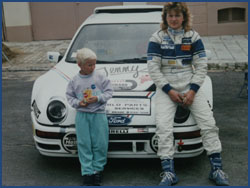
Jenny van Hilten


Jenny van Hilten is most famous for racing a Group B-spec Ford RS200 in Europe in the late 1980s. She is from Luxembourg, and did most of her racing in the Netherlands.

Jenny and her husband Bram bought the RS200 in 1987. It had been used as a pace car by the factory previously.  

One of her most memorable races was at Zandvoort in 1988, when she entered the NTK (Dutch Touring Car) round there. After making the most of her four-wheel-drive in the wet in the Group A Super Touring race, she was fourth overall. This was her only NTK race of the year.

That year, she also drove  an RS500 in the Spa 24 Hours, with Evert Bolderheij and Bernard Winderickx. They did not finish.

She did another 24-hour race in 1988, driving a Honda Civic at the Nürburgring 24h as part of a Luxembourgish team. Her co-drivers were Carlo Gillen and “Lou”.  

Jenny, driving with her husband Bram van Hilten this time, and a driver called Phillips, returned to Spa in 1989, in the Honda Civic. They were 38th overall.  

That year, she made another appearance in Dutch touring cars, driving a Ford Fiesta XR2. Bram had made some appearances in the car earlier in the season and Jenny ran in the final round at Zandvoort. She was second in class in the Group A race, behind Bram in another XR2.

In 1990, she competed in the Citroen AX GTI Cup, and managed some top-five positions. She was noted for her pace in qualifying. Mid-season, she was third in the overall standings, second in the Ladies’.

The following year, she opted for another one-make series: the Ford Fiesta Mixed Cup, which was based in Germany. She was already familiar with the XR2s used by the series. Her male team-mate was Thomas Wirtz, a German driver. The series that year was dominated by Sabine Schmitz/Thomas Marschall and Claudia Hürtgen/Michael Funke. As a pair, Jenny and Thomas were not among the front-runners, although Jenny was sixth in the women’s points table.

The van Hilten/Wirtz pairing did another Mixed Cup season in 1992. Again, Sabine Schmitz and Thomas Marschall were runaway winners, but Jenny and Thomas had a decent season, and were fifth in the team standings. Jenny was second in the ladies’ championship.

Alongside her circuit racing career, Jenny became an adept hillclimb driver. In 1988, she won her class in the Lorentzweiler climb in the RS200. She repeated this in 1989. The Lorentzweiler course is the closest thing that Jenny had to a home circuit, being situated in Luxembourg.

(Image from http://fordrs200.altervista.org/curiosi.htm)

Monday, 5 June 2017

Chantal van der Sluis


Chantal van der Sluis raced in the early and mid 1990s, in the Netherlands. She was a race-winner in one-make series and a popular figure at the time.

She was introduced to karting at the age of thirteen, by her then-boyfriend. For three years, she steadily gained experience, competing up to European level. Her first senior season was in 1991, when she entered the Citroen AX GT Cup. For her first race, she qualified in fifth place, but went off at the first corner trying to out-manoeuvre her rivals.

This would not be the last of Chantal’s offs. At Zandvoort in 1992, she managed to vault her car over the armco barrier, although she was not hurt. Despite these mishaps, she became one of the star drivers of the series in 1992, winning two races outright and finishing third in the championship. She won the Ladies’ Cup, ahead of Sandra van der Sloot. This was Sandra’s debut year, and she looked up to Chantal as her earliest female role model. The two later became friends. The Ladies’ Cup was quite hotly contested that year, with at least seven female drivers racing in the series.

That year, she tested an Alfa Romeo 155 Cup car, alongside Allard Kalff and Ton Roks. She was almost as fast as the experienced Allard Kalff. Her other activities included posing for some pictures in Dutch Playboy.

The following year, she moved to the Renault Clio Cup and was on the pace in her new car straight away. Her best finishes were two second places and she was sixth overall.

In 1994, she drove in some rounds of the European Renault Clio Cup, although she was not as successful. It was this year that she crashed very spectacularly at Zandvoort, sending her Clio over a crash barrier and through an advertising hoarding. Her season was not all about crashes, however; she did manage a third place at Spa, behind Allard Kalff and Jip Coronel.

1994 was her last season of competition. She died in 2008, aged 38, after a long struggle with cancer.

(Image from www.autosport.nl)


Monday, 14 September 2015

Jill Scott-Thomas


Jill in 1938

Jill was a British racer of the late 1920s and early 1930s. She was born Eileen May Fountain in 1902, and was the daughter of a coal mine owner. Her entry into motorsport came via her first husband, William “Bummer” Scott, who was a regular at Brooklands and lived next door.
She competed at Brooklands between 1926, when she entered her first trial, and 1939.

1928 was the year when Jill really made her mark on the motor racing scene. She became one of the first women to be awarded the Brooklands 120mph badge, to be displayed on the front of her car. This was given to her after she lapped the circuit at the requisite speed in September, driving an ex-Grand Prix Sunbeam that she and Bummer owned jointly. She was also elected to membership of the BARC, but this offer was downgraded to honorary membership; the BARC was a conservative association and had only recently allowed women drivers to enter its sanctioned meetings. Jill was the first woman suggested for membership.

At about this time, she attempted to race the ex-J.G. Parry-Thomas Leyland Eight, which she and Bummer had bought after the death of their friend and mentor. Although the car was nominally hers, and she was actually quite skilled in handling very large cars, it defeated her. Her main Brooklands experience in it was riding as a passenger with John Cobb, who raced the car on her behalf. They also owned the Thomas “Flatiron” special, which Jill is said to have driven, but no results are forthcoming.

In 1929, she entered her first big international race, driving a 4.5 litre Bentley with Bummer. It was the JCC Double Twelve race, and the Scotts were eleventh overall, from 26 finishers. Just a week later, Jill won a Brooklands ladies’ handicap, driving a Delage, after Miss Burnett was judged to have jumped the start.

The following year, she tried her hand at the Double Twelve once more, in a Riley Brooklands 9. She and her team-mate, Ernest Thomas, were sixth, a very pleasing result. Jill also had another go at one of the Brooklands ladies’ handicaps in March, and was second. Her car was a Bugatti.

After the 1930 season, Jill was absent from the track for a long time. Her marriage to Bummer Scott ended, and she started a relationship with Ernest Thomas, her erstwhile Double Twelve team-mate. The pair had met whilst flying their respective planes at the Brooklands airfield (Jill had had her pilot’s license since 1927). They married, a union that lasted until Jill’s death in 1974.

As Jill Thomas, she returned to Brooklands in 1938. She drove an Alfa Romeo in the March meeting, and in the JCC International Trophy, but did not finish either of the races. In the international Ladies’ Race at Crystal Palace, held in June, she was third, in a Delahaye, behind Mrs Lace and Kay Petre. Despite her absence, and the personal upheaval she had experienced, she was still a popular figure. Madame Yevonde produced a colourised photograph of her in her distinctive red racing attire, which is now in the National Portrait Gallery.

In 1939, she mostly drove a Frazer-Nash BMW. She was second in the First March Long Handicap at Brooklands, but was disqualified from first place in the Second March Handicap, due to a coming-together with another driver. In April, she also raced a big Alfa Romeo in the Road Championship, but did not finish. She then raced at Crystal Palace again in April. Her best finish was a third place in the Second Long Scratch Race. Her last competitive outing looks to have been the Second August Mountain Handicap at Brooklands, in which she was unplaced.

After the war, Jill did not return to motorsport. Although her marriage to Ernest was a happy one, her personal life was not straightforward, particularly in regard to her eldest daughter, Sheila, whose father was Bummer Scott. After her death, her racing trophies and Brooklands 120mph badge were found in a charity shop.

(Image copyright The National Portrait Gallery)

Tuesday, 5 August 2014

Annette Meeuvissen


Annette was a German driver who raced in the 1980s and 1990s, in Europe mainly, but also further afield, as far as Bathurst in Australia. She began her motorsport career in 1980, when she was 18, and initially competed in slaloms. In 1982, she entered her first major championship, the Ford Fiesta Ladies’ Cup. She won the first race, at Wunstorf, and went on the win the Cup, after multiple wins. Throughout the season, Delia Stegemann matched her performances, and they were declared joint winners, the prize doubled. Despite her success, Annette was sometimes the target of disparaging comments from spectators, but she did not let this deter her. Despite her rivalry with Delia Stegemann, the two teamed up for the Nürburgring 24 Hours mid-season, in the Fiesta, with Peter Marx. They did not finish.
For the 1983 and 1984 seasons, she raced in the VLN long-distance series, at the Nürburgring. Apparently, she almost won her class at the 1984 Nürburgring 24 Hours, but was prevented from doing so by a mechanical problem. The complete starting and finishing lists for these races do not seem to be available.
In 1985, she stepped up to international competition, driving a Ford Escort for the Gerstmann team, in the European Touring Car Championship. Driving with Jörg van Ommen, she entered the championship in the third round, at Donington, and was 20th overall. After missing the Anderstorp round, she reappeared at Brno, with Arno Wester as a third driver. They did not finish. The trio were then fifteenth at Zeltweg. After another break, they entered the Spa 24 Hours, but do not appear to have finished. Back as a pair, Annette and Jörg van Ommen raced at the Silverstone Tourist Trophy, but were only 26th. Their last race of the season was at Zolder, but they did not qualify.
1986 was a quieter season for Annette. She raced a Porsche in the 944 Turbo-Cup, against her former team-mate, Jörg van Ommen, and the likes of winner Joachim Winkelhock, but was not among the front-runners. Mid-season, she was linked with another Gerstmann drive in the Spa 24 Hours, but this did not happen.
1987 was certainly not quiet. Annette was paired up with former beauty queen, Mercedes Stermitz, to drive the second Schnitzer Motorsport BMW M3 in the International Touring Car Championship (ITC), competing around the world. Their first race was the second round, at Jarama, and they qualified ninth. However, an accident put them out after eleven laps. Back in action after a short break, they did not finish at the Nürburgring either, driving as a trio with Altfrid Heger. For the Spa 24 Hours, they transferred to the satellite Linder team, still driving a works BMW, with assistance from Gerrit van Kouwen. Despite only qualifying 35th, they were seventh overall. Driving for the factory team, Annette and Mercedes were then fifteenth at Brno. They missed the Silverstone round, but then flew across the world for the Pacific-region races. The prestigious Bathurst 24–hour race in Australia ended in clutch failure, and third driver, Roland Ratzenberger, did not get a look-in. The second Australian race, at Calder Park, was more productive, and the two women were seventh again. Their last race was at Wellington, New Zealand, and it resulted in another crash. Annette was unplaced in the ITC standings.
Away from the ITC, the Schnitzer M3 was entered into the Zeltweg round of the ETCC, Mercedes Stermitz’s home race. They finished seventh, again. The team’s poor finishing record this season was blamed squarely on Stermitz, whose incautious and rather crash-happy style was ridiculed in the motoring press.
In 1988, Annette became one of the first women to race in the DTM, one of several at this time. She was driving another BMW M3, for the Zakspeed team. This year, she was very much a secondary driver, and at the AVUS race, had to give up her car to Markus Oestreich. That said, she participated in almost all of the other races, and finished a large majority of them. She appears to have had some degree of mechanical sympathy, unlike her previous team-mate. Although she was a reliable finisher, her results were not spectacular this year, with a twelfth at the Nürburgring being her best. Towards the end of the season, she was getting into the top twenty regularly, in large fields of about 35 cars. She was 31st in the championship.
 In 1989, she only managed a few DTM races, in a Linder-run BMW M3. She raced at the Hockenheim Rennsport-Festival, and was twelfth, 22nd and 21st in her three races. Later, at Hochenheim again, she was twelfth in a qualification race, but did not finish the race proper, after a rare accident. The rest of the year may well have been spent in the VLN once more, although results are hard to find.
The following year, she was back in the Zakspeed M3, and did the whole DTM season, apart from the fly-away season finale at Kyalami, South Africa. Her year started badly, with a double DNF at Zolder, but it soon picked up and settled down. Her qualifying performances were improving, and she often able to hold her position, just outside the top ten. Her best performance was at AVUS, where she was seventh in the qualification race, and converted it into eleventh in the first feature race. She was also eleventh in a feature race at Hockenheim, part of the Rennsport-Festival, after finishing eleventh in the preliminary qualifying race. That year, she was linked to a drive in a Rimstock M3 in the Spa 24 Hours, but it did not happen.
1990 saw her back in the DTM, driving for the satellite Linder team again. She was entered into the main championship, but not any of the extra races, some for privateers, put on that year. Her team-mates, usually Dieter Quester and Altfrid Heger, were not really on the pace, and Annette did not fare as well as she had in previous years, with a best result of fifteenth, achieved at the Diepholz airfield track. The Mercedes and Opels were more dominant that year, and she was getting left behind somewhat. This would be her last DTM season.
The Nürburgring was a happier hunting ground for her. She was fifth in the 24 Hour race, driving another BMW. During her career, she entered this classic event four times.
In 1992, she did less racing than in previous years. Her only big event was the Spa 24 Hours, in which she drove am M3, run by Bychl Euroracing. With her team-mates, Marc Gindorf and Heiner Weis, she was 17th overall.
Towards the end of her career, Annette became rather frustrated by motorsport and its vagaries. She retired in 1992, and for some time, worked as a performance driving instructor for BMW. In the mid-1990s, she travelled to Africa, where she ended up founding an animal sanctuary in Namibia. Later, she worked as airline cabin crew, and gave birth to a son. She was in the process of setting up her own kindergarten when she became ill with cancer. Sadly, she died a year later, in 2004.
(Image from http://www.carlosghys.be/html/autographs_meeuvissen.html)