Thursday, 29 July 2010

Fiona Leggate


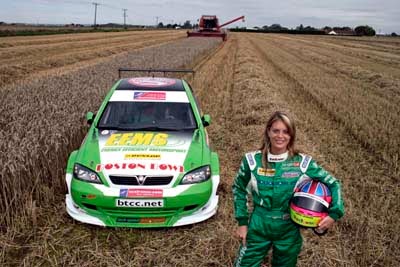
Fiona with the bio-ethanol Astra

Fiona Leggate was born into a motorsport family; her father is saloon-car racer Malcolm Leggate. However, she herself did not get started in motor racing until the relatively late age of twenty-three. Since then, she has more than made up for lost time.

After spending her teenage years in equestrian competition, Fiona won a rally driving day with former British champion Gwyndaf Evans as a competition prize in 2003. After spending the day in an MG ZR rally car with Evans, Fiona set her sights on a motorsport career of her own. She took advantage of her new-found connections with MG and entered some rounds of the MG Mayflower Trophy, an arrive-and-drive saloon series, to familiarise herself with competition driving.

After impressing many with her driving skills, Fiona found herself with a full-blown motorsport career in 2004. Assisted by MG and by sponsorship from the childrens' play centre she managed, she tackled not only another full season of the Mayflower Trophy, but the Britcar championship as well. In a 190hp MG ZR, she was sixth overall in the Mayflower Trophy, and managed to set a fastest lap at Brands Hatch. In Britcar, mainly driving a 210hp Judd-engined ZR run by the MG works team, she did even better. She was the champion of class 3 and third in the overall rankings, with an impressive run of five class wins and seven fastest laps. Her co-driver was ususally ex-BTCC driver Anthony Reid, but she was also joined by Tony Jardine and Paul O'Neill, who has been a coach and mentor to Fiona since the beginning. Remarkably, the 24-year-old Fiona achieved all this despite suffering a broken collarbone in a nasty crash at Spa-Francorchamps.

As well as her winning streak in class three, Fiona also dropped down to class four in her Mayflower car for one round, where she joined by a team of female drivers. This was only one diversion in a season full of "extra-curricular" activity; she was offered several guest drives and took the chance to try out new cars whenever it came along. She got a taste of sportscar action at Brands Hatch, guesting in two rounds of the TVR Tuscan Challenge, where she came eleventh and thirteenth. Later in the season, at Zolder, she was competing against sportscars in the 24 Hour race. She had been recruited by the Daikin team to pilot their BMW Mini, and her team-mates were Vanina Ickx, Alexandra van de Velde and Sylvie Delcour, all experienced European racers. Despite the team line-up, the car gave up on them and they didn't finish.

Back in an MG ZR, Fiona got her first taste of competitive rally action on the Lombard Revival Rally, a classic-style event based on the old Lombard and RAC Rallies. She was partnered by Tony Jardine.

Probably her most newsworthy achievement was the weekend in July where she spent a day travelling between Silverstone and Brands Hatch, competing in six separate races; a record number for one driver to take part in in a single day. She started at the Northamptonshire track with a 15th place in the MG Trophy, before jumping in a helicopter to head down to Brands, for Britcar. She was due to share her ZR with her early inspiration, Gwyndaf Evans, but he crashed the car just as she landed and she was unable to start the race. Fiona carried on and was eighth in another MG Trophy race. After a return trip to Kent, Fiona claimed her record, having raced in six events. She even scored two wins in the Abingdon Trophy and a single-driver MG Enduro, the last of the day. Her previous MG Enduro had resulted in a second, assisted by Don Kettleborough. She was also second in class in her first-ever Sprint, driving a BTCC MG ZS, and fourteenth in an MGB Trophy race, sharing Paul White's classic MGB.

2005 started in a similar vein. Fiona signed up once again for Britcar and entered an MG Trophy race at Silverstone. Using different cars, she attempted both Britcar and its sister series, Production S1. The Production car was fast enough to net her a lap record at Brands Hatch.

However, later in the year, her career received a huge injection. She joined the Leamington-based Tech-Speed Motorsport team for the BTCC. As well as a higher level of competition, she would be away from MG for the first time, driving a Vauxhall Astra Coupe. The car was converted to run on bio-ethanol, the first BTCC car to do so.

Fiona joined the championship for round 18. She made steady progress, although the car was not up to speed straight away as the team were still experimenting with the fuel mixture. By the time the Silverstone meeting came round, she was much more confident and using the tactical knowledge she had gained; she scored her best result of fifth here after capitalising on the situation wherein a pack of drivers were fighting over tenth position, hoping to win pole for the reverse grid in the next race. This was also a best-ever BTCC result for a female driver.

She did not repeat her fifth position, but kept her car on the track and consistently outpaced the Alfa Romeos on the grid. She was 16th overall and eighth in the Independents Trophy at the end of the season. Her popularity and promising results also earned her the Rookie of the Year award.

It was back to the BTCC in 2006 as Tech-Speed retained Fiona's services. The biofuel-powered car was still attracting attention, as was its driver, but the results were not forthcoming. Fiona was struggling to keep pace with the rest of the grid and often retired with technical problems. A couple of engine failures cost her whole meetings. At the beginning of September, she pulled out of the series and left the team for reasons which have never been disclosed.

In typical Fiona fashion, this was not the end of her motorsport campaign. She quickly found herself a seat in the Mini Challenge and was sixth in her first race, at Thruxton. The second race of the day resulted in a DNF, although she had started well. She stayed with the Mini and took a trip to Spa for the next meeting, coming fifth and exorcising her crash demons in the process. Despite her chequered history with the Belgian circuit, she still names it as one of her favourites. As well as the Mini Challenge, she also participated in the Dutch Supercar Challenge in the ZR. Her partner was Paul White, another old colleague. The ZR was wheeled out again for two enduro races at the Silverstone MG club meet. Driving with Mark Stacey and Rob Oldaker respectively, Fiona was fifth and seventh.

Britcar had not been forgotten either; she got back in the faithful ZR for a few rounds and lined up for her second attempt at the season-ending Silverstone 24 Hours. The team was Fiona, Rob Oldaker, Ben Jacques and Umberto Nacamuli. Despite a few problems including some crash damage, the car was running well and Fiona's stint passed uneventfully. The team were running sixth in class when an engine failure dropped them out of the race for good, at the agonisingly-late time of 22 hours.

During 2006, Fiona tested a SEAT Leon Supercopa car at Brands, with which she was very impressed, with a view to racing one in 2007. She was keen to return to the BTCC, but knew she would be racing for a different team if she comes back. In the end, it was not a SEAT but another MG that she drove in the 2007 BTCC; Kartworld Racing offered her a contract.

She raced for Kartworld at all of that year’s meetings, although car trouble meant many retirements, and stopped her from starting some races. Her season was badly affected as a result. Her best finish was a twelfth at Thruxton, well down on her previous record. She was 18th in the drivers’ standings.

As well as the BTCC, she continued her involvement with the EERC, using her 2006 MG. She entered the PS1 production series and was rewarded with four class wins, and top-ten overall finishes. Driving for a different team, she entered her third Silverstone 24 Hours in a Daniels Motorsport Honda Civic. Assisted by Malcolm Edeson, Michael Hartley and Dave Abbott, she finally recorded a finish, fourth in class. This was despite a lengthy stop following an accident.

Fiona did not return to the BTCC for the 2008 season. Early in the year, she demonstrated a Metro 6R4 at the Rallye Sunseeker in Bournmouth, but after that, things went very quiet. In January 2009 she had a baby with her then-partner, Danny Watts, which explained her absence.

Her layoff from motorsport continued until the start of the 2010 season. The Zing Trofeo Abarth 500 was her chosen championship for her comeback. She entered six races in the new Fiat 500, and scored a best finish of seventh, achieved at Cadwell Park and Oulton Park. Her other finishes were an eighth at Cadwell and an eleventh at Silverstone. Fiona admitted to finding the car difficult to drive.

She does not appear to have competed after that, and her future plans are unknown. Her website is no longer being updated.

(Image from www.fionaleggate.co.uk)

Fanny Duchateau


The Uniroyal Rain Tyre Ladies

Yet another versatile Belgian, Fanny branched out into GT racing later in her career, although most of her big successes came in touring cars.

The Duchateau family were all involved in karting (Fanny's father ran his own kart track) so it was inevitable that Fanny would take it up at a young age. She began at seven, in 1984. She was Belgian junior champion in 1992, sixth in the European Championships in 1994 and a member of the winning team in some notable 24 hour- races in Belgium. After a glittering kart career she moved on to cars in 1997, at the age of twenty.

From the beginning, Fanny was quick and competitive. In her first season she was fourth in the Belgian Renault Championships and second in the VW Fun Cup series. The following year she won the Fun Cup outright, a first for a woman.

For the next two years she continued as a front-runner in the Fun Cup and also tried her hand at national-level sports and touring car races. In 2000 she was the runner-up in the VW series and attempted her first Spa 24 Hour race. She drove a Gillet Vertigo Streiff but failed to finish. Always keen to try new forms of motorised competition, Fanny also entered her first rally, driving a Ford Ka in the Rallye Condroz. She was 75th.

She continued her rallying adventures in 2001. As part of a driver exchange programme organised by the two national motorsport bodies, Fanny got the chance to sample winter rallying in Canada. She did not finish the Perce Neige et Glace Rally, or the Charlevoix event in Quebec, in her SEAT Ibiza, but she returned a better driver for it. In the Rallye Condroz in 2002 she was second in class N2 in a Volkswagen Polo, 37th overall.

In 2002 Fanny was receiving works support from VW, mainly due to her Fun Cup success. She was entered into the Belgian Procar championship in a Bora turbodiesel, and carried off the Division Two crown. She often finished in the top ten alongside more powerful Division One teams. Spurred on by her good results, she hooked up with Gillet Vertigo Streiff again for the Spa 24 Hours. The team was 26th after a fire.

2003 was a busy year. Rallying in the Polo again featured large in her calendar. She was 35th and second in class N2 in the Omloop van Vlaanderen (Tour of Flanders) rally and third N2, 44th overall in the 12 Hours of Haspengouw event. The big Condroz rally was her only disappointment as she failed to finish.

The Fun Cup had not been forgotten either. It had expanded into a multi-driver VW enduro series and Fanny, Sylvie Delcour and Sabine Dubois were competing as the Rain Tyre Ladies Team in selected events. Mechanical troubles meant that they suffered a few retirements, but they also scored a momentous win in the 25 hour race at Spa, Fanny's favourite track.

Towards the end of the season, Fanny was invited to join the Chamberlain TVR women's team for the inaugural Le Mans 1000km. She drove alongside Amanda Stretton and Liz Halliday, after fellow Belgian Vanina Ickx pulled out due to illness. The girls were a respectable 19th overall, closely behind their more experienced male team-mates.

Sportscars became her main focus for 2004. She had been selected to drive the Rollcentre Noble GTO in the British GT championships, with young GT ace Simon Pullan. Testing went very well, and Pullan remarked how quickly Fanny learnt the car. In their first race at Donington they were 13th, fourth in the GT Cup class. The second race ended in a slightly disappointing 18th. Mondello Park in Ireland gave the pair their best result: two eighth places and a second in class. Sadly, they were unable to match that form for the rest of the season. They failed to finish both Snetterton races and managed a 16th and 13th at Castle Combe, regarded as a good circuit for GT cars. Simon Pullan parted company quite suddenly with Rollcentre and Fanny drove with team boss Martin Short at the Oulton meeting. Both races ended in DNFs and Fanny herself was replaced by Harvey De'ath, who fared only marginally better.

However, back in Belgium, her efforts had not gone unnoticed. She was invited to join Zwaan Racing for the Spa 24 Hours, driving a Chrysler Viper with Marc Duez, Loic Deman and Stephane Lemeret. Unforunately they did not finish. She also returned to rallying for the Boucles de Spa, and was 25th overall in a VW Polo. Her co-driver was Denis Borremans.

At the time of writing, Fanny's future in motorsport is unclear, and she does not appear to have competed since 2004. She has become a mother to at least one child.

(Image source unknown)

Elsie Wisdom


Known affectionately as "Bill", Elsie Wisdom was one of the first female winners in a mixed race at Brooklands, and probably its most prestigious female victor. In 1932, she and Australian Joan Richmond won the JCC's 1000 Mile Race in fine style. They drove a Riley Brooklands 9 at an average speed of around 90 mph for the best part of twelve hours, recovering from a spin and other mishaps. The win, in one of the longest races held at Brooklands, was rightly celebrated.

Elsie was married to motoring journalist and gentleman racer Tommy Wisdom. She began racing after her marriage. Her first notable results appear in 1931, when she was driving a 1500cc Frazer Nash Boulogne II. In this car, she set the Ladies' Record at the Shelsley Walsh hillclimb, and entered the Brooklands Double Twelve Hour Race with Don Aldington. Like many others, they failed to finish.

A switch to a Riley gave "Bill" and Joan Richmond their historic win the following year. 1932 also shad Elsie driving a Leyland-Thomas special, solo. In it, she entered a Ladies’ race at the Autumn BARC meeting at Brooklands. Tommy also drove the car during that meeting. She also drove an Invicta in the Duchess of York’s race for lady drivers, losing out to Eileen Ellison.

In 1933, she scored another top-three finish in a prestigious Brooklands race. Driving an MG Magnette, she was third in the JCC International Trophy, behind Brian Lewis and Eddie Hall. That year’s race was a real war of attrition over 250 miles. There were seven finishers out of at least 28 starters.

The following year, she drove a Talbot in a Ladies’ Handicap over the tricky Brooklands Mountain circuit. She was third behind Doreen Evans and Fay Taylour.

Elsie often drove a Riley and was an occasional member of the works team. In 1935 she and Kay Petre raced for the squad at Le Mans, but retired with engine trouble. The following year, the pair scored another DNF in the Brooklands 500 Mile race, in a works Riley 6.

Elsie's first attempt at Le Mans had been in 1933, when she shared an Aston Martin with Mortimer Morris-Goodall. The car's bearings failed. She had another start in 1938 in an MG Midget PB with Arthur Dobson, but clutch trouble and an empty radiator put paid to that attempt.

Elsie drove a variety of cars during her career. She raced several different MGs, including a Magnette K3 in the 1935 Brooklands 500 Miles. This was Reg Parnell’s car, and she drove alongside him. A timing gear problem put them out of the race. Later, she drove a PB in the 1938 Irish Tourist Trophy with Dorothy Stanley-Turner. They came 23rd. On the 1937 Mille Miglia, Elsie and Tommy drove a Tipo SA Berlina together, but crashed out in an accident involving a lorry.

Arthur Dobson’s Fiat 508S had been her chosen car for the 1936 Tourist Trophy, but Elsie and her co-driver Mrs Dobson did not finish. She also raced an Alta at Crystal Palace, most famously in a high-profile ladies' race.

It was not just racing that she excelled at. In 1936 she and Tommy won the tricky International Alpine Trial, a mountain rally, in a Jaguar SS100. Elsie had driven in major rallies since at least 1933, when she entered the RAC Rally in an Armstrong-Siddeley. That year, she and Tommy tackled the Alpine Rally together in an MG. They finished the same event together with no penalties the following year, in a Talbot this time. In 1935, Elsie used a Chrysler and the Jaguar SS on the Monte Carlo and RAC rallies, respectively. After a season’s break, Elsie drove the SS herself for the 1938 and 1939 RAC Rallies, although she retired in 1939. In between, she used a Vauxhall for the 1939 Monte.

After World War II, Elsie concentrated exclusively on rallying, with some good results. One of her later finishes came on the Monte Carlo Rally, driving a Morris Minor with Betty Haig and Barbara Marshall, in 1948. She and Barbara drove again together on the 1950 Monte, but in a Vanguard this time.

She continued to compete regularly until 1951, when she temporarily called it a day after a serious crash involving her and Tommy on the Alpine Rally. They were no stranger to scrapes and had survived some previous rally disasters, including a crash on the 1949 Rallye des Alpes Francaises, so perhaps Elsie didn't want to tempt much more fate. Fittingly, the pair had won a Coupe des Alpes together earlier in the season on the French Alpine, in an Aston Martin. Elsie had competed with Sheila van Damm on the RAC and Monte Carlo rallies, in a Hillman Minx.

Both Elsie and Tommy continued to enter occasional rallies, but not together. Elsie was part of a three-woman crew for a Sunbeam Talbot on the 1952 Monte, along with her earlier colleague, Sheila van Damm, and Nancy Mitchell. In 1955, Elsie drove an Austin to 68th place on the Monte.

Elsie died in 1972. Her daughter was Ann Wisdom, navigator to Pat Moss in the earlier part of her rally career. After 1956, it was left to her to uphold the name of Wisdom on the stages.

(Image by Bassano, from the collection of the National Portrait Gallery)

Ellen Lohr


Ellen as a DTM winner

Born in Germany in 1965, Ellen started early in motorsport, and was karting competitively at the age of thirteen. She was German regional champion in 1983, as a senior, and had World Championship experience, before moving on to Formula Ford in 1984. She remained in the German series until 1987, when she graduated again to Formula Three, having scored at least one win.

It wasn't long before Ellen's talent and experience paid off and in 1989 she was seventh in German F3 as part of a strong field. She branched out into European races the following season and was rewarded with a superb second place in the rain at the blue-riband Monaco race. She was signed by the Marko team for Formula 3000 but only entered one race, for which she failed to qualify. This may have been the impetus behind the change of direction in her sporting career in 1991.

1991 was the year Ellen, then twenty-six, became a full-time professional racer. Having competed occasionally in touring cars since her earliest racing days, she became part of the AMG Mercedes team for the DTM touring car series. Her first season was a learning year, but probably the greatest achievement of her career came in 1992. At that season's first race at the Hockenheim Grand Prix circuit, Ellen won a sprint race, a first for a woman in the DTM. She followed it up with a strong second place at Avus, against established touring car specialists and ex-F1 drivers such as 1982 World Champion Keke Rosberg. She ended the year tenth in the standings.

Sadly, Ellen was unable to follow up her stellar year. She continued to race a Mercedes in the DTM until 1995, with some solid midfield places but no fireworks. In 1995, upon the DTM's cancellation, she moved across to the short-lived ITC world touring car series with Zakspeed Mercedes, but could only muster 17th and 25th in the points in her two seasons there.

Her prior success and links with Mercedes led to a test with the Sauber F1 team being arranged, she revealed in an interview with The Race in 2021. The team's schedule was thrown into confusion by a serious accident in practice for the Monaco Grand Prix, which left their driver Karl Wendlinger seriously injured. The team was unable to rearrange the test and its arrangement with Mercedes concluded at the end of the season.

It was time for another change of direction. Sticking with Mercedes, she entered the European Truck Racing Championships and tried her luck there for a couple of years, before moving back to touring cars in 1999. She broke the habit of a lifetime and switched to a Honda for the German Touring Cup, but it seemed to be the lift her fortunes needed. The following year she changed again for BMW and the results started to appear again. She was fifth in German Super Touring and a regular visitor to the top ten again. There was more of the same in 2001 and she was seventh this time.

Ellen tried something different again in 2002; US-style stock car racing in the V8 Star series, and was twelfth overall. The following year she was part of the Formula One-supporting Porsche Supercup and came eleventh after a couple of good finishes.

Yet another change beckoned in 2004. Switching disciplines completely, Ellen turned her hand to rally raids with a Mitsubishi. After a couple of promising finishes in desert events, she proved her mettle by coming third in the Baja Deutschland, way ahead of her German rival Andrea Mayer, who had been tipped to win. She tackled some more cross-country rallies in 2005 in a Mitsubishi Pajero and went some way to overcoming the disappointment of going out of the Paris-Dakar early on. She took part in World Cup raids in Spain, Portugal and the United Arab Emirates and was second on the Baja Deutschland.

A second Dakar beckoned at the beginning of 2006. Ellen and her navigator Detlef Ruf started well, and by Stage Six had worked their way across the Mauritanian desert into the top thirty. However, disaster struck on Stage Twelve. Another competitor crashed into the duo's buggy, leaving them needing assistance from the service truck. The resulting carnage meant that the stage was declared impassible for trucks and the service vehicle was delayed by six hours, dropping Ellen and Detlef out of the running. The rest of the stage was cancelled.

Despite her early-season disappointment, Ellen was slated to enter the whole Cross-Country World Cup in 2006, driving for Mercedes once again, in their new ML prototype. However, results suggest that she did not drive in any of the major raids that year.

She returned to the Dakar for a third time in 2007, driving a Mercedes with Antonia de Roissard. They did not finish. The pair did not get the chance to try again the following year due to the cancellation of the Dakar. They did enter its impromptu replacement, the Central Europe Rally, but retired on Stage Three. They then turned their full attention to stage rallying for most of the season, driving a Subaru Impreza in six events. Their last German championship outing was the Saarland Rally, which ended with the Impreza upside down in a river. Thankfully, both crew members escaped unscathed. They managed to finish their other rallies.

As well as rallying, Ellen returned to her circuit roots with a one-off outing in the Nürburgring 24 Hours. She drove an Alfa Romeo 147 with Hubert Nacken, Chris Vogler and Martin Richter, but did not finish.

In 2009, the Dakar Rally was moved to South America in a bid to escape the political unrest and safety concerns of Northwest Africa. Ellen drove a FleetBoard Mercedes but yet again, failed to finish.

In 2010, she returned to the track for some sportscar action. She was driving a Lamborghini Gallardo GT3 as a guest driver in the FIA GT3 series and the ADAC GT Masters. The ADAC series gave her a 15th and a DNF at Oschersleben, while the FIA races went much more smoothly: Ellen achieved a fourth and a third at Silverstone.

She also drove in the Dakar, still relocated to South America, in a Mercedes R-Class, this time as a press reporter. After a successful run of reports, she continued this role in 2011 and 2012.

In a surprising move, Ellen came out of her semi-retirement from competitive motorsport for the 2012 season and announced that she would be racing a truck once more, in the FIA European Truck Racing Championship. Her machinery would be by Mercedes, as always. With a best finish of ninth, she was not among the front-runners. She was 21st overall.

Her truck exploits continued in 2013, driving a Freightliner. She was still not quite quick enough to score points, but she managed one eleventh place at Zolder, and a string of twelfths in the later two-thirds of the season. These were mid-field finishes. She was unplaced in the championship.

For Mercedes, she also competed in some off-road events, mostly in Germany, including some rounds of the German Off Road Meisterschaft. She also did some historic racing at the Nürburgring.

In 2014, she drove for MAN in the European Truck Racing Championship. Towards the end of the season, she managed to finish in the points three times. Her best finishes were two eighth places, at Jarama and Le Mans. At Jarama, she also managed a couple of tenths. She was 16th overall in the championship.

She returned to the European Truck Racing Championship in 2015, driving for the Truck Sport Bernau team in a MAN. She was tenth in the championship, with two fifth places as her best finishes, at the Hungaroring.

Her 2016 season in the ETRC was her best yet. She was ninth in the championship, with a new best finish of second, which she achieved in the last race of the season, at Le Mans.

She did not compete in 2017 or for most of 2018, although she revealed plans to enter the Whelen Euro NASCAR series in 2019. Her season was not a huge success and her best finish in the Dexwet DF1 Racing Chevrolet Camry was a fourteenth place in the Elite 1 class, at Franciacorta and Most.

In addition to endurance events and truck racing, she also commentates on motorsport for German television. She now competes for Monaco, her adopted home country. Recently, she has become increasingly outspoken on issues affecting women in motorsport, such as the FIA's Girls On Track karting programme and the 2018 Formula E track test for female drivers hosted by Saudi Arabia.

(Image from www.dtm.com)

Elisabeth Junek


This Czech lady is perhaps one of the most famous speedqueens, best known for her heroics on the legendary Targa Florio. Until the arrival of Tomas Enge onto the Formula One scene in 2001, she was also the only Czech to have driven in Grands Prix.

Elisabeth, also known as Eliška Junková, was married to a banker called Čeněk Junek. He was interested in motor racing and competed at national level. Initially, Eliška had little interest in cars, but she warmed to them, and by 1923 was acting as Čeněk’s riding mechanic. She began driving herself in 1924. Her first race was at Pilsen and she came away with a win in the touring car class. She continued to compete in a Bugatti Type 30 known as Babushka in 1925, and soon her achievements on the track began to eclipse her husband's. She won her first race at Zbraslav-Jiloviste that year.

Her first major win came in 1926, an international race held in Prague, with Babushka. Soon afterwards, Elisabeth visited the Bugatti factory and drove away a much newer Type 35. Although she never drove for the works Bugatti team, she was a good friend of Ettore Bugatti and especially his daughter, L'Ebé. Whenever she bought cars from them she always drove them away herself instead of having them delivered. It was in this car that she was runner-up in the 2000cc class of the Klausen hillclimb. She was eleventh overall, after driving through wet, changing conditions for the duration of the twenty-minute climb.

Elisabeth became more ambitious in 1927 and attempted the treacherous Targa Florio for the first time. An accident broke the steering of her Bugatti this time, but she would be back. More pleasing was her fourth place in the German Grand Prix. She won the touring car class and was the first Bugatti home after a fleet of Mercedes-Benzes. That year, she was also scheduled to enter two French races at Montlhèry, but pulled out. No reason is stated for her Grand Prix de l’A.N.C.F., but she decided to enter the Ladies’ event of the Coupe du Salon in October. The result seems to have been lost.

She had unfinished business to attend to in Sicily, so she entered the Targa Florio again in 1928. She caused a sensation by leading for most of the arduous race, until a broken water pump threatened to put her out towards the end. Elisabeth got the problem sorted and fought back to an excellent fifth place. Alberto Divo was the winner.

For a change, Čeněk decided to drive with his wife in the German Grand Prix that year. Unfortunately he was involved in an accident and was killed. Elisabeth retired from motorsport forthwith. It was not until much later that she was coaxed back into a car for some demonstration races. She remained active for most of her life and died, as old as the century, in 1994.

She is credited as being one of the first drivers to recognise the benefits of walking the course before a race, memorising the corners and noting any hazards. This habit served her well on the Targa Florio.

(Image from www.grandprix.com)

Dorothy Levitt


When this post was first written, very little was known about this very early speedqueen. Few pictures of her seemed to exist. What glimpses there were of her life showed her to be a larger-than-life personality, straight from a novel or a TV drama.
In recent years, Dorothy has been the subject of a television programme starring Penelope Keith, which recreated part of a record-breaking promotional journey that Dorothy made from London to Liverpool and back again, in 1905, driving a De Dion-Bouton. This rekindled interest in her and her career, and it is now known that she was born Dorothy Elizabeth Levi in London, in 1882. Her Jewish family anglicised their name to Levitt.
Dorothy probably first came into contact with motorsport through her work; she was employed as a secretary at the Napier motor company. She became acquainted with Francis Selwyn-Edge, a senior figure at the company, and through him, motor racing. It is unclear how their relationship developed, or its precise nature, or why Selwyn-Edge took such an interest in her. He claimed that it was he who arranged for her to learn to drive and maintain a car, possibly sending her to Paris for training. SCH Davis, in Atalanta, claims that Napier apprentice and future racer, Leslie Callingham was the one who taught her to drive. The truth has probably disappeared; both Edge and, in her way, Dorothy, were keen and effective self-promoters, who seemed to have a good relationship with the contemporary press. Dorothy's "authorised" version of this story, written by C Byng-Hall in the introduction to The Woman and the Car, states that she learned to drive at home, "in the West Country", in the car of a visiting friend. They went together to watch a local driving competition, with Dorothy at the wheel, and her motoring prowess so impressed a watching motor company manager, that he asked her to drive one of his company's cars in a competition. This manager could have been Edge, but this story is at best, a simplification.

For a long time, Dorothy’s true origins were obscured. She is sometimes described as a skilled horsewoman, an enthusiastic angler and markswoman, implying that she was from country stock, but her urban upbringing, and her family’s commercial background, do not support this idea of Dorothy as a country lady. She did not live in the West Country, but had grown up in London, and had familial links with the south coast. In her own writings, she never openly acknowledged her time as a typist and secretary.
Dorothy began her high-speed career in motor boat racing. She was quick and competitive. In the first running of the Harmsworth Trophy in 1903, she is widely accepted as the victor, even though Edge, as the owner of the craft, took the credit for the win. He is reputed to have hired Dorothy to skipper the boat for him. That year she also set the first Water Speed Record, managing 19 miles per hour in a Napier-engined speedboat.

By 1903 she was also racing cars, under the tutelage of Edge. Women were never excluded from speed eventing and Dorothy excelled in it, winning her class at the Southport Speed Trial, in a Gladiator. Using a similar car, she competed around Britain in reliability trials. According to her diary, she won one such event in September that year, over 1000 miles. She also claimed to be the first woman to take part in "public motor car competition" in 1903, but omits to name the competition. (This is incorrect: Louise Bazalgette competed in the 1000 Mile Trial in 1900). According to SCH Davis, she finished "quite high in the results" in a 1000-mile trial, but does not mention which one. She was also thirteenth in a London to Edinburgh trial. Her first hillclimb was to be the Rising Sun climb, at Edgehill in Warwickshire, but her car, the Gladiator, was out of order, so she acted as Edge’s passenger instead. Napier were the importers for Gladiator in the UK, as well as selling De Dion-Bouton cars, another marque associated with Dorothy. 
The accounts of her racing are not detailed, but in 1904 she became the first female "works" driver to get to compete. She drove a De Dion in the Hereford 1000 Mile Trial and would have won a gold medal, had it not been for a carburation problem. This particular trial was five days long, and she completed it without any assistance. For this, she received a silver medal. There are also reports of her winning a motor race on the Isle of Wight, although there could some confusion here with a boat race she entered at Cowes. She won her class in the Southport trial again, in a Napier, and also in a Blackpool trial.

The former secretary continued to enter speed events for De Dion and Napier the following season, driving a formidable 80hp car for the latter. Her most high-profile appearance that year was at the inaugural Brighton Speed Trials, where she impressed doubtful onlookers with a competent display of driving. She is said to have won a match race against the pioneer French driver, Camille du Gast, setting a women's speed record in the process, but the official reports from the event make no mention of this. If it happened at all, it was a private race. She also won one of the classes in which she was entered, and the Autocar Challenge Trophy. Contemporary sources mention an actual women's race, but Dorothy did not enter this. It was organised by the Ladies' Automobile Club, of which she was not a member.


In the main speed trial section, she was beaten to the Ladies Prize by Claudia Lasell, driving a Benz. At least five female drivers took part in the event that year. For the Blackpool trials, she drove an even more powerful Napier, with 100hp, but her result is not forthcoming. In a De Dion, she drove in the Scottish Trial, completing each day's section without stopping, and winning an award for the manufacturer.

Following her Brighton exploits, Dorothy was offered a drive in the Tourist Trophy race, for the French Mors team. This was a full race, on a road course, and she was desperate to give it a try. However, Edge vetoed the idea, wanting to protect the Napier company's interest. Dorothy, by now, was a Napier "works" driver, representing the Napier sales department. Officially, she pulled out of the event due to ill-health, but no-one was fooled.

In 1906 she set the Ladies' Record at the Shelsley Walsh hillclimb in a 50hp Napier. She made the climb in 92.4 seconds, around 12 seconds off the winning time and knocking around three minutes of the previous record set by June Larkins. She was sixth overall. The record stood until 1913. As well as the Shelsley record, she set another in the Blackpool speed trial, was third in a hillclimb at Aston Clinton, and broke the world Women’s Land Speed record, all in Napier machinery. In the Herts County Club climb, she defeated her team-mate Cecil Edge, cousin to Selwyn. In a De Dion, she was sixth in the Coventry and Warwickshire hillclimb. This all must have made up somewhat for the disappointments she suffered that season and the last: narrowly missing out on a win in a famous challenge run against Freddie Coleman's steam car, and not being able to take part in her first proper race.

Having proved herself a worthy opponent on British trials and hillclimbs, Dorothy made her appearance on the continental scene in 1907. She won her class at the Gaillon hillclimb in France. This time she also had the prestige of being part of the winning Napier team. Apparently, she was thirteenth or fourteenth in the Herkomer Trial, and first lady driver. Reports also exist of her being the runner-up in a speed trial at Bexhill on Sea, and in some sort of Concours event associated with it. This was in her own De Dion-Bouton, rather than a works Napier, which she used for the trial itself.

The Brooklands racing circuit opened its gates that year, and again Dorothy tried to enter a full race. Although she had the backing of Edge and Napier this time, the Brooklands authorities would not allow it. Her name appears in the race programme as the car's entrant, and it was driven by another Napier works driver. Intriguingly, the photograph above shows Dorothy seated in a racing car, with the Brooklands banking in the background. The occasion on which this picture was taken is unclear. However, Edge set a 24-hour speed record there in 1907, and was supported by two other Napier drivers. Dorothy may have been involved in this in some way, although it would have been somewhat unusual for Napier not to exploit the inherent publicity value of it. Edge's two teams of support drivers were all named in the programmes as regular, male Napier works drivers.

In 1908, she managed a penalty-free run in the taxing Herkomer Trial in Germany and won an award, a silver plaque, in the Prinz Heinrich Trial section. This was for completing the trial without stopping. She was second in the Aston-Clinton hillclimb, and also drove in another climb at Trouville in France. However, only the car owner’s name appears on the entry list. According to her own writings, she was second in the Aston Clinton hillclimb she had entered the year previously. It seems to have been this year that she took part in the South Harting hillclimb, using a Minerva for the first time. The Napier company also imported Minerva cars into the UK.


Dorothy Levitt's motorsport career petered out here, but her interest in motoring remained. She published several books on driving, the most famous being 1909’s The Woman And The Car. In it, she recommends keeping a hand mirror in the tool drawer under the driving seat, to enable the motorist to see behind her when necessary. The idea caught on; this is the first known use of the rear-view mirror.


After her motoring adventures, Dorothy aimed to become an aviatrix, and took flying lessons in France. It is unclear whether she ever qualified as a pilot. After 1911 or so, she disappears almost completely from public life, as a personality and a writer. Her co-operation with Edge was seemingly over; her 1909 book barely mentions his name, despite the huge influence he had on her motoring career. 
During her heyday, Dorothy was often described as being very feminine and modest in her demeanour, as well as physically small and dainty. Although her actual size would be hard to exaggerate, this idea of her as a shrinking violet seems at odds with her actual behaviour, and may well have been down to the Edge publicity machine, again. A shy and demure lady would hardly wish she had run down a police officer who had arrested her for speeding (in 1903), in a public newspaper, or deliberately outshine another female competitor (a Frau Lehmann) at a post-hillclimb reception, in an extravagant dress, as Dorothy is said to have done at Herkomer in 1907. The dress was green, a favourite colour of hers, which often appeared in the paint jobs of her cars.

One of her other recognisable quirks was that she was normally accompanied by her black Pomeranian dog, Dodo, even whilst racing. The dog was said to have bitten at least one official observer during a trial. Male competitors in the 1904 Hereford trial showed up one day with a variety of stuffed and porcelain dogs attached to their cars, to try to ridicule Dorothy. She was not offended, and retaliated by giving them all gifts of dog biscuits, at one of the receptions after the event.

As a nominal member of the Napier sales team, she gave various driving demonstrations of their latest models. She was not averse to the odd publicity stunt, such as driving a taxi in London for a Daily Express feature, despite having no cab license.
Among the other stories attributed to her, was a claim that she made a small living as a society driving instructor of sorts, and that she had taught Queen Alexandra and her daughters to drive. This has never been confirmed or denied, but reports state that the Queen was driving herself around in an electric Victoriette from at least 1901. This was before Dorothy learned to drive, in 1902 at the earliest, therefore I am inclined to disbelieve this story.

The rumours of her carrying a revolver with her on long drives, for self defence, were apparently true. This has been put down to her “hunting background”, which was probably fictitious. Separating fact from colourful story is made harder by the way that Dorothy herself sometimes wrote ambiguously in her diaries and publications, describing “motor events” without separating races, trials and even concours d’elegance. Her 1903 entry, where she describes herself as the first British female racing driver, is a case in point. She also made allusions to competing against other female drivers, such as Camille du Gast, although she may only have been comparing the performances of individual cars they drove.
Following the BBC film, various new snippets of information have surfaced about her. The Radnorian blog has uncovered various other pieces of biographical information, including a date of death in 1922, when Dorothy was still only 39. You can access Radnorian's last Dorothy-related post here.

It is not completely clear why Dorothy died so young, although her long period of reclusiveness before her untimely demise could suggest a debilitating illness of some kind. The official cause of death was morphine poisoning, and some reports state that she had been suffering from measles. Her moderate legacy was left to her sister. Although she was not hugely wealthy at the time of her death, she was far from destitute, which makes her later years that bit more mysterious. It was a sad end for a great character.

(Image source unknown)

Denise McCluggage


Denise with Stirling Moss.

Denise started out as a motorsports journalist, before embarking on a long and varied driving career in the late 1950s. She took part in many international sports car races and saloon events, picking up a number of class wins. Unusually for an American, she drove in rallies in Europe and the Americas, as well as circuit races.

She was born in 1927, and began her motorsport career through her writing. As a sports reporter, she wrote about chiefly motorsport and skiing for a number of increasingly-important American papers, and used this as a springboard for her own participation.

Her first competition car was an MG, which was upgraded to a Jaguar XK140MC a year later. She used this car in local circuit events during the 1955 and 1956 seasons. Part-way through 1956, she exchanged it for a Porsche 550 RS, in which she won a ladies’ race at Nassau Speed Week. She also tried to qualify in an Osca MT4-2AD, but only managed sixth.

Back in the Porsche in 1957, she won a Ladies’ race at Watkins Glen and came fifth in a mixed SCCA National at Montgomery. On her return to the Bahamas, she was ninth in the Nassau TT race, against a strong field, which included Masten Gregory, Stirling Moss and Olivier Gendebien. She was also fourth in the Governor’s Trophy, eighth in the Memorial Trophy and first in all three Ladies’ races.

She continued to enter SCCA events at home throughout 1958, still driving the Porsche. Her exact placings are hard to come by, but it is known that she was eighth in a National race at Lime Rock in June, entered by Briggs Cunningham. This year, she seems to have made her first forays into European racing: she was seventh the Rheinland-Pfalz Preis for 1300cc sportscars at the Nürburgring, driving an Alfa Romeo Giulietta. At the end of the season, in the Bahamas, she shared a Lotus 11 Climax with Marion Lowe and was ninth in the Nassau Trophy.

Still supported by Briggs Cunningham, Denise was eighth and fifth in two SCCA races at Montgomery in 1959. She was fifth in the Porsche and eighth in an Osca 750. In a move up the motorsport ladder, she shared a similar Osca with Isabelle Haskell and Alejandro de Tomaso in the Sebring Twelve Hours. They were 18th overall, second in class. In the familiar Porsche, she made the step up to the USAC Road Racing Championship at Lime Rock, and was twelfth. At Nassau, she drove the Osca again and was not quite as competitive as in previous years: 17th in the Governor’s Trophy, 27th in the Nassau Trophy and thirteenth in a Governor’s Trophy preliminary.

It was this year that she got her first taste of rallying, having been selected for the Triumph team to run in its three-car effort in the Cross Canada Rally.

There were no more USAC races for Denise in 1960, but she continued her rise with another run at Sebring. She and Marianne Rollo drove the Osca in the first part of the race, until a bearing jammed after an oil leak.

In 1961, she drove a Ferrari 250 GT SWB with Allen Eager. They won their class at Sebring and were tenth overall. The Nürburgring 1000Km brought a DNF, but when Denise returned to the States with the car, she won two National races in it. Denise later claimed that this car, which she owned herself, was one of her favourites; she drove it on the road and to and from race meetings, as well as on the track.

The Ferrari was traded for an Osca S1000 the following year. Denise and Allen Eager went out of the Sebring Twelve Hours very early after an accident, starting the season badly. Denise, driving solo, is listed as a driver in both of the Bridgehampton events, driving the Osca and an Austin Healey Sprite respectively. She crashed out in the Osca.

In 1963, undeterred by a bad previous season, she did a number of US and European races with Christabel Carlisle, in the latter’s MGB. Their fortunes were mixed: they went out early on yet again at Sebring, but did manage a third in class at Brands Hatch. It was about now that Denise really got into, rallying. She drove and navigated in the UK and France, usually in a Mini. It was in the Mini that she navigated Terry Hunter to the end of the Tour de France. In the RAC Rally, she drove a Ford Falcon with Rosemary Seers, but got stuck in a ditch. The two also retired from the Alpine Rally, for unknown reasons. With a different Ford, a Cortina, she appears to have finished the Spa-Sofia-Liege marathon with Anne Hall.

She co-drove for Anne Hall in 1964. Their car for the Acropolis as a Rover 3L. On the Monte Carlo Rally, they drove a Ford Falcon, but their car details for the Spa-Sofia-Liege event have been lost.

After 1964, Denise fades from the competition scene somewhat, and her journalistic career takes over. She was one of the founders of what became the car magazine, Auto Week, in the States, and wrote many articles, columns and books about cars and driving. She continued to publish until shortly before her death, in May 2015.

(Image from www.barcboys.com)