Showing posts with label SCCA. Show all posts

Sunday, 21 November 2021

Marion Lowe


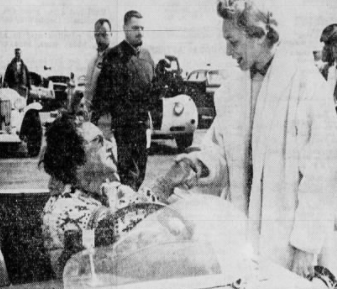
Marion Lowe raced on both the East and West coast of the USA in the 1950s. She was one of several women drivers who got their start in the ladies’ races that were common at the time, but moved into mixed competition.

Her first car was an MG TD, bought for her as a birthday present by her British husband, Jim. The couple often raced together, with Marion, who was younger than Jim, often being the faster driver. Unlike many other couples, they preferred to compete against one another, rather than share cars. They lived in California where they ran a timber firm, but their considerable wealth allowed them to travel extensively in order to compete.

She was second in her first race, a ladies’ event at Torrey Pines in California, in 1952. Josie von Neumann was the winner. Marion was one of the older novices on the scene at 44; Josie was 18 at the time.

She continued to race the MG the following year, entering her first open event, the SCCA Nationals held at March airfield in Riverside. Competing against the likes of Masten Gregory and Briggs Cunningham, she was 17th overall and third in her class. Jim had paid for significant upgrades to the MG in the off-season.

The MG was exchanged for another British car for the start of the 1954 season. Her first race win came at her first meeting of the year, driving a Frazer Nash Le Mans Replica. She beat ten other women and five male drivers competing in a different class at Bakersfield. Later in the year, she was seventh in an SCCA National race held at Seattle Seafair.

Marion and Jim owned both the Le Mans Replica and a Targa Florio Frazer Nash, taking turns to drive both. The Seafair race was her first major event in the Targa Florio and she continued to use it throughout 1955. In it, she won ladies’ races at Stockton and Santa Rosa. In mixed competition, she was eighth in a National preliminary race at Seafair and ninth in another race at the Sacramento Nationals. At the end of the year, she made her first trip to compete abroad, travelling to the Bahamas for Speed Week with the Targa Florio. She entered the Governor’s Trophy, racing against such luminaries as Phil Hill, Stirling Moss and Alfonso de Portago, and was 31st, from 42 finishers.

Lou Brero, who had raced against her at Nassau in 1955, offered her a drive in his D-Type Jaguar for the ladies’ races of the 1956 Nassau Speed Week. She was ninth in the first heat but won the second. For the open events, she drove the Targa Florio, finishing 29th in the Nassau Trophy and 31st again in the Governor’s Trophy. On the mainland, she won ladies’ races at Santa Barbara and Palm Springs, this time in the Le Mans Replica.

She did not go to Nassau in 1957, although she did debut a new car at the inaugural Hawaii Sports Car Week in April. She was fourth in a preliminary race in an Alfa Romeo Giulietta, then sixth in the corresponding main race. Her next event was the Luther Burbank Rose Festival Sports Car Road Races, held at the Cotati airfield course. She was disqualified from her heat for receiving a push start in the Alfa, but she got to start the main six-hour race alongside Al Coppel in his Renault Spyder Le Mans. They did not finish due to a broken valve.

The Alfa was her preferred car for the 1958 sportscar season and earned her podium finishes in ladies’ races at Laguna Seca and Vaca Valley. She and Jim had also bought themselves his and hers Lotus Elevens, and Marion used hers to good effect. She was fourth in an SCCA Regional race at Laguna Seca, just behind Jim in his Eleven.

The Lotus starred in Marion’s return to Nassau. She won both heats of the ladies’ race, ahead of Evelyn Mull’s Eleven. Teaming up with Denise McCluggage in the car, she was ninth in the Nassau Trophy. The team won their class, with Jim’s Lotus second and 17th overall.

Her final year in sportscar racing began with a win in a ladies’ race at Laguna Seca, followed by another at Riverside a week later. In mixed competition, she was fourth in a November race at Hourglass Field. What would be her final Nassau appearance began with a DNF in the Governor’s Trophy, having finished 17th in the preliminary race. She was second in the ladies’ event, winning one of the heats and finishing second to fellow Eleven driver Prudence Baxter in the other. Both she and Jim failed to finish the Governor’s Trophy.

She was still competing in 1960 and even moved into single-seater racing in the form of Formula Junior. Her car was a BMC Mk1, built by Joe Huffaker from British BMC A-series parts. This year’s calendar included the Stockton Road Races, in which she was sixth. 

Jim’s health began to fail in 1961 and both retired from motorsport that year. Their relationship broke down in the following years and they divorced in 1965.


(Image copyright Santa Cruz Sentinel)

Friday, 14 August 2020

Evelyn Mull


Evelyn Mull was one of the fastest of the many women drivers active on the US sportscar scene in the 1950s.

She learned to drive aged eleven but did not start racing until she was forty and married for the third time. Her husband John Mull acquired a sportscar of his own and Evelyn made plans of her own to compete in the ladies’ race held at his first meeting. She was not from a motorsport background and is usually described as a “Pennsylvania socialite”. Her prior sporting interests had been based around horses.

Wealthy and well-travelled, Evelyn had access to the European sports cars popular with the sportscar racing fraternity on both the East and West coast. Her first was a Jaguar XK120 which she debuted in the ladies’ race at Thompson, finishing second behind Carlye Ann Scott’s MG TC.

Although she continued to enter the ladies’ races popular at the time, she was soon taking her chances in the mixed fields at Thompson, as well as competing in hillclimbs alongside John.

She was one of the early members of the SCCA, which was the dominant motor club on the East coast. Within a few years, she became one of their racing instructors and assessors. Despite her love of the sport, she never worked on her own car and nor did John; they travelled with their own mechanics.

Her first win was in a 1954 Ladies’ race at Thompson, ahead of Isabelle Haskell’s OSCA. She was ninth in the CP class race at the same meeting, against a field of other XK120s. A few weeks earlier, she had her first race at Watkins Glen, a Formula Libre race. She returned to the same event in 1955 but did not finish.

By 1955 she was getting more competitive in mixed competition and finished fourth in an SCCA race at Thompson. Her career received another boost with the arrival of a Bristol-engined AC Ace for her and John part-way through 1956. Evelyn won her first race in this car, at her favourite Thompson circuit. Later in the year she was second there, racing in the same class.

She raced a works-supported Ace with John in 1957, entering that year's Sebring 12 Hours but failing to finish. Sharing a similar car with Harry Carter, she was 24th in that year’s Road America 500 Miles. This Ace belonged to Ernest MacNabb, a rare run in a car other than her own. She and John shared ownership of their cars but they preferred not to race together or against one another, according to Todd McCarthy in his book Fast Women. He describes John’s mild unease at his wife’s enthusiasm, expressed in such behaviour as insisting that she always wore skirts when in the paddock.

Evelyn was probably the better driver and she finished sixth in a one-hour race at Thompson that year to his ninth.

Lime Rock was her lucky track that year; she won an SCCA Regional race there in July and was second in a similar event later in the month. 1957 was one of her busiest years on-track and she competed most weekends between March and December, all across the Western part of the States.

She won another SCCA Regional race at Watkins Glen in 1958, from eighteen other drivers. The day before, she had been second in a Ladies’ race behind Suzy Dietrich in an Elva. Two more SCCA thirds at Lime Rock added to her podium tally.

Occasionally she competed outside America. In 1956 and 1957, she made the trip to the Bahamas for Nassau Speed Week. She was third in a Ladies’ race in 1956 and did better in 1957, coming seventh in the GT race and second in a Ladies’ race. The 1958 Speed Week was another rare occasion where she drove someone else’s car, using Don Fong’s Lotus Eleven in the ladies’ races.

The AC was sold during the summer of 1959. A newspaper report of the time joked about it being advertised as a car that had been owned by a grandmother and never been driven on the road. Evelyn did one more major race that year with Pinkie Windridge, finishing 22nd in the eight-hour “Little Le Mans” race at Lime Rock. They were driving an NSU Prinz.

After 1959, Evelyn stepped back from motorsport. The US sportscar scene was becoming professional and amateurs like her, however skilled, were being pushed out. Female drivers in particular were marginalised in favour of male pros and ladies’ races went into decline.

Away from the racetrack, Evelyn wrote a book about her fellow women on the US sportscar scene, Women In Sportscar Competition, published in 1958.


(Image from AC Owners’ Club website)

Tuesday, 14 July 2020

Josie von Neumann


Josie von Neumann raced sportscars in America in the 1950s. She was one of the most talented of the many female drivers on the US sportscar scene of the time.

Her earliest outings were ladies’ races in an MG TD. She won her first race, a five-lap ladies’ handicap at Torrey Pines in 1951, laying down a gauntlet for the entrants in a burgeoning women’s racing scene centred around the Women’s Sports Car Club in California.

Early in her career, she raced an Allard J2 special with a Cadillac engine. In 1952, Josie continued to be the woman to beat in it. The car belonged to Bud and Gwen Goodwin and it was considered a very challenging car to drive. Josie won a ladies’ race at Madera in it. Throughout her career, she often had access to very good cars, due to her family connections. John von Neumann was her stepfather who had become her adoptive father and he had a considerable stable of cars. The red and white TD had been a birthday present from him. Later on, her mother Eleanor was the family’s titular entrant after doing well out of her divorce from John. The von Neumanns helped many notable drivers at the start of their careers, including Richie Ginther and Phil Hill. John also ran a Porsche 550 for future Le Mans winner Ken Miles in 1956. The Women’s Sports Car Club itself was closely associated with the California Sports Car Club (CSCC), of which Ken Miles was a leading member. He was the editor of the club magazine and Josie had her own column.

Always a fan of European cars like the rest of the CSCC, she had continued success in ladies’ races in a Porsche 356 in 1953 and 1954. A Ferrari 500 Mondial followed and it was in this car that she branched out from ladies’ races and started making an impression in the main draw. She entered SCCA events at Bakersfield, Torrey Pines and Glendale. She did best at her favoured track of Torrey Pines, finishing tenth overall and first in class. Carroll Shelby was the winner and Phil Hill was second, driving with John von Neumann. Both were in Ferraris.

She shared the same car with Richie Ginther at the Santa Maria airport track in 1956. This was a difficult and dangerous course that was only used for a couple of seasons. They were fifth overall in the Ferrari. Contemporary newspaper reports suggest that Josie had been planning to use a Porsche 550, but that car was driven by Ken Miles that year, entered by John von Neumann. At about this time, Josie took a break from the track, married John McLaughlin and had a son.

In 1958 and 1959 she returned and drove a Ferrari 250 Testa Rossa. This was a sought-after car at the time. Josie’s detractors liked to claim that she was not the fastest of the Californian ladies, merely that she had better cars than everyone else, but she was a steady pair of hands who was capable of handling very fast machinery. Her rivals sometimes appeared to be out of their depth in cars of the calibre of the Testa Rossa.

She was fifth in the SCCA Nationals at Vaca Valley in 1958, behind her father, who was her team-mate and the race winner. She was also second in a Modified race at Del Mar, a round of the Pacific Coast Championship. This year, she was almost unbeatable in ladies’ races, racking up at least eleven victories on her way to a Pacific Coast women’s title.

In 1959 she concentrated more on open events, entering only a few women-only races. She was fourth in the Avandaro GP and eleventh in the LA Times GP in the Testa Rossa. She was also fourteenth and 16th in the Riverside and Vaca Valley USAC races. This was significant as she would become the first woman to receive a full USAC racing license that year, allowing her to compete as a professional. Her appearance in the Riverside 200 Miles was her first “big” USAC race and she was eleventh, despite admitting to being nervous and only expecting to finish. Josie’s interviews at the time reveal a personality at odds with her list of results; she claimed that women were naturally less good drivers than men and that they were often more nervous. Todd McCarthy, in his book about the US sportscar scene “Fast Women”, speculates that it was the longer races she found hard.

1959 was also the year that she first competed internationally. The East Coast racing fraternity usually decamped to the Bahamas in December for Nassau Speed Week, but West Coast stalwart Josie joined them this year with the Ferrari. Competing against the likes of Stirling Moss, Richie Ginther and Dan Gurney, she was 16th in the Governor’s Trophy for cars over 2000cc. Her best result was a fifth place in the Ferrari race, which was won by Phil Hill in a later TR.

Much earlier in the year, she raced in Mexico for the first time. Josie was third in the Lago de Guadalupe, sandwiched between famous brothers Ricardo and Pedro Rodriguez who were second and fourth respectively.

After 1959, she disappeared from the scene, despite being in possession of a full USAC license and considerable experience. She moved away from her previous home with her son and lived among a huge menagerie of animals, including as many as twenty cats. She died in 1997, aged 64.


Younger women were coming through and becoming more competitive, but the American sportscar racing scene was becoming increasingly professionalised and the both the Women’s Sports Car Club and the CSCC were in decline.