Showing posts with label 1950s. Show all posts

Wednesday, 23 September 2026

Suzanne Largeot


Suzanne Largeot (born Suzanne Daviet) was a French rally and endurance driver who competed both before and after the Second World War.

Her entry into motorsport came after her marriage to Pol Largeot, a car preparer, when she was in her mid-thirties. She took part in three Le Mans races between 1937 and 1939. With Just-Emile Vernet, she won her class in 1937 and was twelfth overall. The car was a Simca, a make Suzanne used quite a lot during her long career. The same team and marque entered again in 1938, but did not finish. Driving a similar car, Suzanne competed again in 1939, with Anne-Cecile Rose-Itier, but again, did not make the finish. Their car went off during the fourth hour of the race, missing a corner at Arnage.

She and Yvonne Simon were also eighth in the 1938 Paris 12 Hours, held at Montlhery, in a Simca 8.

Most of her motorsport activities centred around rallying. The two strands of her career began at the same time in 1937. Suzanne's first major rally was the Criterium Internationale de Touisme Paris-Nice, which consisted of a regularity trial, a hillclimb at La Turbie and a test at the Monaco Grand Prix circuit. She was 24th overall in her familiar Simca. 

In the same event in 1938, she was 30th, but in the Paris-St. Raphael women's rally, she was fourth, with a class win. Her 1100cc Simca proved more effective than some of the bigger cars, including Germaine Rouault's Delahaye and Amy Johnson's Talbot.

In 1939, she drove a Simca T8 to fourth overall in the Criterium Paris-Nice. In a reversal of fortune, she retired from the Paris-St. Raphael. Her last event, just before the war broke out, was the La Baule Rally, which had to be shortened due to growing forces mobilisation. She was 20th overall. 

That year, she had also navigated Yvonne Simon to eighth position in the Monte Carlo Rally. Their car this time was a Hotchkiss, one of the large cars that Suzanne had beaten in the 1938 Paris-St. Raphael.

After the war, she got back involved in motorsport, almost exclusively in rallies now. Her first event back was the Rallye dess Alpes Francaises in 1946. Her car was a Lancia Aprilia and she did not finish. Her first post-war women's rally was in 1947, when the Rallye International Feminin de Paris took place. She was back in a familiar Simca 8, but again, does not appear to have finished.

Later in her career, she competed almost exclusively in long-distance rallies in North Africa, driving a Renault 4CV. She and Ginette Francois-Sigrande attempted the Atlas Mountains Rally in Morocco in 1951 for the first time, the first of three yearly attempts at the Moroccan national event. Sadly, they do not look to have finished.

Back in France, Suzanne entered the Renault into the 1952 Evian-Megeve Rally, but she does not appear on the list of finishers.

In 1954, a French girls' magazine, La Semaine de Suzette, interviewed her and described her as a "grandmother on wheels". Writer Leah Lourie stressed that Suzanne loved the sound of engines and the smell of tyres, but also that she was an excellent cook and devoted mother.

She also discussed her work as a driving instructor and how male learners would be taken aback when she got in the car with them, having assumed she was an administrator.

She died in 1991.

(Image copyright Le Semaine de Suzette)

Tuesday, 8 September 2026

Marianne "Pinkie" Windridge (Rollo)


Marianne Windridge, who was nicknamed Pinkie and later known as Marianne Rollo, raced in the USA in the 1950s and 1960s. 

She got into motorsport through her first husband, Fred Windridge. As an accomplished equestrian who competed in dressage, she already had bravery and balance on her side. Her first car was a Jaguar XK140. In 1956, she won one of her first races, the Marlboro 6 Hours, sharing with Fred. They were three laps up on the second-placed car. That year, she also raced a brand-new Alfa Romeo Giulietta in SCCA events. She was third in her first race in it, at Beverly. 

She took the Alfa over to the Bahamas for the 1958 Nassau Speed Week, finishing ninth in the Ladies' race. This was her first race after a long break, probably due to her being pregnant with her daughter.

Her preference for European cars continued in 1959, this time leaning more towards endurance events. Driving a FIAT Abarth Allemano, she entered the Marlboro 6 Hours again, with Toni Cappiello. In August, she teamed up with Evelyn Mull for the 8-Hour Little Le Mans, held at Lime Rock. Their car was an NSU Prinz and they were 22nd, having blown an engine up during the race. Their pit crew took 53 minutes to install a new engine. The biggest race of her season, in terms of prestige, was probably the ladies' event that supported that year's US Grand Prix at Watkins Glen. Briggs Cunningham entered a Stanguellini single-seater for her and she was third overall, winning the Formula Junior class.

She and Denise McCluggage entered the 1960 Sebring 12 Hours together in an Osca S750, prepared by Briggs Cunningham's team but run under the banner of Camoradi Racing. They failed to finish; Pinkie only got to drive it for two laps before the oil pressure tanked. Denise had driven for two hours beforehand.

For the rest of the year, she raced the Alfa in SCCA events, and also had another run out in the Stanguellini Formula Junior. She was second in a Ladies' race at Cumberland in this car, behind Denise in an Osca Formula Junior.

Eve ready to try out new vehicles, Pinkie and Fred joined the Karts Unlimited team for the President's Cup kart race at Marlboro. Their finishing positions in the multi-heat event are not recorded. Later in the year, she got the best time for a female driver in the SCCA Field Trials at Epping Forest, Annapolis. Her car was the Alfa. 

Her racing in 1962 was also based around Marlboro, in an Alfa. She entered the 6 Hour race again, but had to retire after being forced into a fence by a spinning car. She suffered some cuts to her face which required "35 stitches and plastic work for a cut lip" according to the Evening Star newspaper. Her car was a Veloce belonging to Reed Rollo, another racer and a physicist who would become her second husband the following year.

As Pinkie Rollo, she returned to the track in 1964. She raced a Triumph Spitfire in some SCCA National events, winning her class at least once, but also joined forces with another female driver, Pat Mernone, in a Peugeot 404. They entered the Marlboro 12 Hours together and were tenth overall, fifth in class. In September, a month later, they took on the Four Hour Endurance event at Vineland.

They continued to race the Peugeot together in 1965. Their season started at Marlboro again, with a ninth overall and class third in the Washington Regional SCCA championship race. They followed it up with fifth at Vineland in New Jersey, runners-up in a ten-car class. In comparison, Pinkie driving solo in the Spitfire did not fare quite as well, although she and Reed won two races in the same day at Cumberland in it. Her season was cut short this year as she was involved in a serious road accident and suffered another head injury.

1966 was in some ways a change of direction, although she continued to race European saloons. She and Reed had got hold of a BMW 1800 TiSA and entered the fourth round of the Trans Am championship together. The deal came about as Pinkie was now working for BMW Imported Cars as their safety director. She only seems to have done one Trans Am race at Virginia, but she and Reed were seventh. It was Reed's last major event. He had been injured quite badly in the same car accident as Pinkie the previous year. The couple were both involved in the setting-up of an SCCA Sedan (saloon) championship. Pinkie spoke about her fondness for tin-tops in an interview with the Telegram & Gazette, she said "...I'm a frustrated stock car driver. If I were six feet two..." She was reportedly 5'5", so not even particularly short for a woman.

Despite claiming in a syndicated newspaper article the year before that she was "sick of driving with other women", Pinkie and Denise returned to Sebring in 1967. This time they were driving a Ferrari 275 GTS/4, and were 17th, second in class and the only Ferrari finishers. Their car was prepared by NART and this was the only time this model ever competed. The very same car was later driven by Steve McQueen in The Thomas Crown Affair.

Her career tails off after Sebring. Back in the BMW, she entered that year's Watkins Glen 500 with Ed Diehl, but it isn't clear if she actually made the start.

Throughout her time in the spotlight, Pinkie often presented herself as a family-oriented housewife away from the track, but she had a professional career of her own, first working with prisoners leaving jail, then finding work placements for young adults with special needs.

(Image copyright Sussman)

Wednesday, 2 September 2026

Viviane Elder


Viviane Elder, a French driver, pilot and actress, is most famous for her Le Mans start in 1949. 

She was born in 1904. Her given name was Eugenie Anne Marie Madeleine Hignette, but she always went by the name Viviane Elder. She married very young and the marriage did not last, although she did have one son. After extricating herself from the union, she began acting. Her first film was French crime drama Mephisto in 1931, which became a series of films. 

Her petrol-powered career began with air races, not long after she started making films. Given her interest in aviation, it is possible that she took her stage surname from the American pilot and actress, Ruth Elder. She owned at least two aircraft during the 1930s, a Farman and a Caudron. At first, she entered French flying rallies and races, then she began flying further afield into the Mediterranean and North Africa, then largely French-occupied.

In popular record, the first mention of her in a car was when she and three colleagues got lost during a rally in the Sahara in 1936. However, sources such as "L'Aerophile" magazine suggest that the misfortune happened during an air race or rally. "Le Record" states this unequivocally. It also names Guy Hansez as one of her co-pilots, the same as the reports describing the incident as happening during a motor rally. The four crew members waited for two days to be rescued. Later that year, she was also picked up by a Greek ship after bailing into the Mediterranean on the way to Morocco.

It was not until the end of the 1930s that she became interested in motor racing. There was a crossover between pilots and racing drivers, and Guy Hansez was one who did both. He apparently introduced her to Amedee Gordini and others. The war then intervened. Her flying comes to an end here.

Motorsport took some time to get going again in Europe after the deprivations of World War II, and it was 1948 before Viviane actually got on track. During the war itself, there are suggestions that she was investigated for supposed links to Italian fascists, but she does not appear to have been interned or imprisoned.

She drove solo in her first major race, which was the Grand Prix des Frontieres at Chimay in Belgium. Her car was a Simca-Gordini T8 and she was third in the 1100cc race.

A little later, she joined up with Jean Estager in a Simca-Gordini T8 for the Paris 12 Hours, held at Montlhery. She was 28th overall. The winner was future Formula One driver Luigi Chinetti in a Ferrari.

The following month, she was back at Montlhery for the Coupes du Salon. She was eighth overall, ahead of one of the works Gordini cars.

In 1949, the 45-year-old Viviane and her co-driver Rene Camerano entered the little Simca into the Le Mans 24 Hours. The 1100cc car lasted for 95 laps before it retired. She was the first woman to race in the 24 Hours since before the war. 

This appears to have been her last appearance on track until French sources are consulted. According to L'Equipe, she entered the 1951 Coupes du Salon in a Ford Vedette, finishing 27th. This was a departure from her usual Simca cars, but the Vedette model would soon be rebadged as a Simca in France.

She died in 1960, aged 56.

Friday, 26 June 2026

The Macau Ladies' Races


The Macau Grand Prix and Macau Guia races are still an important part of the international motorsport calendar, although perhaps not as much as in previous years. 

In the 1950s, the early days of the Macau race circuit, the Guia meeting also hosted a ladies' race, usually for saloon cars. The first event was in 1955 and was set to be contested by three women. One dropped out. Jean Lam was leading when her rival's car broke down, giving her the win by default.

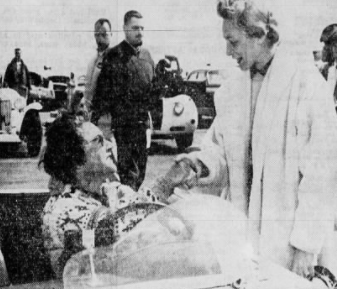
The most famous winner of the event was Maria Fernanda de Menezes Ribeiro (pictured), popularly known as "Speedy Ribeiro". She had been born in Macau itself in 1924 and was the daughter of a diplomat. Her Fiat 1100, which took her to one win and one second place, was her daily driver. She had actually taken part in the 1954 version of the Macau Grand Prix, which was then run as a regularity trial. Her car was a Vauxhall Velox belonging to her father and she was second overall. 

The Ladies' Race was never particularly over-subscribed and reports describe the action one year as "a procession". It was discontinued after the 1959 edition, which was won by Carol Ungricht. Carol was an American driver based in Okinawa, Japan. She also entered the Formula Libre race in 1958.

All-female races were later held at Macau, but they were celebrity events contested by actresses and TV personalities. Jackie Chan promoted one for several seasons.

For a list of female drivers who have attempted the Macau Grand Prix, click here. For a profile of Anne Wong, the only woman to win a race on the Guia circuit, click here.

1955

1. Jean Lam (Jaguar XK120)

2. Wen Lenard (Austin Healey)

1956

Maria Fernanda de Menezes Ribeiro (Fiat 1100)

1957

1. Narcee Matchett (Triumph TR3)

2. Maria Fernanda de Menezes Ribeiro (Fiat 1100)

1958

1. Carol Ungricht (MGA)

2. Narcee Matchett (Triumph TR3)

3. Miss S Anderson (Jaguar XK140)

1959

1. Carol Ungricht (MGA)

Maria Fernanda de Menezes Ribeiro (Fiat 1100)

(Image from macaubusiness.com)

Monday, 25 May 2026

Anna van Vredenburch Limburg-Stirum


Anna on the 1950 Monte

Anna von Vredenburch Limburg-Stirum was a Dutch rally driver who competed under her birth name, and as the Countess Limburg-Stirum. She won the Coupe des Dames in the 1949 Monte Carlo Rally and entered the classic alpine event six times.

Born in 1914, she first competed in rallying before and after the Second World War, starting when she was in her twenties. Her first attempt at the Monte Carlo Rally seems to have been in 1937, co-driving a Ford as Miss van Vredenburgh. The Countess Limburg-Stirum was recorded as her navigator and was probably a relative of her future husband. They were fourth in the Coupe des Dames rankings. Two years later, in the last pre-war Monte, she and the Ford were 25th overall, tied with Mrs AC Lace. In between, still in a Ford, Anna had come 85th in the 1938 Monte.

Anna married Frans Willem Van Limburg Stirum in 1946. He also competed in the Monte at least twice, driving Ford cars.

On her return to rallying, she was twelfth in the 1949 Monte, and won the Coupe des Dames, still in a Ford. Her navigator was Miss Van Vredenburch, who may have been her younger sister, Elisabeth. Their start point was Monte Carlo itself.

The Ford was brought out again for the 1950 Monte. The Countess got to the finish in 131st place, assisted by Mrs. Stahl Wytema. In April of that year, she was part of a Dutch four-woman team in a big American-styled Ford Vedette, in the Tulip Rally. One of the other drivers was Miss Vredenburch, possibly Elisabeth, who had been part of the team the year before.

She had one more go at the Monte in 1951 with Mrs Stahl-Wytema, but their Ford didn't make it to the end.

Anna was part of two major Dutch aristocratic families. Research into her personal life is made difficult by the number of "Countess Limburg Stirums" who existed at roughly the same time. They include ladies in waiting to the Dutch queen and cookbook writers. Some of the Limburg Stirum family was related, by marriage, to Audrey Hepburn, through her mother.

She died in 1999.

(Image copyright Alamy)

Friday, 22 August 2025

Rita Rampinelli


Rita Rampinelli was a Swiss driver active in the 1950s. 

She mostly competed in hillclimbs across Europe, first in a Cisitalia D46, and later, a Porsche 550 Spyder. 

The Cisitalia was a Formula 2-spec car. She drove it extensively in hillclimbs, although she does not seem to have raced it on track. Between 1951 and 1955, she was a regular top-three finisher in the class for racing cars up to 1100cc, including a second place in the 1953 Ollon-Villars climb, which was faster than the time set by bigger cars. She repeated this at the 1953 Mitholz-Kandersteg event. This hillclimb was one of her favourites; she scored another class third in it in 1955. 

She is sometimes described as the first Swiss woman to buy a Porsche, although this might mean a racing Porsche, as glider pilot Jolanda Tschudi owned one of the first ever production Porsches, as a road car. 

Before the cessation of circuit racing in Switzerland, she came fourth in the Swiss national championship twice, although details of which race series this referred to, are hard to pinpoint. It is likely that hillclimbs played at least some part.

In 1953, she drove in a sportscar race supporting the Swiss Grand Prix, at Bremgarten, and was sixth, in a Porsche 356. Driving a 1500cc Porsche, she crashed out of the Preis von Bremgarten later in the year.

She appears in the start list for a similar event in 1954, but the result is not forthcoming. 

For the summer of 1956, she bought the 550 Spyder, first racing it in the Saint Ursanne-Rangiers hillclimb in June.

As well as circuit racing and hillclimbs, she also participated in rallies, including the Monte Carlo Rally in 1954, alongside Max Brunner, a hot-air balloonist. Her car was an Opel Olympia and she just made it to the finish in 215th place, having started at Munich. Early in the rally, she was penalised for damaging the car's wing in collision with a lorry. This was probably not the first time she had entered. 

Rita was quite self-motivated in her racing career, although she was from a family with motorsport heritage. Her father, a car dealer, had competed in the 1930s. She herself was involved in the motor trade, giving her profession as "garagiste" in an interview during the 1953 Monte. 

Rita died in 2011, at the age of 88. She outlived her partner, opera singer Hansy von Krauss, by three years.

(Image copyright Berner Zeitung)

Friday, 20 June 2025

Angela Palfrey


Angela Palfrey rallied in the 1950s, and for a couple of seasons was Britain's leading new female driver.

She is chiefly known for winning the Ladies’ Prize on the 1956 RAC Rally. Her car was an Austin A40, and she was navigated by Aileen Jervis, with Pauline Pither as a third team member. The rally ran between Blackpool and Hastings and had 2100 miles of navigation. The car itself belonged to her and was an older model no longer in production. She defeated Pat Moss and Mary Handley-Page, with Pat Moss taking a wrong turn around a pylon during a driving test.

The following month, she won the ladies' award in the Birmingham Post Rally. 

Previously, she had competed in a Morgan 4/4, and is recorded as the winner of the Worcester Motor Club’s Autocross event in 1955. She was only 20 at the time. Her first major rally award came in this car, the ladies' prize in the 1955 MCC Rally. The Morgan was borrowed from her boss at the fruit and vegetable canning factory where she worked, Barrie Phipps. Aileen Jervis had been her navigator again and they won £50 from the Daily Mirror. It was her first rally as a driver.

She drove another borrowed Morgan later in 1956, entering the Morecambe Rally, also sponsored by the Mirror. She also entered the MCC National Rally for a second time, starting from Kenilworth as she did before.

As well as rallies, she also competed on track occasionally. In summer 1956, she took to the circuits at Oulton Park, taking part in the Lancashire & Cheshire MC's high-speed trials. There were two trials lasting half an hour each, and Angela used the A40 she had driven in the RAC Rally. 

Angela was from Pershore in Worcestershire. Her competition career was very short and she does not appear to have rallied after 1957. During her brief time as a rally driver, she enjoyed the spotlight. The newspapers liked reporting on this very young, pretty and talented new star.

Her married name was Phipps; she married Barrie Phipps in 1958. She died in 2018, aged 83.

(Image copyright Daily Mirror)

Monday, 9 December 2024

Hila Paulson Sweet


Hila with Parnelli Jones


Hila Paulson Sweet
was an American driver known for her stock car racing in the 1950s, and for being instrumental in setting up all-female racing clubs.

Born in Compton, Los Angeles, she spent most of her adult life in California. She started racing in 1950, when she was 22, initially in the "Powder Puff Derby" events put on for wives and girfriends of male drivers. Her younger brother Ray also raced. To begin with, she competed alongside her first husband, Bob Morgan, and the pair owned a car together. She was later married to Ummie Paulson, an expert car builder who acted as her crew chief.

She raced in a couple of official NASCAR Late Model races in 1956 and 1957, in a Chevrolet. Both races were at the Gardena circuit, and she did not finish either of them.

Hila is most famous for her huge success in the “Powder Puff Derby” scene, where she was almost unbeatable. Although there were no rules specifically banning female drivers, or limiting them to ladies' races, they normally had to share a car with a husband, boyfriend or male relative, who would use the car for the main events, hence the popularity of powder puff or "Cheesecake" derbies.

She was part of a group of female drivers who became known as the Lady Leadfoots, which set up a racing league for women. The group's official name was the California Women's Racing Association and it was formed in 1950, amalgamating several groups active in jalopy racing, including the Cheesecake Derby Association. Hila was not part of the combined committee at the beginning, having led one of its constituent groups, but she had risen to the rank of President by 1953. This was in spite of a claim that one of the organisations tried to ban her from competing as she won too often. The CWRA advertised for new drivers in newspaper Situations Vacant columns, promising start money.

The CWRA's home track would become Gardena Stadium, but their first all-female event was at Carrell Stadium in 1950, before the other groups joined them. Hila competed against pre-war Irish driver Fay Taylour, visiting from Europe, as well as the glamorous Peggy Peek, Esta Cornett and Ellen McCoy. Her sister Edna Bates was a regular rival. Most powderpuff races were contested over a few laps in a single heat, but the Carrell event was a full programme of heats and a final.

Hila was never shy of publicity and must have jumped at the chance to enter a match race against Parnelli Jones in 1955, then a leading jalopy racer at the Carpinteria Thunderbowl. According to the Santa Barbara News Press, there was little to choose between the two drivers for the first third of the six-lap race, before Parnelli Jones pulled ahead. Hila kept on his tail until the final corner, when she pulled up the inside of him and sent him off the track, taking the win for herself. Later in the year, she also took on brothers Marty and Tommy Artoff at the San Bernardino track.

In 1959, she also did some sportscar racing, and won a Ladies’ race at Ascot, in a Jaguar. The year before, she took a Ford Tractor stock car to a ladies' race at her home track of Gardena, winning from Barbara Scott and Bonnie Bosley, both in MGs.

After retiring from the track herself, she continued to be active in motorsport until an advanced age, organising get-togethers for other former racers on the jalopy and stock car scenes. Her marriage to Ummie did not last and she later married Bob Sweet. They moved to Florida, where they owned their own track.

Away from active competition, she was instrumental in getting Parnelli Jones drives, alongside Ummie. Parnelli Jones won the Indy 500 in 1963. She also wrote about stock car racing for local newspapers. Later, she organised get-togethers for former racers.

(Image from The Jalopy Journal)

Saturday, 11 November 2023

Annie Neil


Annie Neil, alongside her navigating sister Chrissie, rallied in the 1950s. Their first international event seems to have been the 1953 RAC Rally, driving a Morgan Plus 4, which was given to Annie by Peter Morgan, in recognition of her performance in a trial. 


Annie’s given name appears to have been Ines or Innes and she was sometimes known as Andy as well. Chrissie was also known as Kiki. She was awarded a Silver Garter in recognition of her being the “best woman driver in Britain” in 1953, following her Coupe des Dames in the Hastings Rally.


Having been interested in motorsport for a while, Annie entered her first rally and named her sister as her navigator, even though Chrissie could not drive. Her niece Candy says that she had to take a week-long crash course in order to be allowed to compete. They initially rallied mostly in Scotland and in the north of England, including the Morecambe Rally.


Quickly they became popular local media figures and even donned Edwardian outfits for a Glasgow-Largs-Kilmarnock veteran car race in 1957. They were driving a 1912 Vulcan.


As well as the RAC Rally in 1953, the Neil Morgan made an appearance in the Daily Express Rally in November. It had been successfully repaired after a roll on the RAC event.


The sisters competed abroad for the first time in January 1954, driving the Standard Vanguard they would become associated with in the Monte Carlo Rally. The Scotsman described them as being welcomed with flowers by spectators. The Morgan came out again for the MCC National Rally later in the year. 


In 1955, they entered the Monte Carlo Rally again, but retired after a lighting failure on their Standard Vanguard in Belgium. They drove the same car in the 1956 Monte, but appear to have retired again, possibly after missing a time control at Besancon. As ever, the reports of their Monte adventures mentioned their matching tartan-lined ski suits and tartan berets.


They are on the list of finishers for the 1955 Scottish Rally but their final position is not noted.


The Neil sisters were regulars in Scottish rallies until 1957, when Annie retired from major competition to start a family. Her daughter Candy was born in early 1957. Chrissie carried on for a short while, co-driving for her brother-in-law, Annie’s husband Frank Dundas.


Both were involved in motorsport administration as well as competition and were committee members for the Lanarkshire Motor Club. Chrissie even ran a local rally with an all-woman organising team in 1954, calling it “La Flop Des Dames”.


Annie had learned to drive during the War, and after her rallying days were over, ran the family pig farm in Tollcross. She died in 2004 aged 80. Chrissie became a fashion designer. She died in 1991, aged 64.


Listen to a podcast featuring Candy and Donald Dundas here. Photos from the same page.

Thursday, 21 September 2023

Louisette Texier


Louisette (right) with Annie Soisbault and Germaine Rouault

Louisette Texier was an Armenian-French driver and rally navigator in the 1950s and ‘60s. 

Her ten-year driving career began when she was in her mid-forties and running her own clothes shop. She had been born in central Turkey to Armenian parents and her birth name was Arpine Hovanessian. Evacuated to Greece and then to Marseille, she escaped the 1915 Armenian genocide which claimed her father. Her mother also survived, but the two did not meet one another again until Arpine was an adult. At the age of 15, she left school and became a showgirl in Paris. This may well have been when she changed her name. She would have been a contemporary to the likes of Helle Nice and perhaps saw her compete in the Coupe des Artistes. A much later meeting with Grand Prix driver Jean Behra during a visit to Montlhery in 1955 is said to have been her inspiration to take up motorsport herself.

An ambitious competitor nicknamed the Bulldozer, her first major rally was the 1958 Acropolis, which she tackled in a Simca Aronde Montlhery model. This was a car she was already familiar with, having co-driven for Germaine Rouault in one for the 1956 Monte Carlo Rally. She had raced a slightly different model on track during the same season, finishing sixth in class in the Coupes de Vitesse at Montlhery. Later in the year, she was thirteenth in the Coupe de Salon, held at the same circuit.

The 1956 races were the only times she took to the circuits for dedicated races, but she got more experience of the French tracks during the Tour de France. She entered four times between 1961 and 1964, as both co-driver to Annie Soisbault and named driver. In 1961, she drove an Alfa Romeo Giulietta, and in 1964, a Jaguar MkII. Her co-driver both times was Marie-Louise Mermod of Switzerland. On the other two occasions she navigated for Annie Soisbault, also in a Jaguar. 

The Monte Carlo Rally was another favourite. She first entered in 1959, still driving a Simca Aronde. Louisette and co-driver Francoise Archambault narrowly missed the cut to enter the final leg and finished 106th overall. She switched to a Renault Dauphine in 1960, but she and Helene Cherret did not finish. Driving an Alfa Romeo Giulietta and Renault 8 respectively, she entered again in 1961 and 1964. 

As well as events, Louisette was quite loyal to team-mates. Between 1960 and 1963, she co-drove for Annie Soisbault in the Tour de France and in French rallies such as the 1960 Stuttgart-Charbonnieres event, where they shared an Alfa Romeo. Marie-Louise (or Mary Lou) Mermod was another regular colleague; she navigated for Louisette in the 1962 Monte and the 1964 Tour de France, then Louisette returned the favour for the Geneva Rally in 1964. They were 30th in an Alfa Romeo.

Louisette was also a participant in the Paris-St. Raphaël womens' rally, in which she used a Renault Dauphine in 1962.

Her last rally was the Rallye du Maroc in 1968. She drove a Renault 8 Gordini but joined a lengthy list of non-finishers.

She died aged 108 in 2021. In her final years, she achieved some fame in France due to her great age, adventurous life and wartime heroics in the French resistance, helping to hide Jewish families. She worked in womenswear retail until she was 92 and enjoyed karting with her grandchildren and great-grandchildren when she was even older.

For an interview with Louisette as an old lady, click here.

Image copyright Le Monde

Thursday, 6 July 2023

Sybil Lupp


Sybil Lupp was New Zealand’s first female racing driver. 

Her interest in cars began on the engineering side in the 1930s, and she was one of New Zealand’s first female mechanics, taking a job at JG Ingrams garage in 1938. She started racing after her second marriage, in 1947. She took part in the first hillclimb organised by the Otago Automobile Club.


Initially, she only drove in hillclimbs, scoring several wins in MG cars. She had learned to drive aged eleven and her first car was an MG M-Type, bought for her by her father three years later. The Australian Women’s Weekly reported in November 1948 that Sybil had won her second Otago hillclimb championship in succession, and that she held their circuit’s track record. Her records included the full hillclimb for her class and for the standing quarter-mile sprint.


Circuit racing was quite slow to get going in New Zealand after the Second World War, having been quite sporadic before that anyway. In 1949, she entered the first road race held in the country, the appropriately-named Road Racing Championship. The event was a 105-mile circuit, consisting of 50 laps of an aerodrome. She drove an MG TC and was fifth on scratch, fourth on handicap.


In 1950, she was second in the same race, driving the TC, and first on handicap. She had made considerable progress from twelfth on the grid.


After a year when she does not appear to have raced at all, she returned with an MG TD in 1952. She was seventh in both the Lady Wigram Trophy and the CWF Hamilton Trophy. The RRC’s original organisers had switched their attentions to another track and the Lady Wigram Trophy was its replacement. Her Wigram result was another run from the back of the grid. The CWF Hamilton event was held at the 4km Mairehau circuit, run over 40 laps. Sybil had been given a substantial ten-minute handicap.


In 1953, she changed from an MG to a Jaguar XK-120. In this car, she was seventh in the CWF Hamilton Trophy, driving with “HR Brown”, who was a Dr Bruce Hay driving under a pseudonym. Driving solo, she was seventh in the fifth RRC, now held at Dunedin. 


As well as racing, she was one of the founder members of the Otago Motor Association, and ran a series of garages and car dealerships. Her first marriage ended when Jack Lupp died in 1945; two years later, she married his brother Percival. They divorced in 1961. After 1969, when she married Lionel Archer, she was known as Sybil Archer. They had been partners in a Jaguar garage.


Despite her choice of occupation, Sybil always distanced herself from “women’s lib” and claimed that a woman should be led by her man, although she also bragged about being quicker than her husband early in her career.


She died in 1994, aged 78.


(Image copyright Wellington Evening Post)


Sunday, 14 May 2023

Elyane Imbert


Elyane, left, in 1953

 Elyane Imbert was a French driver who raced sportscars in the mid-1950s. 

A rather elusive figure, she first appears on the circuit entry lists in 1952, racing a Porsche in the Coupe d’Automne, held at Montlhery. The same year, she drove a Simca Sport in the Rallye Maroc.


In 1953, she and Simone des Forest drove a Porsche 356 Super 1500 together, starting with the Monte Carlo Rally. Elyane drove with Simone as navigator and they were 281st overall, from 346 crews that finished. This was Simone’s last major rally.


On the circuits, they competed in two World Sportscar Championship races: the Spa 24 Hours and Nürburgring 1000km. They were disqualified both times, once for receiving assistance. Driving solo, Elyane was fourth in the Rouen GP. The car appears to have been the same one each time and it belonged to Elyane. The pair were photographed together at both the Nürburgring and Monte Carlo.


In 1954, she returned to Morocco and was third in the Marrakesh Grand Prix. She was then third in the Circuit de Bressuire race for cars of more than 1100cc. 


She did not enter any more World Championship races. The retirement of her usual co-driver Simone may have been a factor. She did, however, do some more rallies in France that year, including the Rallye Sable Solesmes, driving for a team called “Ecurie des ecureuils”, or “Team Squirrel”. She had joined the team in February, alongside Gilberte Thirion. After 1954, she disappears completely from the entry lists.


(Image copyright Mike Copperthite)


Tuesday, 13 September 2022

Female Rally Drivers Around the World: the Netherlands


Most of the entries in this post were previously part of other posts relating to European rally drivers. Anna van Vredenburch Limburg-Stirum has her own post.

Angelique Aufderhaar (pictured) - usually rallies a Ford Escort RS2000 in the Netherlands, with frequent outings in Germany. She has been active since at least 2008 and for the first couple of seasons, she used a MkI Escort. Her best results have been on different versions of the Hellendoorn Rally, with a twelfth place in the 2019 Hellendoorn Historic event her highest finish. In 2013, she was also thirteenth in the Hellendoorn Short Rally. Other cars she has rallied include a Mitsubishi Lancer Evo IV, which she used on and off between 2018 and 2021. In 2022, she concentrated on German events, in the RS2000. She did two Dutch rallies and one German event in 2023, finishing the Rallye Ostwestfalen in 38th place. In 2024, she finished one rally in the Escort, finishing 46th in the Legend Boucles a Bastogne event in Belgium. The following year, she finished all three of the rallies she entered, with a best finish of fourteenth, with a class win, in the NED GTC Historic Rally.

Lieke Bouman (Dautzenberg) - driver and co-driver active since at least 2001, when she co-drove for her brother, Bob Dautzenberg. Since then, she has won rallies as a navigator with different drivers. As a driver, she favours small cars, most recently a Renault Clio but also a Renault 5 and a Nissan Sunny. She specialises in shorter sprint rallies, usually in the Netherlands or Belgium, but often in Germany as well. Her best result has been an eighth place in the 2017 Twente Short Rally, driving a Honda Civic. This helped her to the Dutch ladies’ title that year. More recently, she was ninth in the 2019 JUMBO Short Rally, driving a Clio. She returned to competition in 2022 after a break and was 26th in the GTC Rally, in the Clio. After another break, she did a couple of rallies in 2025, using the Clio and a Peugeot 205. She did not finish either.

Louk Heidendahl – Dutch driver who was active in the 1960s. She was a regular on the Tulip Rally, and first entered in 1960, driving a DKW Junior with Ida de Fouw. The same pairing were 29th in 1961, this time driving a Saab 96. In 1962, she was fourth in the Ladies’ standings, and 59th overall, in the Saab, with erstwhile driver, Diana van Strien, on the maps. It was back to the DKW in 1963, but a change to an Alfa Romeo Sprint Veloce in 1964 brought her a pleasing 25th place. In 1965, she moved over to the co-driver’s seat, with Joop Heidendahl, in a Mercedes. She seems to have stopped rallying after that.

Marieke van Kamperdijk (Rietveld) - rallied a Peugeot 206 in the Netherlands in 2017. She was runner-up in a Dutch ladies’ championship held that year and got her season off to a strong start with an eighth overall in the Zeebodem Short Rally. She was also thirteenth in the Centraal Nederlands Short Rally. Her only rally outside the Netherlands was the Gronegau event in Germany. Despite her relatively strong debut year, she does not appear to have competed again. 

Diana van Strien – Dutch driver who competed in the Tulip Rally on at least three occasions, between 1960 and 1962. The first two rallies were as a driver, in a Renault Gordini, and she was co-driven by Truus van der Voorst Vader. In 1962, she was the co-driver to Louk Heidendahl, another Dutchwoman, in a Saab 96. Diana was from a motorsport family, and the 1960 Tulip Rally was not her first involvement with the sport. She is recorded in 1957 as taking part in the Vaals hillclimb, a round of the Dutch Touring Car Championship, in a Ford Taunus. She was second in class, and defeated her mother, whose name is not given. Diana may well have co-driven for her mother in rallies at about this time.

Titia Westerhof - Dutch driver active in the 1970s and early 1980s. She almost always drove an Opel Kadett, although she did try out an Opel Ascona and a  Renault 5 towards the end of her career in 1980. She entered the Tulip Rally three times, beginning as a works Opel entry in 1977. Her best year was 1978, when she won the Netherlands National class and finished 23rd overall. Her best outright finish came during the same year: she was eleventh in the AMAC International Rally. Mainly, she competed in the Netherlands, although she also entered some Belgian rallies, including the 1979 Condroz event, and one Swedish rally. The Sjuharadsnatta Opel Rally Jamboree was held on snow, as opposed to her favoured asphalt.


(Image copyright Lars Smook/tubantia.nl)

Tuesday, 23 August 2022

Louise Smith


Louise after a crash at Occoneechee in 1949

Louise Smith was a successful NASCAR driver from its earliest days, who has become part of the legend of the series. 

Born in Greenville, South Carolina, 1916, she made her NASCAR debut at Daytona in 1949, although had driven in some local, informal races before that.

Her driving style was aggressive and she often crashed, endearing her to spectators. Her nickname was “The Good Ol’ Gal” and she became the subject of NASCAR legends; it has proved impossible to work out which stories about her are true. For example, she is supposed to have come third in her first race, but failed to stop at the chequered flag, because the team owner had told her only to stop in the event of a red flag. She may also have destroyed her husband’s car in a beach race during her first competition. Neither of these was the 1949 Daytona event, although some reports say that she did flip her car during that race, only to be helped by spectators and carry on. Some sources suggest that this happened in 1946.

Other rumours abounded about her background, with some claiming that she was a moonshine runner who could drive faster than all of the local police.

A newspaper report from May 1950 claims that she “became a driver only last winter”. Searches of newspaper archives bring up nothing from before 1949, so this could be the truth. Other reports suggest that she started racing a little earlier, perhaps in 1948. 

Evidence comes from before Daytona in 1949, she was recorded as entering a ladies-only race at Greenville Speedway with her “student” Barbara Peigler in two cars. Barbara had apparently been taught to drive by Louise and was having her first race. This does suggest that Louise had been driving for longer than a couple of months.

 She won 38 races during her seven-year career, taking in most of the NASCAR categories, including Grand Nationals (now the Sprint Cup). Most of her wins (28 of them) came in the Modified class. She did eleven Grand National races between 1949 and 1952, with a best finish of 16th at Langhorne in 1949. Langhorne was later described as her favourite track. This was one of three races she entered that year, normally competing against either Sara Christian or Ethel Flock Mobley as well as the male drivers of the time. Both of these women were also present at Greenville when Louise and Barbara raced there, along with Sara Christian’s sister, Mildred Williams. NASCAR’s founder, Bill France, was keen for the three women to race as it was good publicity for his fledgling series.

She never ran even close to a full Grand National season, with 1950 being her biggest campaign. She entered six rounds, qualifying for all except Darlington and finishing two. Both of these were 19th places, at Dayton and Hillsboro. Her second Daytona start ended in a first-lap crash. 

After not racing in 1951, she did three races in 1952, but did not finish any of them, two due to mechanical problems and one due to her falling ill early in the race itself at Morristown.

Among the other drivers she raced were Buckshot Morris, Lee Petty, Curtis Turner and Bob and Fonty Flock, Ethel Flock Mobley’s brothers.

As well as mixed events, she often raced against other women. In 1954, she travelled to Knoxville, Tennessee and took on local drivers Mildred Beets and Joyce Gunter, among others. At the time, she was described as “the 1953 Southeastern States women’s stock car champion.” She travelled widely during her career, racing in the northern and eastern states.

This part of her racing life is not particularly well-documented, as her novelty value had worn off somewhat by now and Bill France was no longer promoting her.

Her career ended very suddenly in 1956. She had just finished a race at Bronx, New York and was on her way to Daytona when her husband decided to “rededicate himself to the Lord” with the help of a local preacher. After speaking to her husband and the preacher, Louise decided to follow suit and pulled out of the Daytona event.

After a long period away from motorsport completely, she returned as a car owner in 1971, continuing for some years. She also oversaw the beauty contest attached to the Southern 500 race. The drivers who used her car included Ronnie Thomas in 1978, the year he won Rookie of the Year. While she was racing, she often ran a car for another driver at the same time.


She died of cancer in 2006, aged 89.

Sunday, 21 November 2021

Marion Lowe


Marion Lowe raced on both the East and West coast of the USA in the 1950s. She was one of several women drivers who got their start in the ladies’ races that were common at the time, but moved into mixed competition.

Her first car was an MG TD, bought for her as a birthday present by her British husband, Jim. The couple often raced together, with Marion, who was younger than Jim, often being the faster driver. Unlike many other couples, they preferred to compete against one another, rather than share cars. They lived in California where they ran a timber firm, but their considerable wealth allowed them to travel extensively in order to compete.

She was second in her first race, a ladies’ event at Torrey Pines in California, in 1952. Josie von Neumann was the winner. Marion was one of the older novices on the scene at 44; Josie was 18 at the time.

She continued to race the MG the following year, entering her first open event, the SCCA Nationals held at March airfield in Riverside. Competing against the likes of Masten Gregory and Briggs Cunningham, she was 17th overall and third in her class. Jim had paid for significant upgrades to the MG in the off-season.

The MG was exchanged for another British car for the start of the 1954 season. Her first race win came at her first meeting of the year, driving a Frazer Nash Le Mans Replica. She beat ten other women and five male drivers competing in a different class at Bakersfield. Later in the year, she was seventh in an SCCA National race held at Seattle Seafair.

Marion and Jim owned both the Le Mans Replica and a Targa Florio Frazer Nash, taking turns to drive both. The Seafair race was her first major event in the Targa Florio and she continued to use it throughout 1955. In it, she won ladies’ races at Stockton and Santa Rosa. In mixed competition, she was eighth in a National preliminary race at Seafair and ninth in another race at the Sacramento Nationals. At the end of the year, she made her first trip to compete abroad, travelling to the Bahamas for Speed Week with the Targa Florio. She entered the Governor’s Trophy, racing against such luminaries as Phil Hill, Stirling Moss and Alfonso de Portago, and was 31st, from 42 finishers.

Lou Brero, who had raced against her at Nassau in 1955, offered her a drive in his D-Type Jaguar for the ladies’ races of the 1956 Nassau Speed Week. She was ninth in the first heat but won the second. For the open events, she drove the Targa Florio, finishing 29th in the Nassau Trophy and 31st again in the Governor’s Trophy. On the mainland, she won ladies’ races at Santa Barbara and Palm Springs, this time in the Le Mans Replica.

She did not go to Nassau in 1957, although she did debut a new car at the inaugural Hawaii Sports Car Week in April. She was fourth in a preliminary race in an Alfa Romeo Giulietta, then sixth in the corresponding main race. Her next event was the Luther Burbank Rose Festival Sports Car Road Races, held at the Cotati airfield course. She was disqualified from her heat for receiving a push start in the Alfa, but she got to start the main six-hour race alongside Al Coppel in his Renault Spyder Le Mans. They did not finish due to a broken valve.

The Alfa was her preferred car for the 1958 sportscar season and earned her podium finishes in ladies’ races at Laguna Seca and Vaca Valley. She and Jim had also bought themselves his and hers Lotus Elevens, and Marion used hers to good effect. She was fourth in an SCCA Regional race at Laguna Seca, just behind Jim in his Eleven.

The Lotus starred in Marion’s return to Nassau. She won both heats of the ladies’ race, ahead of Evelyn Mull’s Eleven. Teaming up with Denise McCluggage in the car, she was ninth in the Nassau Trophy. The team won their class, with Jim’s Lotus second and 17th overall.

Her final year in sportscar racing began with a win in a ladies’ race at Laguna Seca, followed by another at Riverside a week later. In mixed competition, she was fourth in a November race at Hourglass Field. What would be her final Nassau appearance began with a DNF in the Governor’s Trophy, having finished 17th in the preliminary race. She was second in the ladies’ event, winning one of the heats and finishing second to fellow Eleven driver Prudence Baxter in the other. Both she and Jim failed to finish the Governor’s Trophy.

She was still competing in 1960 and even moved into single-seater racing in the form of Formula Junior. Her car was a BMC Mk1, built by Joe Huffaker from British BMC A-series parts. This year’s calendar included the Stockton Road Races, in which she was sixth. 

Jim’s health began to fail in 1961 and both retired from motorsport that year. Their relationship broke down in the following years and they divorced in 1965.


(Image copyright Santa Cruz Sentinel)

Friday, 16 July 2021

Alexandra Hammersley


Peugeot 203 in rally trim

Alexandra Hammersley was a French driver who entered both races and rallies. Her British name came from her husband, who was also a rally driver.

She was a regular in rallies in France and Europe in the 1950s, often with her daughter, Genevieve, as her navigator. 

In 1950, she co-drove for her husband in the Liège-Rome-Liège Rally. She entered the event for the first time in 1951, sharing a Peugeot with Ginette Francois-Sigrande.

Genevieve first joins her mother later that year. In 1951, they were 40th in the Tour de France, driving a Peugeot 203. In the 1952 Tour, they were 50th. 

They entered the 1953 Monte Carlo Rally together, but retired shortly after the start when Genevieve Hammersley was hit by a bicycle. They had arrived on time from their start point at Lisbon but the accident happened at Cannes, not far away. Genevieve was taken to hospital.

The same year, they were 19th overall in the ADAC-Rallye Travemunde and second in the Paris-St. Raphaël, driving a Lancia Aurelia. This was her second go at the women-only rally, having finished sixth in the Peugeot in 1951. 

An outing in the Aurelia for the Alpine Rally ended in retirement. Driving the Peugeot 203, the mother-daughter team finished 72nd in the Tulip Rally, starting from Paris.

In 1951, Alexandra was also sixth in the Bol d’Or endurance race in Paris, driving a Peugeot 1.5. She only raced occasionally on circuits.


She disappears from the entry lists after 1953. Other than the accident to Genevieve, Alexandra’s career went largely unremarked-upon in the French press. Her origins and later life are a mystery and no photos of her have come to light.

Tuesday, 8 June 2021

Lady Mary Grosvenor


Lady Mary Grosvenor was a British driver in the mid-20th century who could have been the first woman to race in Formula One.

Blessed with a huge family fortune as the youngest daughter of the Duke of Westminster, she was able to afford a series of increasingly powerful cars. Her father was, at the time, one of the richest men in the world.

She most often competed in hillclimbs and sprints, but did both circuit racing and rallying before and after World War II. 

It was in rallies that she first came to prominence. She entered the 1936 RAC Rally in a Riley, starting from Buxton. She is recorded as having finished 156th in the 1938 event. She also rallied in Scotland early in her career.

She first appears on the circuit racing entry lists in 1937, as a member of the Lancs & Cheshire Car Club’s relay team for a race at Donington. Her team-mates were AC Molyneux (Lea Francis) and Hugh Cocker, who drove a Riley like Mary. They were fourth.

Her second major race was a Short Handicap at Crystal Palace in 1939, and she was second, in a Riley Sprite. This was the first of her racing cars; she favoured the Sprite in the early part of her career and owned several. 

The same year, and in the same car, she was second in a two-lap Scratch Race at Donington, held by the Cambridge University Auto Club. She also entered a three-lap relay with Midge Wilby (Atalanta) and a T Winstanley in a Bentley, finishing second. 

After the war, she raced a Riley and an Allard, which she used for hillclimbs and sprints, sometimes driving both cars in a single meeting. 

She was third in a sportscar race at Gransden Lodge in 1946, in the Riley, and continued to compete strongly in hillclimbs until 1949, using a 1929 Bugatti T37A and an Alta as well as the Allard. The Bugatti was a particularly strong car for her and she set a ladies’ record at Prescott in 1947 that stood for more than 30 years.

The Alta, once it had been fitted with a 1500cc engine, would have been eligible for Formula One, but despite having the means, Lady Mary declined to pursue this. She preferred to use the car in speed events. Throughout her motorsport career, Lady Mary was always very independent, choosing her own path. She does not appear to have competed outside the UK, although she travelled extensively in Europe and Africa, and was never part of any of the women-only rallies that took place on the continent.

She had bought her first Alta, a 69IS in 1939 but never got the chance to race it and sold it after the war. Later, she ran a different Alta in both 1500cc and 2000cc guises. As a 1500cc Grand Prix car, it took her to sixth place in class in a hillclimb at Prescott in 1949. That summer, she used the Alta at another Prescott climb, at Shelsley Walsh and the Chester Motor Club’s sprint, where she was second in class.

Later, she raced a Frazer Nash Le Mans Replica at Silverstone and Goodwood, finishing third in a handicap at Goodwood in 1951. 

She retired from motorsport in 1953, after the death of her father, the Duke of Westminster, and devoted her time to running the family estates. Only once did she come out of retirement, in 1955, when she entered a Bentley Drivers’ Club event at Oulton Park driving a Triumph TR2.

The Westminster title could only pass to a male heir, so neither Mary nor her sister Ursula could inherit. It passed to Mary’s second cousin William. Mary herself never married, although she was suggested as a potential bride for The Prince of Wales, later briefly Edward VIII, as a young woman.

She died in 2000, aged 89.

(Image copyright Tips Editorial)

Friday, 30 April 2021

Delia Borges


Delia Borges is believed to be Argentina’s first female racing driver. 


Delia was from Buenos Aires and did not start racing until she was 50, although she may have competed as a speedway rider prior to that.


She took part in the Argentine touring car championship in 1951, entering seven races. This included the Argentine Touring Car Grand Prix, a multi-day road race with 199 starters. She was not classified at the end, possibly due to some irregularities with her car, a Ford-engined Chevrolet. 


Her best recorded finish was 21st, driving a Chevrolet in the Mil Milhas Argentina, held on the Buenos Aires street circuit. Her co-driver was Manuel Arrouge, who had raced since the late 1920s. He was a policeman and this may have connected him to Delia, who was believed to have worked for the Peronist secret police in Argentina.


Later, in 1954, she registered as an entry for the Carrera Panamericana, but did not race. Newspaper reports in the USA suggest that she put her name down for the event but did not even have a car. She eventually chose one and was due to start in the “small stock” class, but her Argentine racing license had expired. The El Paso Times on November 19th that year describes her selling her house to afford the entry fees and travelling to Mexico City to bargain with officials. She then apparently “went into hysterics and lost consciousness” before being moved to hospital to recover. The same article claims that she gave up a job with the Argentine Secret Service. 


Other sources have her sending her mechanic to the USA to buy a car with the proceeds of her house sale, although she did not know which car he had bought.


Sometimes, she is claimed to be a driver who raced under the pseudonym “Julia Lagos” later in the 1950s and up to 1961, but this apparently stems from an error; Julia Lagos may well have been another woman called Julia Sivori de Montenegro. 


She died in 1961.