Showing posts with label MG. Show all posts

Friday, 26 June 2026

The Macau Ladies' Races


The Macau Grand Prix and Macau Guia races are still an important part of the international motorsport calendar, although perhaps not as much as in previous years. 

In the 1950s, the early days of the Macau race circuit, the Guia meeting also hosted a ladies' race, usually for saloon cars. The first event was in 1955 and was set to be contested by three women. One dropped out. Jean Lam was leading when her rival's car broke down, giving her the win by default.

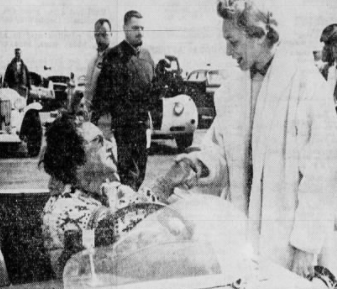
The most famous winner of the event was Maria Fernanda de Menezes Ribeiro (pictured), popularly known as "Speedy Ribeiro". She had been born in Macau itself in 1924 and was the daughter of a diplomat. Her Fiat 1100, which took her to one win and one second place, was her daily driver. She had actually taken part in the 1954 version of the Macau Grand Prix, which was then run as a regularity trial. Her car was a Vauxhall Velox belonging to her father and she was second overall. 

The Ladies' Race was never particularly over-subscribed and reports describe the action one year as "a procession". It was discontinued after the 1959 edition, which was won by Carol Ungricht. Carol was an American driver based in Okinawa, Japan. She also entered the Formula Libre race in 1958.

All-female races were later held at Macau, but they were celebrity events contested by actresses and TV personalities. Jackie Chan promoted one for several seasons.

For a list of female drivers who have attempted the Macau Grand Prix, click here. For a profile of Anne Wong, the only woman to win a race on the Guia circuit, click here.

1955

1. Jean Lam (Jaguar XK120)

2. Wen Lenard (Austin Healey)

1956

Maria Fernanda de Menezes Ribeiro (Fiat 1100)

1957

1. Narcee Matchett (Triumph TR3)

2. Maria Fernanda de Menezes Ribeiro (Fiat 1100)

1958

1. Carol Ungricht (MGA)

2. Narcee Matchett (Triumph TR3)

3. Miss S Anderson (Jaguar XK140)

1959

1. Carol Ungricht (MGA)

Maria Fernanda de Menezes Ribeiro (Fiat 1100)

(Image from macaubusiness.com)

Saturday, 4 October 2025

Jackie Astbury


Jackie Astbury was a British driver who rallied from 1933, in the UK and France. She is normally credited as "Miss J Astbury".

She drove a Wolseley Hornet in the 1933 RAC Rally, which was then held in March, and finished 70th in class 2, having started at Bath. In the summer, she used an MG Magna in the Scottish Rally, having started at the opposite end of England in Harrogate. Her first outing in the Singer Nine which became her regular car was the Ulster Rally in August. In December, she tried a lower-paced event, entering the London to Gloucester Trial in the MG. She won a silver medal for keeping 90% of her starting score.

There was more trial action in 1934, when she took part in the Colmore event in a Singer. Again, she was among the second-class award winners. Driving the Magna this time, she won a first-class award in the trial section of the Women's Automobile and Sports Association's Day in the Hills. 

The biggest brush with fame she had in 1934 was not completely related to her performance on the rally stage. She had protested the result of the Ulster Rally, claiming that she had waited for a signal to leave one stage and not received one, making her late for the Bangor time control. Her protest was upheld and she was promoted to third place, winning herself £20 and the Visitors' Cup in the Singer.

In 1934, she finished the RAC Rally in a Singer. Using the same car, she won the Thistle Cup for best Scottish-starting driver in the 1935 Monte Carlo Rally. Her final finishing position was 50th. She also won her class in the RAC Rally. In between, she competed in the JCC's Brooklands Rally, winning a second-class award. She also travelled back to France for the Criterium International de Tourisme Paris-Nice, finishing 13th behind Grand Prix driver Raymond Sommer. She was second in the Coupe des Dames standings and third in the Light Car class.

In 1936, she repeated her Monte Carlo achievements, still in the Singer, improving her final position to 40th. This was in spite of a double spin on a sharp corner, before she even left Scotland. The Coventry Evening Telegraph acknowledged that she "did well",  taking time to praise her "fair curls in immaculate order" and her "smart khaki driving suit adorned with a Scotch thistle". She took the same car to the Brooklands Rally and won another second-class award, and finished another RAC Rally. Back in France again, she entered the all-female Paris-St. Raphael Rally for the first time, and was sixth overall, behind Betty Haig and Enid Riddell.

Jackie occasionally raced on track, including a run in a ladies' race at Donington in 1935. She was second in a Frazer Nash, behind Fay Taylour in a similar car.

Her motorsport career ends in 1936, although she did present a "Perseverence Prize" at the 1937 Scottish Rally. John M Archer was the winner; this award went to a driver who had entered the rally three or more times and had never previously won a prize. A Sketch report from September 1937 says that she had been "very ill indeed", and that "motoring friends crowded round congratulating her on her recovery" at Shelsley Walsh. This would explain her abrupt disappearance.

She may also have played badminton competitively before she began her motoring career.

(Image from the Brian Goodman Collection)

Thursday, 8 May 2025

Sheleagh Aldersmith


Sheleagh before the 1963 Monte

Sheleagh Aldersmith was a British driver and navigator in the 1960s. She competed in the Monte Carlo Rally many times between 1960 and 1970.

The first success she had at the wheel seems to have been a win in the Cowley & Wilson Trophy in 1957, a navigational event with driving tests and a quiz element organised by the Buckingham and District Motor Club. This had followed a second place in their "Spring Sprints" navigational rally. Her car is not recorded.

Some time between then and 1960, she started competing in stage rallies. A 1962 Worthing Herald news article from 1962 has her as "rally driving for the past two years".

Her first international event was in 1960. She teamed up with the multiple French champion, Claudine Trautmann (then Vanson) for the RAC Rally, driving a Citroen ID19. This was despite There was some confusion over whether they had actually started, but they made progress in Scotland until rolled, having stopped to help Claudine's future husband, Rene Trautmann. Sheleagh continued as a driver of the team's chase car. At the time, some said this was her second RAC Rally. 

As co-driver to Rosemary Seers in 1961, she entered an Triumph Herald in the Tulip Rally, held in the Netherlands. They were 73d overall, seventh in class, from 113 finishers.  Rosemary then switched to an MG Midget for the car-destroying Liege-Sofia-Liege Rally, which had eight finishers. The Seers/Aldersmith car was not among them. It had lost its exhaust system on the Resia Pass going into Italy, then gradually lost power until it expired at Sofia. The lack of an exhaust meant the the car's floor pan got very hot, particularly under the co-driver's feet. Both Sheleagh and Rosemary burnt through the soles of their shoes and had to jump out of the car at time controls. To add insult to injury, they received a speeding ticket in Yugoslavia.

They also drove an MG together on the 1961 RAC Rally and the 1962 Monte, although they did not finish either event. The Midget's gearbox broke on the RAC Rally.

In April, she came to the rescue of Irish driver Pat Barr, who found herself without a navigator for the Circuit of Ireland. Sheleagh answered an advert in the motoring press and cancelled another rally in England the help Pat out. They drove a Mini, but finished over the time limit and were not classified.

She did her first international rally as a driver in 1962, taking on the Tulip Rally, driving an Austin Seven wiht David Howick. She seemed equally happy working with male and female team-mates and was aiming for the mixed team award this time. On the way, she took her friend, Mrs Stromwall, as an additional, unofficial navigator; Mrs Stromwall wanted to visit her daughter in Bruges. Sheleagh was 88th overall.

Teaming up with Pat Barr again, but switching seats, she tackled the Tulip Rally again in 1963. This followed an ignominious exit from that year's Monte, when her road car broke down as she tried to get to the airport on her way to Ostend, the radiator bursting on co-driver Jean Aley's driveway. Later, she tried the Spa-Sofia-Liege event again, driving a Mini for the first time. She and co-driver Michael Nesbitt, a racing mechanic who owned the car, did not finish. The Mini's suspension, brakes and clutch were defeated by poor Yugoslavian roads near Titograd, now Podgorica in modern Montenegro.

Another Monte in 1964 began in Minsk, where she spent some time visiting local hospitals to compare conditions with the UK. She used the a Mini from the same garage as the one she shared with Michael Nesbitt, but had Elizabeth Jones as her co-driver this time. They got as far as the Alps without too much trouble, despite snow and bad Czech fuel, but the Mini was ailing and they went over the time limit trying to finish a special stage on an icy road.

Switching seats with Nesbitt again, she entered the Spa-Sofia-Liege again, but it continued to beat the, the car's radiator giving out this time. 

Another navigating job that year was helping Bill West on his first international rally, that year's RAC Rally. His Mini was a production model, as opposed to the Nerus-engined Hares Garage car Sheleagh was used to. They finished, in spite of changeable weather, including blizzards and fog in Scotland and northern England. The car's suspension had problems and the fan belt came off twice.

1965 was a quieter year. Sheleagh and Pat Walton had another go at the Tulip Rally in a Mini, but did not finish. This was a new car for her; she had elected not to enter the Monte to allow time for it to be prepared.

1966 was also relatively quiet. Sheleagh had been down to co-drive for a garage owner, John Barnes, but a bout of sciatica meant she had to drop out. It was also suggested that the Mini they were hoping to use had too many spotlights to be legal as well.

Another co-driving job came in in May, when she sat beside ED Jenkins for the Austrian Alpine Rally in a Mini. Their finishing position is unknown. 

The Mini was her chosen car in 1967 as well: she and Carolyn Tyler entered the Monte Carlo Rally, described as Sheleagh's sixth attempt. The car was hers, and she and Carolyn had tried it out on the Isle of Wight in October 1966, in a local rally. They won the Coupe des Dames. Unfortunately, they were non-finishers in the Monte itself.

She was set to drive in the RAC Rally with Susan Porch, until it was cancelled due to foot and mouth disease. Susan just wanted to get to the finish, in order to be eligible for the 1968 Monte. 

As a navigator, she entered two more rallies in 1967, in two separate Minis. She partnered Australian Lyndon McLeod for the Tulip Rally and Christopher Coburn for the Alpine Rally, although neither team finished.

Her partnership with Christopher Coburn continued for another two seasons, always with her in the navigator's seat. In 1968, they drove a Mini on the Monte, her seventh edition and his first. Their rally ended stuck in a bramble bush, going over the time limit in order to free themselves.

Their final event together was Sheleagh's last international rally. It was the 1969 Monte, driving a Vauxhall Viva. The alternator became faulty shortly after the start and they did not finish.

A hospital doctor and consultant in physical medicine, she was usually referred to as “Dr. S Aldersmith”, and has been described as "formidable". That said, she told the Worthing Herald in 1962 that her parents would not allow her to learn to drive, and she had to wait until she had qualified until she began "eight years ago". She had been practising medicine since at least 1954, when she worked in Nottingham. This was after she contracted polio in 1952, which must have necessitated time off work and sporting activity. She later lived in the south of England, at Rustington. She was sometimes a member of the circuit medical team at Goodwood, Silverstone and Brands Hatch, and the first woman to serve as a medical officer at the British Grand Prix.

As well as motorsport, she took an interest in flying and gliding and was one of the donors towards the 1954 World Championship Appeal Fund.

She died in 2002, aged 78. Her given name appears to have been "Sheila" on her birth certificate, but she used the spelling "Sheleagh" to refer to herself.

(Image copyright Worthing Herald)

Saturday, 12 April 2025

Jenny Tudor-Owen


Jenny Tudor-Owen raced and rallied, mostly in Europe, during the 1960s. She normally drove British cars.

Her first car, lent to her in 1962 by John Coombs, was a Mini, which she crashed. Her then-boyfriend Mike Parkes built her another Mini, in which she qualified on pole for her first race at Brands Hatch, only to over-rev on the startline due to valve bounce. 

She quickly moved on to an MGB. This particular car is the one most associated with her, and she raced several different versions. The first of these was run by Barwells in 1963. 

In 1964, she was fourth in the Copenhagen Cup at the Roskildering. Her MGB was the first one to race in Denmark.

Tracking down her race results has proved difficult, but she did enter at least some of the Freddie Dixon Challenge Trophy and other club meetings organised by the BARC and BRSCC. The MGB was often up against much more powerful cars, such as Ferrari 250s and Jaguar E-Types. Among her rivals were Jackie Stewart, Bernard Unett and Alan Minshaw. Her best result in the MG, in the UK at least, was a fifth place at Oulton Park in June. Later in the year, she tried out a Lotus Elan for a couple of races, and she was third at Mallory Park in a 1600cc GT race. 

The Elan was her main focus in 1965, although it looks to have been a much shorter season for her. The biggest event on her calendar was an early-season race at Goodwood for small-engined sportscars, in which she was eleventh. She also tried out single-seaters, in the shape of a Formula Vee. 

After another spell in the MGB, which included an entry in a BWRDC ladies' race at Oulton Park in 1967, she acquired a Jaguar E-Type, which she used in 1967 and 1968, winning the 1968 BWRDC Racing championship following an outright second place at Thruxton. She had been leading the race on a wet track and recovered from a spin to hold on to the runner-up spot.

Racing a Bamford MGB at Oulton Park in October 1968, she managed to crash during practice and write off the car at Cascades. Her accident was overshadowed by James Hunt famously throwing an Alexis Formula Ford in the lake at the same meeting. That year, she also raced an E-Type for Warren Pearce's team. 

On the rallying side, she is best known for her Coupe des Dames in the 1968 London-Sydney Marathon, driving a Volvo 145. She was part of a four-woman team with Elsie Gadd, Anthea Castell and Sheila Kemp. The car belonged to Elsie Gadd, who had no rallying experience, so she hired Jenny and Sheila as her lead drivers. They were 41st overall, just in front of Jean Denton’s MGB, which had been the favourite for the Ladies’ prize. They had their share of troubles, including a fire in the car's battery in the closing stages in Australia, and large cracks in the car's bodywork, which needed to be welded, after crossing the gravel roads of Turkey and the Middle East.

After the London-Sydney, Jenny disappears from the entry lists. Her marriage ended and she seemed to retire from motorsport completely, although she occasionally popped up in the papers. One such appearance was in the Kent Evening Post in 1970, where the "really expert driver" opined that other women drivers "don't concentrate enough".

She moved to America and then South Africa, where she used her skills at the wheel as a film stunt performer. She also bred Pekinese dogs successfully.

(Image courtesy of Greening Australia)

Thursday, 6 July 2023

Sybil Lupp


Sybil Lupp was New Zealand’s first female racing driver. 

Her interest in cars began on the engineering side in the 1930s, and she was one of New Zealand’s first female mechanics, taking a job at JG Ingrams garage in 1938. She started racing after her second marriage, in 1947. She took part in the first hillclimb organised by the Otago Automobile Club.


Initially, she only drove in hillclimbs, scoring several wins in MG cars. She had learned to drive aged eleven and her first car was an MG M-Type, bought for her by her father three years later. The Australian Women’s Weekly reported in November 1948 that Sybil had won her second Otago hillclimb championship in succession, and that she held their circuit’s track record. Her records included the full hillclimb for her class and for the standing quarter-mile sprint.


Circuit racing was quite slow to get going in New Zealand after the Second World War, having been quite sporadic before that anyway. In 1949, she entered the first road race held in the country, the appropriately-named Road Racing Championship. The event was a 105-mile circuit, consisting of 50 laps of an aerodrome. She drove an MG TC and was fifth on scratch, fourth on handicap.


In 1950, she was second in the same race, driving the TC, and first on handicap. She had made considerable progress from twelfth on the grid.


After a year when she does not appear to have raced at all, she returned with an MG TD in 1952. She was seventh in both the Lady Wigram Trophy and the CWF Hamilton Trophy. The RRC’s original organisers had switched their attentions to another track and the Lady Wigram Trophy was its replacement. Her Wigram result was another run from the back of the grid. The CWF Hamilton event was held at the 4km Mairehau circuit, run over 40 laps. Sybil had been given a substantial ten-minute handicap.


In 1953, she changed from an MG to a Jaguar XK-120. In this car, she was seventh in the CWF Hamilton Trophy, driving with “HR Brown”, who was a Dr Bruce Hay driving under a pseudonym. Driving solo, she was seventh in the fifth RRC, now held at Dunedin. 


As well as racing, she was one of the founder members of the Otago Motor Association, and ran a series of garages and car dealerships. Her first marriage ended when Jack Lupp died in 1945; two years later, she married his brother Percival. They divorced in 1961. After 1969, when she married Lionel Archer, she was known as Sybil Archer. They had been partners in a Jaguar garage.


Despite her choice of occupation, Sybil always distanced herself from “women’s lib” and claimed that a woman should be led by her man, although she also bragged about being quicker than her husband early in her career.


She died in 1994, aged 78.


(Image copyright Wellington Evening Post)


Sunday, 21 November 2021

Marion Lowe


Marion Lowe raced on both the East and West coast of the USA in the 1950s. She was one of several women drivers who got their start in the ladies’ races that were common at the time, but moved into mixed competition.

Her first car was an MG TD, bought for her as a birthday present by her British husband, Jim. The couple often raced together, with Marion, who was younger than Jim, often being the faster driver. Unlike many other couples, they preferred to compete against one another, rather than share cars. They lived in California where they ran a timber firm, but their considerable wealth allowed them to travel extensively in order to compete.

She was second in her first race, a ladies’ event at Torrey Pines in California, in 1952. Josie von Neumann was the winner. Marion was one of the older novices on the scene at 44; Josie was 18 at the time.

She continued to race the MG the following year, entering her first open event, the SCCA Nationals held at March airfield in Riverside. Competing against the likes of Masten Gregory and Briggs Cunningham, she was 17th overall and third in her class. Jim had paid for significant upgrades to the MG in the off-season.

The MG was exchanged for another British car for the start of the 1954 season. Her first race win came at her first meeting of the year, driving a Frazer Nash Le Mans Replica. She beat ten other women and five male drivers competing in a different class at Bakersfield. Later in the year, she was seventh in an SCCA National race held at Seattle Seafair.

Marion and Jim owned both the Le Mans Replica and a Targa Florio Frazer Nash, taking turns to drive both. The Seafair race was her first major event in the Targa Florio and she continued to use it throughout 1955. In it, she won ladies’ races at Stockton and Santa Rosa. In mixed competition, she was eighth in a National preliminary race at Seafair and ninth in another race at the Sacramento Nationals. At the end of the year, she made her first trip to compete abroad, travelling to the Bahamas for Speed Week with the Targa Florio. She entered the Governor’s Trophy, racing against such luminaries as Phil Hill, Stirling Moss and Alfonso de Portago, and was 31st, from 42 finishers.

Lou Brero, who had raced against her at Nassau in 1955, offered her a drive in his D-Type Jaguar for the ladies’ races of the 1956 Nassau Speed Week. She was ninth in the first heat but won the second. For the open events, she drove the Targa Florio, finishing 29th in the Nassau Trophy and 31st again in the Governor’s Trophy. On the mainland, she won ladies’ races at Santa Barbara and Palm Springs, this time in the Le Mans Replica.

She did not go to Nassau in 1957, although she did debut a new car at the inaugural Hawaii Sports Car Week in April. She was fourth in a preliminary race in an Alfa Romeo Giulietta, then sixth in the corresponding main race. Her next event was the Luther Burbank Rose Festival Sports Car Road Races, held at the Cotati airfield course. She was disqualified from her heat for receiving a push start in the Alfa, but she got to start the main six-hour race alongside Al Coppel in his Renault Spyder Le Mans. They did not finish due to a broken valve.

The Alfa was her preferred car for the 1958 sportscar season and earned her podium finishes in ladies’ races at Laguna Seca and Vaca Valley. She and Jim had also bought themselves his and hers Lotus Elevens, and Marion used hers to good effect. She was fourth in an SCCA Regional race at Laguna Seca, just behind Jim in his Eleven.

The Lotus starred in Marion’s return to Nassau. She won both heats of the ladies’ race, ahead of Evelyn Mull’s Eleven. Teaming up with Denise McCluggage in the car, she was ninth in the Nassau Trophy. The team won their class, with Jim’s Lotus second and 17th overall.

Her final year in sportscar racing began with a win in a ladies’ race at Laguna Seca, followed by another at Riverside a week later. In mixed competition, she was fourth in a November race at Hourglass Field. What would be her final Nassau appearance began with a DNF in the Governor’s Trophy, having finished 17th in the preliminary race. She was second in the ladies’ event, winning one of the heats and finishing second to fellow Eleven driver Prudence Baxter in the other. Both she and Jim failed to finish the Governor’s Trophy.

She was still competing in 1960 and even moved into single-seater racing in the form of Formula Junior. Her car was a BMC Mk1, built by Joe Huffaker from British BMC A-series parts. This year’s calendar included the Stockton Road Races, in which she was sixth. 

Jim’s health began to fail in 1961 and both retired from motorsport that year. Their relationship broke down in the following years and they divorced in 1965.


(Image copyright Santa Cruz Sentinel)

Saturday, 21 August 2021

Micki Vandervell (Chittenden)


Micki Vandervell, also known as Micki Chittenden, raced at national level in the UK in the 1970s. 

She was a member of the Vandervell racing family, the niece of legendary car designer Tony Vandervell and the cousin of racer Colin Vandervell. “Micki” was short for Michaela.

Her earliest adventures in motorsport were in autocross, driving a Mini in 1967. She gained some attention early on, not due to her family connections, but to finishing third in one of her first races in 1968 with a wrist in plaster. The event was at Sherwood Farm in Drayton and she won the ladies’ trophy.

By 1969, she was racing a Mini on track as well as on the dirt circuits of autocross, mainly in the south of England. At the end of the year, she took the Mini to Lydden Hill for the Grandstand Trophy, which was broadcast on BBC television. 

She continued to race the Mini in 1970, including at least one run in the Triplex Saloon Championship at Silverstone and an appearance at Brands Hatch. According to newspaper reports, she combined her racing with a job as a lab technician.

In 1971, she was part of "The Carmen Curls", an all-female racing team who competed in Formula F100. She raced a Royale sportscar alongside Gabriel Konig. The team was sponsored by Carmen hair products (“The House of Carmen”), and managed by Tina Lanfranchi. Among the four team officials was Roz Hanby, who later found fame as the face of British Airways. Neither of the team’s drivers completed the whole 20-round season and Micki was not as quick as Gabriel. She was thirteenth in the championship, which folded at the end of 1971.

She was an enthusiastic early member of the BWRDC, and competed in their women-only events. Her best result in one of these was a third place in the “Fast Girls Consul Challenge”, held at Brands Hatch in 1972 as a support to the Rothmans Formula 5000 championship. Gillian Fortescue-Thomas was the winner, ahead of Jenny Birrell and Micki, who finished ahead of her Carmen Curls team-mate Gabriel Konig. 

Much later, she took part in the Brands Hatch rounds of the 1976 Shellsport Ladies’ Escort series, scoring two seventh and one eleventh place.

For at least part of 1973, she raced an MG Midget in the STP Production Sports Car Championship.

She raced less often after her marriage to Mike Chittenden. Tiffany Chittenden and karter Tamsin Germain are her daughters.


(Image copyright Reading Evening Post)

Tuesday, 14 July 2020

Josie von Neumann


Josie von Neumann raced sportscars in America in the 1950s. She was one of the most talented of the many female drivers on the US sportscar scene of the time.

Her earliest outings were ladies’ races in an MG TD. She won her first race, a five-lap ladies’ handicap at Torrey Pines in 1951, laying down a gauntlet for the entrants in a burgeoning women’s racing scene centred around the Women’s Sports Car Club in California.

Early in her career, she raced an Allard J2 special with a Cadillac engine. In 1952, Josie continued to be the woman to beat in it. The car belonged to Bud and Gwen Goodwin and it was considered a very challenging car to drive. Josie won a ladies’ race at Madera in it. Throughout her career, she often had access to very good cars, due to her family connections. John von Neumann was her stepfather who had become her adoptive father and he had a considerable stable of cars. The red and white TD had been a birthday present from him. Later on, her mother Eleanor was the family’s titular entrant after doing well out of her divorce from John. The von Neumanns helped many notable drivers at the start of their careers, including Richie Ginther and Phil Hill. John also ran a Porsche 550 for future Le Mans winner Ken Miles in 1956. The Women’s Sports Car Club itself was closely associated with the California Sports Car Club (CSCC), of which Ken Miles was a leading member. He was the editor of the club magazine and Josie had her own column.

Always a fan of European cars like the rest of the CSCC, she had continued success in ladies’ races in a Porsche 356 in 1953 and 1954. A Ferrari 500 Mondial followed and it was in this car that she branched out from ladies’ races and started making an impression in the main draw. She entered SCCA events at Bakersfield, Torrey Pines and Glendale. She did best at her favoured track of Torrey Pines, finishing tenth overall and first in class. Carroll Shelby was the winner and Phil Hill was second, driving with John von Neumann. Both were in Ferraris.

She shared the same car with Richie Ginther at the Santa Maria airport track in 1956. This was a difficult and dangerous course that was only used for a couple of seasons. They were fifth overall in the Ferrari. Contemporary newspaper reports suggest that Josie had been planning to use a Porsche 550, but that car was driven by Ken Miles that year, entered by John von Neumann. At about this time, Josie took a break from the track, married John McLaughlin and had a son.

In 1958 and 1959 she returned and drove a Ferrari 250 Testa Rossa. This was a sought-after car at the time. Josie’s detractors liked to claim that she was not the fastest of the Californian ladies, merely that she had better cars than everyone else, but she was a steady pair of hands who was capable of handling very fast machinery. Her rivals sometimes appeared to be out of their depth in cars of the calibre of the Testa Rossa.

She was fifth in the SCCA Nationals at Vaca Valley in 1958, behind her father, who was her team-mate and the race winner. She was also second in a Modified race at Del Mar, a round of the Pacific Coast Championship. This year, she was almost unbeatable in ladies’ races, racking up at least eleven victories on her way to a Pacific Coast women’s title.

In 1959 she concentrated more on open events, entering only a few women-only races. She was fourth in the Avandaro GP and eleventh in the LA Times GP in the Testa Rossa. She was also fourteenth and 16th in the Riverside and Vaca Valley USAC races. This was significant as she would become the first woman to receive a full USAC racing license that year, allowing her to compete as a professional. Her appearance in the Riverside 200 Miles was her first “big” USAC race and she was eleventh, despite admitting to being nervous and only expecting to finish. Josie’s interviews at the time reveal a personality at odds with her list of results; she claimed that women were naturally less good drivers than men and that they were often more nervous. Todd McCarthy, in his book about the US sportscar scene “Fast Women”, speculates that it was the longer races she found hard.

1959 was also the year that she first competed internationally. The East Coast racing fraternity usually decamped to the Bahamas in December for Nassau Speed Week, but West Coast stalwart Josie joined them this year with the Ferrari. Competing against the likes of Stirling Moss, Richie Ginther and Dan Gurney, she was 16th in the Governor’s Trophy for cars over 2000cc. Her best result was a fifth place in the Ferrari race, which was won by Phil Hill in a later TR.

Much earlier in the year, she raced in Mexico for the first time. Josie was third in the Lago de Guadalupe, sandwiched between famous brothers Ricardo and Pedro Rodriguez who were second and fourth respectively.

After 1959, she disappeared from the scene, despite being in possession of a full USAC license and considerable experience. She moved away from her previous home with her son and lived among a huge menagerie of animals, including as many as twenty cats. She died in 1997, aged 64.


Younger women were coming through and becoming more competitive, but the American sportscar racing scene was becoming increasingly professionalised and the both the Women’s Sports Car Club and the CSCC were in decline.

Wednesday, 24 June 2020

Alison Davis


Alison Davis was one of Britain's most successful female club racers and the first woman to win a club championship outright. 

She won the 1979 BRDC Production Sportscar Championship in a Ginetta G15 and also won races in the 1984 MG Metro Challenge. 

The first racing car that she owned was a Diva GT which she and her husband Roger bought from Frank Williams in 1970. Before that, she had done some hillclimbs and sprints in borrowed cars or her roadgoing Austin Healey. The Diva helped her to transition from speed events to wheel-to-wheel racing but it was replaced for the 1971 season by a Ginetta G15.

The Ginetta was her most successful car; it also gave her a string of class wins in the few-holds-barred Modsports championship 1971 and 1972. She was voted Driver of the Day at Brands Hatch in 1972 and won the British Women Racing Drivers’ Club’s Embassy Trophy for the best performance by a club member in circuit racing. This was one of a collection of trophies she earned that year.

Alison’s time in Modsports was supported by an unusual sponsor: feminine hygiene product Femfresh. She even appeared in 19 magazine as part of a promotional competition where a reader could win herself a Ginetta sportscar.

The Femfresh G15 was sold at the end of the 1972 season. Alison experimented with a number of different cars. She was a leading competitor in the BWRDC Shellsport Ladies’ Escort series, finishing second in the 1976 and 1977 championships with several wins. Two further standalone ladies’ races were held in 1978 and Alison won one of them. 

One of the cars she raced was a Fiat 124ST and it was this that she used on the 1973 Avon Tour of Britain. She was partnered by Sheila Scott, a pilot. They competed against eventual winner James Hunt, Graham Hill, Rosemary Smith and others.

Most of her outings during this time were in production saloons. She often competed alone, but sometimes teamed up with other drivers, including future Le Mans starter Juliette Slaughter, with whom she shared a Triumph TR7.

Coming back to a Ginetta brought her back to winning ways in 1979. Her new car was a yellow G15 that she and Roger converted from road spec. It always carried the number 33 and became a common and popular sight in parc ferme. Alison had the most successful year of her career in it, winning the BRDC Prodsports championship with a clean sweep of class wins. This was the first time a woman had won a British racing championship outright and she was awarded the BWRDC Wakefield Trophy, for outstanding contribution to motorsport by a woman. 

The trophy was not just the result of her BRDC Prodsports win. Her BRDC campaign was run in tandem with a strong attempt on the similar BRSCC CAV championship, finishing second ten times and setting three lap records at Silverstone, Castle Combe and Brands Hatch.

Although she did not win the championship again outright, she was joint champion in the DB Prodsports series in 1981, winning five times. In between, she scored two further wins and twelve second places in the 1980 season.

Despite her success in the Ginetta, Alison moved on to an MG Metro for the 1982 MG Metro Challenge. It was a steep learning curve for her and she crashed out of her first race. She made up for this by becoming a permanent fixture in the top six by the end of the season. This continued during the 1983 season while Roger and her team of mechanics got to grips with the Metro.

In 1984, she was offered a seat in Terry Drury’s Alfa Romeo GTV for the Tourist Trophy Six Hours at Silverstone. According to newspaper reports at the time, she had to embark on a funding drive to be able to take up her drive. She managed it, although she and Paul Everett were unable to finish the race itself.

For the Metro series itself, she was sponsored by the Melitta coffee brand.

Away from this disappointment, the team had finally got to grips with the Metro and Alison was flying at last. She won the first three races of the 1984 championship and cemented her reputation as a wet-track specialist with a victory at a rainy Silverstone. After her third win, a protest was lodged and she was accused of having an illegal car. A thorough examination by the scrutineers proved this allegation to be false and probably the result of wounded male pride.

Alison left motorsport on a high, as a leading driver in Metros and in Prodsports. She turned to showing Irish draught horses and entered the Horse of the Year Show on five occasions.

Her husband Roger points out that she would have been eligible for membership of the British Racing Drivers’ Club, but it would be another few years before that august organisation permitted female members.

(Thanks to Roger Davis for the information and picture)

Friday, 10 April 2020

Jayne Auden-Row


Jayne Auden-Row is a regular on the UK club rallying scene and Britain’s only hearing-impaired rally driver.

She has been competing in the UK since 2001, initially as a co-driver. She was soon winning class titles in the BTRDA rally series. She started off competing in the North of England, co-driven by her father, but was soon driving all round the UK. An early career highlight was a fourteenth place in the 2003 Roskirk Stages.

Her first couple of rallies were single-stage events on asphalt, but she gravitated towards gravel and began competing almost exclusively on loose surfaces in 2005.

She kept using a Peugeot 106 until 2007, when she changed to a Super 1600-spec green MG ZR part-way through the season. Jayne was a member of the “Babes in the Wood” rally team in 2007 alongside Amanda Cornforth and Shelly Taunt. They were tenth in the BTRDA team standings. Jayne’s best finish was third in class in the Cambrian Rally, 66th overall. She rolled the ZR during her final event, the Grizedale Stages, but was unhurt. She did, however, rally a different ZR for her first 2009 outing, the Malcolm Wilson Rally. 

She continued to drive the rejuvenated ZR through 2008 and 2009, usually in BTRDA rallies, picking up class and club championships including the ANWMC ladies’ award. The car remained reliable, getting to the finish of eleven out fourteen rallies.

Co-driven by her father Dave Auden once more, she rallied the ZR in BTRDA rallies in 2010 and 2011. It was still going strong for the 2012 season; she competed in all eight BTRDA rounds, and was ninth in the 1400cc championship. She was also third in the MGZR class, and won the ladies' prize. 

Continuing with the ZR, Jayne carried on rallying in 2013, mainly in BTRDA events. Her best finish was fourteenth on the Wales Rally GB National event. This was the first of four Rally GBs for Jayne and her best overall finish, although she managed class seconds in 2014 and 2016. 

Wales Rally GB was her strongest finish of 2014. She did an extensive programme of BTRDA rallies and finished every one, netting herself eighth in the 1400S class.  

Her 2015 schedule was very similar, including a run in the National event of the Wales Rally GB. Her best result came from a one-off drive in a Mitsubishi Lancer, with former team-mate, Amanda Cornforth, co-driving. She was 22nd overall in the Phoenix Stages. She was reunited with the Lancer for the Cambrian Rally in October, although she and Dave Auden did not do as well.

In 2016, she contested the Welsh Forest championship, switching between the Lancer and the ZR. Her second Phoenix Stages in the Lancer gave her a strong 17th place, co-driven by Chris Row. The pair were married by now, having been in a relationship for the past few years.
Her best result in the MG was when she was 46th in the Wales Rally GB National event and second in her class. 

A break ensued while Jayne had her first child then she returned to rallying in 2018, first as a co-driver. She returned to the driver's seat in 2019 and did three BTRDA events in her trusty MG ZR. Her father Dave was sharing her now-famous “Green Machine” as his own car was not ready. She rallied the MG in one event in 2021, the Visit Conwy Cambrian Rally, but did not finish. It came out for another single appearance in 2022, the Neil Howard Stages at Oulton Park. Jane and David were 63rd overall.

(Image copyright Manchester Evening News)

Tuesday, 10 March 2020

The Oulton Park Ladies' Handicap


This picture was possibly taken at the Ladies' Handicap. Gabriel Konig is in dark overalls and Rosemary Smith is next to her in a raincoat

A Ladies’ Handicap was held at Oulton Park in April 1967, during the Spring Trophy. Most of its entrants came from the British Women Racing Drivers’ Club.

The race was held over ten laps and was a handicap for saloons and sportscars. It formed part of a “ladies day” held at the circuit, which also included a fashion show sponsored by local department store Browns of Chester. Rosemary Smith was promoting her “Rally Girl” clothing line at the time and her designs were modelled at the show. The event was in aid of the International Grand Prix Medical Service.

Eleven drivers started. Three of them, Anita Taylor, Mary Wheeler and Gabriel Konig, had competed in the Fast Girl Trophy four years earlier. Gabriel Konig, winner of the Fast Girl Trophy, was the winner of the handicap. No incidents were reported.

Results

  1. Gabriel Konig (Austin Healey Sebring Sprite)
  2. Mary Taylor (MGB)
  3. Anita Taylor (Ford Lotus Cortina)
  4. Margaret Cooper (Alfa Romeo GTC)
  5. Jean Denton (MGB)
  6. Natalie Goodwin (Ford Lotus Cortina)

(Image copyright BWRDC)

Friday, 30 September 2016

Gabriel Konig


Gabriel with her Modsports MG

Gabriel Konig (not Gabrielle) was a much-travelled Irish driver who competed off and on from 1962. She was most successful in MG Midgets and a Chevrolet Camaro, winning 18 races in different series, at club and National level mostly.

Living at her mother’s Beaulieu House near Drogheda, she learned to drive very young; at ten, she was able to drive a tractor. She was a regular spectator at motor races with her mother, attending events at Dundrod and Curragh. She earned her driving license at seventeen, then four years later, began racing. By this time, she was married to Mark Konig, another racing driver and car builder, and living in London. Her first racing car was a Lotus Elite. A Lotus Elan soon followed. She rarely raced in her home country, but was a regular face on the scene in England, and also in continental Europe. In 1964, she was twelfth in the Tourist Trophy at Goodwood, in the Elan. The following year, she shared the Elan with Mark for the Nürburgring 1000km, driving for the WJ Moss team. They did not finish due to gearbox problems. That year, 1965, she entered the Autosport Championship in the Elan. Later in the year, she raced a much more powerful Ferrari 250 GTO at Silverstone, but crashed out.

In 1966, she took her first race win, driving a Hillman Imp. This was a National-level race at Mallory Park. This year, she returned to smaller cars, and was rewarded with results that went with her level of experience.

After a quiet 1967, during which she may have raced an Austin-Healey Sebring Sprite, she was taken on by John Brittan’s team in 1968. The car she was given was an MG Midget, and she raced in the Modsports series. This style of competition suited her well, and she ended the year with fifteen class wins. One of her best overall results was fourth at Mallory Park, with a win in the 1150cc class. The year before, she had been a member of the Ring Free Oil “Motor Maids” team in the USA, and had travelled to America for the Daytona and Sebring sportscar races. However, she seems to have been a reserve driver, and did not get to race. Her winning year in 1968 must have gone some way to making up for that.

Her first international win came in 1969. She was first at Fassberg in Germany, driving an Austin-Healey Sprite. The Brittan MG was still competitive, and she travelled to Italy to race in the Mugello Grand Prix, with Garo Nigogosian. They were 31st, fifth in class, from 65 finishers. Also in Italy, Gabriel and Mark did the Targa Florio together, in the Nomad MkII. This car had been designed and built by Mark, and was powered by a BRM F1 engine. Sadly, an accident caused by a puncture put them out of the event on their third lap.

1970 was another year affected by accidents. Gabriel did not do much racing at all this year, as she suffered broken vertebrae in an accident in Brazil. She had been driving in a Formula Ford race at Sao Paulo, and crashed when the steering on her car failed. She was not permanently injured, but had to take almost a year out to recover.

Early in the following year, she returned to UK club racing as part of the “Carmen Curls”, an all-female team who raced a Royale in Formula F100. They were sponsored by Carmen hairstyling products, and Tina Lanfranchi was the team manager. Formula F100 was a poorly-supported series which folded at the end of the year and the Carmen Curls disappeared with it.

In 1972 her career went international again, with her first attempt at the Spa 24 Hours. She drove a Chevrolet Camaro with Marie-Claude Beaumont, a driver with considerable experience of both Chevrolet power and endurance racing. Sadly, they did not finish, due to a loss of oil pressure.

Despite her experience, Gabriel liked the car, and bought it to race for the 1972 season. She competed in the Irish Group 2 championship, now that motor racing had grown in her home country. At the end of 1972, she had it shipped to Guyana, where she would live and race for the next twenty years.

One of her first sporting appointments was joining the BOAC Speedbird team, which took British-based racers to the Caribbean, in partnership with the Guyana Motor Racing Club. Gordon Spice was one of her team-mates. She won at least two races in the Camaro at the South Dakota track in Guyana, and was second at Bushy Park in Barbados.

Among the cars that she raced during her Caribbean years was a Byldenstein Vauxhall Viva, built as a sister car to Gerry Marshall’s famous “Old Nail”. In this car, she won at least one race at Waller Field in Trinidad, in 1976.

During her time in Guyana, she raced again in Barbados. She was part of the group of enthusiasts initially responsible for bringing UK-based drivers to Barbados for its annual rally, something which continues to this day.

Gabriel was one of the founder members of the British Women Racing Drivers’ Club, one of the first group of drivers to be invited to join. In 1968 and 1972, she received awards from the BWRDC for being the highest-achieving female driver in the British Isles.

She also rallied in the UK more recently, doing some classic events in a Ford Escort, among other cars, including a Hillman Imp and an Austin A40. In 1997, she entered the Tour Auto in France, driving a Vauxhall GT. Latterly, she owned her own motor museum at Beaulieu, based around a collection of her own racing cars.

She died in January 2013.

(Image from http://www.backroads.ie/forums)

Thursday, 2 June 2016

Jean Denton


Jean Denton with her MGB

Jean Denton was an international rally driver between 1969 and 1972, after some years as a circuit racer.

She did particularly well in long-distance events, such as the 1968 London-Sydney rally, in which she won the sportscar class in her MGB. Her co-driver was Tom Boyce, a Canadian who had been a friend of Jean and her husband Tony at the London School of Economics, where they all studied. They were 42nd overall, out of 56 finishers and 100 starters. Jean was just pipped to the Coupe des Dames by the Volvo crew led by Elsie Gadd, who were 41st. The MGB was sponsored by Nova, an influential fashion magazine of the time. Jean was a marketing consultant for IPC Magazines, who knew how to use her contacts well.

In the 1970 World Cup event, which ended in Mexico, she, Pat Wright and Liz Crellin were eighteenth in a Morris 1800. Again, they did not manage to get the Ladies’ award, which went to tenth-place finisher, Rosemary Smith, in an Austin Maxi. Jean, however, did manage to secure another good sponsorship package. The car was nicknamed “The Beauty Box”, and was sponsored by Woman magazine.

Jean usually drove BMC/Leyland cars, including an Austin–Healey Sprite in the 1970 RAC Rally. It is not clear whether or not she and co-driver Sandy Lawson finished.

Despite her usual loyalty to British power, she drove a Fiat 128 on the RAC Rally in 1972. Her co-driver was the experienced Elma Lewsey, and they were 80th.

Rallying was not her first love, but her motorsport career had a far from orthodox trajectory. Her background was academic, and not particularly sporty. She did not even learn to drive until 1961, when she was 26. Just four years later, she was competing in a Cooper single-seater that had previously belonged to Jackie Stewart. In this car, she was ninth in the 1965 Leinster Trophy, in Ireland.

In between, she drove a Mini in British club races, although she sometimes found it lacking in power. The Mini was her first racing car, and she began driving it shortly after passing her driving test.

After a while, the expense of maintaining the Cooper to a competitive standard became too much, and Jean took a sideways step into sportscar racing. Her first experiences in a sports racer were in a Morgan Plus 4, much earlier, in 1964. In this car, she won a Ladies’ Handicap at Brands Hatch, organised by the London Motor Club.

In 1966, she started racing a heavily tuned MGB on the British circuits. Her first major race in this car seems to have been that year’s Brands Hatch 500 Miles. Driving with her husband, Tony, Jean was twelfth overall.

Another year of racing the MGB in the UK followed, although details are a little sketchy. One of the races she entered was a Ladies’ Handicap, part of the Oulton Park Spring Cup. This event was associated with the British Women Racing Drivers’ Club, of which Jean was a long-standing member. She was fifth overall.

In 1968, her career went pan-European, with appearances in races at Vila Real, Montes Claros and Mugello. Sadly, the results seem to have been lost. She entered the Nürburgring 1000km with fellow BWRDC member, Natalie Goodwin, but they did not finish. This was a big race, a round of the World Championship for Makes, and won by Jo Siffert and Vic Elford, in a Porsche 908.

This year, she won the second of her British Women’s Racing championships, awarded by the BWRDC.
A second attempt at the Nürburgring 1000km in 1969 led to a finish, in 36th place. Jean was driving an MGB for her own team, and assisted by Mike Garton. The pair raced together in Europe at least twice more that year, at Mugello and Barcelona, but did not make the finish either time.

Jean only became a rally driver through a coincidence. She was apparently at the dentist’s, and found out that the dentist rallied himself. She thought it sounded like a good idea, and got in touch with Tom Boyce again, who, she knew, owned a rally-prepared MG. Her husband, Tony, was unsuitable as a co-driver, as he often suffered motion sickness when a passenger in fast cars. Thus began the professional part of her motorsport career, in 1968, from very unlikely origins.

After 1972, she retired from active competition, and returned to the world of business. Bringing her race and rally experience with her, she worked in corporate communications in the motor industry, up to and including being the head of that department in the MG Rover Group, previously her staunchly-supported British Leyland. She was the most senior woman in the British motor industry.

Later, she became a Conservative politician and a Cabinet member, at first in the Trade and Industry Office, and then in 1994, the Northern Ireland Office, until the Conservatives were deposed in 1997. She was made Baroness Denton of Wakefield in recognition of her achievements.

 She died in 2001, of cancer. Before her death, she used her influence and organisational skills to set up a support group called “Women On The Move Against Cancer.”

She is fondly remembered in motorsport circles as being down-to-earth and funny, as well as being a good driver and a highly organised team co-ordinator.

(Image copyright Alamy)

Sunday, 24 April 2016

Irene Schwedler (Charlotte Sadler)


Charlotte Schwedler's pilot's license photo

Irene Schwedler was part of the Brooklands ladies’ racing “set”, and an occasional rally driver. Her later, post-war career was in rallying, and under a new name, Charlotte Sadler.

She was born in Germany in 1906, and was originally named Ilse Charlotte. Racing-related records tend to refer to her as Irene, but she did not use this name personally, going by Charlotte or Carlotta, Lotta for short. It is not clear where "Irene" came from - possibly an administrative error somewhere.

Charlotte was a German national. She had come to live in England in 1923, in order to work as a nanny. She had several different jobs as an adult. At some point, she apparently owned a shop in Luton. Her pilot's license gives her occupation as “private secretary”. Other records have her as a “garage proprietress”.

During her early time in England, Charlotte took up motorcycling and toured the country. Back in Germany, her father and two sisters were also keen adventurers, with a preference for motorcycles. She seems to have been the first racing driver in the family; according to her nephew, she first raced at Brooklands in 1928, practising for a Ladies' race in an Alvis. She did not make the start due to a piston failure. A year later, she lapped Brooklands as a passenger in an MG Midget, before finally getting to compete in earnest herself.

The earliest media mention of her seems to be as a competitor in the Women’s Sport and Automobile Association (WASA)’s Lands End Trial in 1930, driving an MG. In a similar car, she entered a Ladies' race at Brooklands in March. 

She began racing an Alvis Speed 20 at Brooklands at the start of the 1930s, when she was in her mid-twenties. The car was a new model in 1931. A few years later, in 1934, Charlotte’s Alvis was described as belonging to a C.G.H. Dunham, although this may not be the same car. A small article in the Triple-M Register Bulletin from November 2015 states that Gerald Dunham was a personal friend of Charlotte’s, and that she raced more than one Alvis from his own showroom. Both Dunham and Charlotte lived in Luton.

Her first major Brooklands appearance was a Ladies' Handicap in 1931, in which she was third, in a 1645cc Alvis. There were eight entrants in the race, and she was behind Fay Taylour in a Talbot, and Elsie Wisdom in an Invicta.

In June 1932, she took part in the BARC Inter-Club Meeting at Brooklands. She was representing the Women’s Sport and Automobile Association. Her third place in a nine-mile handicap helped the club to second in the Stanley Cup, for the best club team of the day. Her team-mates were Geraldine Hedges and Margaret Allan.

At the same meeting in 1933, her individual performance was better; she won the Lightning Short Handicap, her first major Brooklands victory. The WASA team was second. This time, she was driving the Speed 20 that probably belonged to Gerald Dunham. At the Whit Monday meeting, she was one of the first female drivers to enter a mixed race organised by the BARC at Brooklands, when she drove in the Cobham Senior Short Handicap.

During her racing career, she often drove alongside other female drivers in the team relays and match races which happened at Brooklands. Her best performance in a relay was third, in the 1934 Light Car Club event, driving an MG Magnette alongside Margaret Allan and Doreen Evans. Despite their superior performance, they were denied a Le Mans place in favour of Kay Petre's Singer team, who had exploited a loophole in the rules that the Ladies' Cup, and the Le Mans entry that went with it, was not awarded to anyone finishing in the top three. The Singer crew had found a copy of the MG pit notes, and successfully intercepted their pit signals, allowing them to maintain position behind their rivals, and claim the Le Mans spot. Charlotte, although a capable driver, never seems to have competed internationally.

In 1934, she took part in the Brighton Speed Trials, driving Gerald Dunham’s Alvis. She was second in the Ladies’ class, behind her regular rival, Kay Petre, in her Bugatti.

As well as circuit racing, she occasionally drove in rallies in the UK in the 1930s. In 1935, she entered a Rover Speed Pilot into the RAC Rally, starting at London. She used the same car and start point the following year. For the 1938 RAC, she used a Hillman Minx, and began at Leamington. This year, she is recorded as finishing in 154th place. She drove the Hillman again in the 1939 RAC Rally, before rallying ceased for World War II.

Her last Brooklands appearance was in 1938, the year before the circuit closed. She drove a Talbot 10 in a one-make Talbot race, during the August Bank Holiday meeting, but she was not among the leaders. Her friend Gerald Dunham also entered.

After the war, she reappeared in the entry list for the 1947 JCC Eastbourne Rally, driving an Alvis, presumably one of her earlier cars.

Some time later, in December 1947, she formally changed her name from Ilse Schwedler to Charlotte Sadler, adopting her erstwhile middle name. This followed her naturalisation as a British citizen in November. She seems to have competed a little in sprints and hillclimbs in 1948, driving an Alvis Speed 20 in the Brighton Speed Trials. This was the start of the second part of her career, as the rally driver, Miss Charlotte Sadler.

After 1950, she was something of a regular on the Tulip Rally. In 1950, she drove a Hillman Minx, with Hazel Dunham and a Mrs. Plummer. Hazel was the daughter of Gerald Dunham, Charlotte’s earlier supporter. They were 37th overall.

The Sadler/Dunham pairing tackled the Tulip again in 1951, assisted by Mrs. DM Alcock. Driving solo in the Minx, Charlotte also tackled the Scottish Rally. The following year, Charlotte and Hazel in their Rover won the Closed Car Ladies’ Cup in the RAC Rally, as well as finishing 31st in the Tulip. Another appearance in the Tulip in 1953 seems to have been their last major event together. She retired from motorsport completely in 1959.

Away from the race track, she was quite an experienced pilot, flying from Brooklands and being awarded her license by the Royal Aero Club in 1937.

As a German national, Charlotte was interned during the War, as a “hostile alien”. She was held on the Isle of Man, after her classification was changed to a higher one. This was practice at the time, and does not reflect any personal misdemeanours or beliefs. She was a private person; other than her closeness to the Dunham family, little is common knowledge about her. One of her sisters emigrated to England later, having survived a prison camp. The two women lived together. She did not have children of her own, but was regarded as a family member by the younger Dunhams, joining her nephews on shoots. Late in life, she took up water skiing.

She died in Luton in the late 1970s.

This post was created with help from the TNF Nostalgia Forum, particularly the users "alvista", “Vitesse2” and “ReWind”.