Showing posts with label Women Only Series. Show all posts

Friday, 26 June 2026

The Macau Ladies' Races


The Macau Grand Prix and Macau Guia races are still an important part of the international motorsport calendar, although perhaps not as much as in previous years. 

In the 1950s, the early days of the Macau race circuit, the Guia meeting also hosted a ladies' race, usually for saloon cars. The first event was in 1955 and was set to be contested by three women. One dropped out. Jean Lam was leading when her rival's car broke down, giving her the win by default.

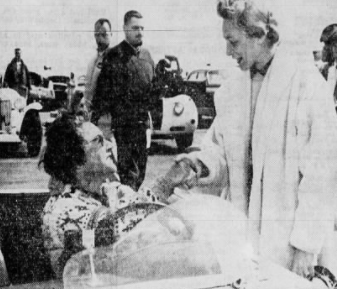
The most famous winner of the event was Maria Fernanda de Menezes Ribeiro (pictured), popularly known as "Speedy Ribeiro". She had been born in Macau itself in 1924 and was the daughter of a diplomat. Her Fiat 1100, which took her to one win and one second place, was her daily driver. She had actually taken part in the 1954 version of the Macau Grand Prix, which was then run as a regularity trial. Her car was a Vauxhall Velox belonging to her father and she was second overall. 

The Ladies' Race was never particularly over-subscribed and reports describe the action one year as "a procession". It was discontinued after the 1959 edition, which was won by Carol Ungricht. Carol was an American driver based in Okinawa, Japan. She also entered the Formula Libre race in 1958.

All-female races were later held at Macau, but they were celebrity events contested by actresses and TV personalities. Jackie Chan promoted one for several seasons.

For a list of female drivers who have attempted the Macau Grand Prix, click here. For a profile of Anne Wong, the only woman to win a race on the Guia circuit, click here.

1955

1. Jean Lam (Jaguar XK120)

2. Wen Lenard (Austin Healey)

1956

Maria Fernanda de Menezes Ribeiro (Fiat 1100)

1957

1. Narcee Matchett (Triumph TR3)

2. Maria Fernanda de Menezes Ribeiro (Fiat 1100)

1958

1. Carol Ungricht (MGA)

2. Narcee Matchett (Triumph TR3)

3. Miss S Anderson (Jaguar XK140)

1959

1. Carol Ungricht (MGA)

Maria Fernanda de Menezes Ribeiro (Fiat 1100)

(Image from macaubusiness.com)

Saturday, 18 October 2025

Nattanid Leewatanavaragul (Kat Lee)


Nattanid Leewatanavalagul is a Thai racer who competes in saloons and sportscar racing in Southeast Asia. She sometimes uses the anglicised name of Kat Lee.

Probably her most notable result was when she was third in the Thailand TCR Championship in 2017, driving a SEAT Leon. She won one race at Bangsaen, and scored four second and two third places.

Her earliest experiences of motorsport appear to be in a women-only Thai series for the Toyota Vios in 2013. She did not win, although she managed a victory the following year, and was able to use her experience to move on to the Thailand Super Series. This led to two seasons in the championship, driving a Honda Jazz for Morin Racing. She won class C in 2015 and won at least one Class B race in 2016, at Buriram. That year, she was seventh in the championship.

After her TCR success, she entered the Asian Mini Challenge and did the Thailand rounds of the Asian TCR series in 2018. Her best result in TCR was a second place at Bangsaen, driving a SEAT Leon. As a guest driver, she did not score championship points. She won at least two races at Zhuhai in China in the Mini.

She raced in the Super Compact class of the Thailand Super Series in 2019.

In 2021, she made some guest appearances in the series, driving a Honda, but was not registered for the championship.

Her first races in Europe came in 2022, when she drove another Leon for Monlau Motorsport in some of the 24H Series races. She was part of a two-car, all-Thai squad featuring Sandy Stuvik and she won the TCR class at Catalunya, finishing 16th overall. She did not finish the Algarve race, driving for the same team but with different team-mates.

After a break, she did some rounds of the 2024 Lamborghini Super Trofeo Asia, sharing the car with Dechathorn Phuakkarawut. They were second in the Am class, with three wins and eighth further podium places. Driving a Huracan, Kat entered the Super Trofeo World Final, finishing eighth in the Am class.

In 2025 she moved back to the Thailand Super Series, racing in the Super Touring category in a Honda CRZ with Thanaroj Tanasitnitikate. They won at least one race at Sepang.

(Image copyright Lamborghini)

Monday, 30 June 2025

Anita Liden


Anita Lidén is a Swedish driver who is most famous for attempting to build a career in NASCAR in 1970.

She tried to enter the Motor Trend 500 at Riverside, but never made the start, having no car and no backers. She had shown up at Riverside and hung around the gates in the week before the 500, handing out business cards in the rain and attempting to persuade car owners to take a chance on her.

Despite her chutzpah, the enterprise did not work. Her complete lack of stock car experience, apart from some slow testing laps, and general lack of American racing experience, worked against her. Her husband Lasse, another racer who was with her, was also unsuccessful in launching a US competition career.

Anita and Lasse lived near the Anderstorp circuit, where he raced both cars and motorbikes. She was formerly a model and got into motorsport through her husband.

She had raced in Formula Ford in Sweden in 1969, in her first year of competition. She usually used the name "Anita Snabb", which translates to "Fast Anita". Her car was a Merlyn. In 1969, she entered the Junior race at the Hyllingeloppet event at Knutstorp, finishing second.

After her trip to America, she returned to Sweden and quickly went back to single-seaters. She continued to race in Formula Ford, then in the Swedish and European Formula Vee championships. She took part in the Swedish series in 1970 and 1971 and the European championship between 1970 and 1072.

Much later, in 1976, she raced in the Lee Cooper Mini Lady Cup, a Swedish all-female racing series, and won at least one race, although not the championship, which went to Birgitta Uppling. Her car was advertised for sale in 1978, so her career appears to end there.

(Image copyright Autosprint, 1971)

Monday, 17 March 2025

The TC2000 Carrera de la Mujer


The Carrera de la Mujer ("Race of Women") is a recurring event held at the end of the TC 2000 season in Colombia. It is a female-only race run in aid of breast cancer charities. The 2024 edition was the seventh running; it is not an annual event.

It is for saloon cars of the type found racing in Colombian TC 2000, and cars of a variety of ages can take part. Grids are normally fairly large and consist of female TC 2000 regulars, celebrities, media and other guest drivers who are competing for charity. The race is a sprint, usually lasting 20 minutes. Drivers can compete solo or with a co-driver, who does not have to be female.

Details of the race are sketchy, although each edition is numbered, which helps a little. It isn't clear when the first race was held, although it was not before 2013. Entry lists, results and winners are similarly difficult to find.

Below is the beginning of a timeline for the Carrera de la Mujer, with winners where they are known.

I

II (2014)

III (2015)

IV

V

VI (2022) 

Angelica Jaimes (Renault)

VII (2024)

Teresa Penuela (Renault)


(Image copyright TC 2000)

Monday, 9 December 2024

Hila Paulson Sweet


Hila with Parnelli Jones


Hila Paulson Sweet
was an American driver known for her stock car racing in the 1950s, and for being instrumental in setting up all-female racing clubs.

Born in Compton, Los Angeles, she spent most of her adult life in California. She started racing in 1950, when she was 22, initially in the "Powder Puff Derby" events put on for wives and girfriends of male drivers. Her younger brother Ray also raced. To begin with, she competed alongside her first husband, Bob Morgan, and the pair owned a car together. She was later married to Ummie Paulson, an expert car builder who acted as her crew chief.

She raced in a couple of official NASCAR Late Model races in 1956 and 1957, in a Chevrolet. Both races were at the Gardena circuit, and she did not finish either of them.

Hila is most famous for her huge success in the “Powder Puff Derby” scene, where she was almost unbeatable. Although there were no rules specifically banning female drivers, or limiting them to ladies' races, they normally had to share a car with a husband, boyfriend or male relative, who would use the car for the main events, hence the popularity of powder puff or "Cheesecake" derbies.

She was part of a group of female drivers who became known as the Lady Leadfoots, which set up a racing league for women. The group's official name was the California Women's Racing Association and it was formed in 1950, amalgamating several groups active in jalopy racing, including the Cheesecake Derby Association. Hila was not part of the combined committee at the beginning, having led one of its constituent groups, but she had risen to the rank of President by 1953. This was in spite of a claim that one of the organisations tried to ban her from competing as she won too often. The CWRA advertised for new drivers in newspaper Situations Vacant columns, promising start money.

The CWRA's home track would become Gardena Stadium, but their first all-female event was at Carrell Stadium in 1950, before the other groups joined them. Hila competed against pre-war Irish driver Fay Taylour, visiting from Europe, as well as the glamorous Peggy Peek, Esta Cornett and Ellen McCoy. Her sister Edna Bates was a regular rival. Most powderpuff races were contested over a few laps in a single heat, but the Carrell event was a full programme of heats and a final.

Hila was never shy of publicity and must have jumped at the chance to enter a match race against Parnelli Jones in 1955, then a leading jalopy racer at the Carpinteria Thunderbowl. According to the Santa Barbara News Press, there was little to choose between the two drivers for the first third of the six-lap race, before Parnelli Jones pulled ahead. Hila kept on his tail until the final corner, when she pulled up the inside of him and sent him off the track, taking the win for herself. Later in the year, she also took on brothers Marty and Tommy Artoff at the San Bernardino track.

In 1959, she also did some sportscar racing, and won a Ladies’ race at Ascot, in a Jaguar. The year before, she took a Ford Tractor stock car to a ladies' race at her home track of Gardena, winning from Barbara Scott and Bonnie Bosley, both in MGs.

After retiring from the track herself, she continued to be active in motorsport until an advanced age, organising get-togethers for other former racers on the jalopy and stock car scenes. Her marriage to Ummie did not last and she later married Bob Sweet. They moved to Florida, where they owned their own track.

Away from active competition, she was instrumental in getting Parnelli Jones drives, alongside Ummie. Parnelli Jones won the Indy 500 in 1963. She also wrote about stock car racing for local newspapers. Later, she organised get-togethers for former racers.

(Image from The Jalopy Journal)

Monday, 5 August 2024

F1 Academy


F1 Academy is the latest in a long line of female-only development championships, launched in 2023. 

It was brought forward by the FIA after the demise of W Series and unlike W Series, has the support of the FIA and its Women in Motorsport Commission.

The championship uses F4 cars with an uprated aero package. There are five independent teams, each running three drivers each. All five are major players in global junior single-seater competition. Drivers must have an appropriate license and be aged between 16 and 25 at the start of the year. They are recruited by the teams privately. Each driver has to bring about £150k in funds to compete, but this is considerably less than it costs to take part in the equivalent mixed F4 championship in their region. Each race seat is subsidised by the teams and the FIA. The championship's CEO is Susie Wolff.

As well as seven meetings with three races (reduced to two in 2024)  at each, F1 Academy drivers have access to 15 official test days throughout the year, giving them a large amount of track time for their investment. 

The aim of the championship is progression, so the winner each year has to move on. No-one may spend more than two seasons in the series.

Prema, one of the Academy teams, offered a Formula Regional Europe (FRECA) race seat to 2023 winner Marta Garcia. Teams who sign any F1 Academy driver finishing first, second or third into FRECA are allowed to run a fourth car for that driver.

2023 Results

1. Marta Garcia (Prema)

2. Lena Buhler (ART Grand Prix)

3. Hamda al-Qubaisi (MP Motorsport)

4. Nerea Marti (Campos)

5. Abbi Pulling (Rodin Carlin)

6. Amna al-Qubaisi (MP Motorsport)

7. Bianca Bustamante (Prema)

8. Jessica Edgar (Rodin Carlin)

9. Emely de Heus (MP Motorsport)

10. Lola Lovinfosse (Campos)

11. Carrie Schreiner (ART Grand Prix)

12. Chloe Grant (ART Grand Prix)

13. Megan Gilkes (Rodin Carlin)

14. Chloe Chong (Prema)

15. Maite Caceres (Campos)

2024

The second F1 Academy season increased its links with Formula 1. Each F1 team chose an Academy driver to support, meaning that two-thirds of the grid ran with F1-related liveries. The race weekends were run alongside seven F1 rounds. Instead of three races, two would be held.

An extra car for a wildcard driver from the country the race is held in was provided for some rounds.

The non-F1 affiliated cars attracted some high-profile sponsors, including Tommy Hilfiger and Charlotte Tilbury cosmetics.

There were six new full-time drivers, after Marta Garcia and Lena Buhler moved into FRECA, with Buhler ageing out of the competition. Megan Gilkes retired from racing and Chloe Chong, Maite Caceres and Chloe Grant went to race elsewhere.

2024 Results

1. Abbi Pulling (Rodin/Alpine) 

2. Doriane Pin (Prema/Mercedes)

3. Maya Weug (Prema/Ferrari)

4. Nerea Marti (Campos)

5. Hamda al-Qubaisi (MP Motorsport/Red Bull)

6. Chloe Chambers (Campos/Haas)

7. Bianca Bustamante (ART Grand Prix)

8. Lia Block (ART Grand Prix/Williams)

9. Carrie Schreiner (Campos/Sauber)

10. Tina Hausmann (Prema/Aston Martin)

11. Emely de Heus (MP Motorsport)

12. Aurelia Nobels (ART Grand Prix)

13. Jessica Edgar (Rodin)

14. Lola Lovinfosse (Rodin)

15. Amna al-Qubaisi (MP Motorsport/Racing Bulls)


2025

The series continued in the same format in 2025, with an additional two-car team run by Hitech, who also ran the wild card entries. Hitech regular driver Aiva Anagnostiadis suffered a foot injury and missed the last two rounds of the season. She was replaced by wild card drivers Megan Bruce and Rachel Robertson.

Nine of the 2024 drivers either aged out or came to their two-season limit, meaning the grid looked quite different in 2025. The championship came down to the final race at Las Vegas, with Doriane Pin taking the crown with one win and a fifth place. Maya Weug, her closest rival, was taken out on the formation lap by Tina Hausmann in Race 1. 

2025 Results

1. Doriane Pin (Mercedes/Prema)

2. Maya Weug (Ferrari/MP Motorsport)

3. Chloe Chambers (Campos)

4. Ella Lloyd (Rodin/McLaren)

5. Alisha Palmowski (Red Bull/Campos)

6. Nina Gademan (Alpine/Prema)

7. Alba Hurup Larsen (MP Motorsport)

8. Tina Hausmann (Aston Martin/Prema)

9. Lia Block (Williams/ART Grand Prix)

10. Emma Felbermayr (Sauber/Rodin)

11. Chloe Chong (Rodin)

12. Rafaela Ferreira (Racing Bulls/Campos)

13. Aurelia Nobels (ART Grand Prix)

14. Joanne Ciconte ((MP Motorsport)

15. Esmee Kosterman WC 

16. Rachel Robertson WC (Hitech)

17. Aiva Anagnostiadis (Hitech)

18. Payton Westcott WC

19. Courtney Crone (ART Grand Prix)

20. Nicole Havrda (Hitech)

21. Mathilda Paatz WC

22. Megan Bruce WC (Hitech)

23. Ava Dobson WC

24. Shi Wei WC

25. Farah Al-Yousef WC

26. Lisa Billard WC


Monday, 27 March 2023

Anne-Sophie Lemonnier (de Ganay)


 Anne-Sophie and her father at the 2011 Andros Trophy

Anne-Sophie le Ganay, who was previously known as Anne-Sophie Lemonnier, competes in ice racing in France. She was previously active in rallycross as well.

It was actually in rallycross that she got her start. Her first championship was a ladies’ Citroen Saxo series in 2003, the Citroen Challenge Feminin. She and her sister Marie-Laure competed together. The Lemonnier family is involved in both rallycross and stage rallying: Anne-Sophie and Marie-Laure’s father is Herve Knapick, a multiple rallycross champion, and their cousin Xavier Lemonnier is also active in rallying. 

The Challenge Feminin retired the Saxos in 2004 and began using the C2 instead. Anne-Sophie competed in one between 2004 and 2006. During her first season in a C2, she remained behind sister Marie-Laure, finishing fifth to her third. In 2005 and 2006, she leapfrogged her for championship third. 

The Citroen one-make series was cancelled at the end of 2006, so in 2007, she moved up to Division 4 of the French championship. Her car was not as competitive as those of the S1600 drivers in the series. After part-seasons without much of an impact, in 2010, she raced a Citroen Saxo kit car in Division 1A. 

In 2011, she was 18th in the Super 1600 championship, driving the same car. She did not compete in the championship in 2012. 

On the ice-racing side, she won the Andros Trophée Féminin “Ice Girls” championship in early 2008, driving a sprint car. In 2010, she was the Andros Ladies’ champion, as the highest-placed woman in the main draw. 

She competed mostly in the Elite class, beginning in 2009. She was a strong finisher in the 2012 Trophy, driving a BMW.

In 2014, she was 18th in the Promotion class, driving a BMW 1-Series. The car was shared with her father, Hervé Knapick, and run by their family team. 

Anne-Sophie reappeared in 2015 as team-mate to her father for the Alpe d'Huez round, driving a Renault Clio. By this time, she was racing as Anne-Sophie de Ganay. After a gap, Anne-Sophie and her father campaigned an Audi A1 in the 2022-23 Andros Trophy, competing at the Isola 2000 event.


(Image copyright Icon Sport/Getty Images)

Thursday, 23 February 2023

Henrietta Lister


Henrietta Lister owned and raced an Aston Martin in the 1920s, sometimes competing at Brooklands. She was sometimes known as Mabel, her middle name.


Pictures of her in racing garb next to a car at Brooklands exist from 1924, but no race results. The car was a “Bamford-type” Aston with a 1500cc side-valve engine, according to Henrietta’s obituary in a 1983 edition of the Brooklands Society Gazette. The author, Geoffrey Smith, states that she raced for four seasons only, which would have been between 1924 and 1928. How and why this professional ballet dancer, dance teacher and art graduate came to own and race such a car, no-one really knows.

The car itself was sometimes looked after by Jack Waters, who would later find fame as the actor Jack Warner. His two sisters were the comedy performers “Gert and Daisy”, friends of Henrietta, and it is possible that the Waters family formed the link between her and motor racing. Another is that she had served in the Scottish Women’s Hospital corps during WWI, working as a driver of ambulances and lorries. She saw action on the Eastern Front in Serbia and may have come across Gwenda Glubb, who was active at Brooklands as Gwenda Stewart at the same time as Henrietta.

In 1925, she was second in two editions of the Essex Long Handicap. One of these was captured on a film titled “Woman Motorist’s 90 Mile an Hour!” 

Later in the year, she entered a 50-mile handicap with the same club, although her finishing position is not recorded. Pictures show her car in action at meetings of the Middlesex Motor Club. At the time, the main organising club at Brooklands did not hold mixed races, but many regional clubs did.

The BARC relaxed its stance somewhat on female drivers in 1928 and she was third in a Ladies’ Handicap held during the August Bank Holiday meeting, behind Margaret Maconochie’s Amilcar and Ruth Urquhart Dykes in an Alvis.

There is some confusion about when exactly Henrietta competed, as other drivers often used her car, and she was named as the entrant. Jack Waters was one of those who drove the Aston.

After her time as a racing driver, she married William Burrill-Robinson and took up watercolour painting, exhibiting regularly in Yorkshire. According to her obituary, she had sold the Aston to a passing soldier at some time during WWII for £35, having helped him to hide some contraband petrol.

She had previously been a ballet dancer, using the name "Henrietta Listakova". Under this name, she performed in a “charity ballet” in West Acton in 1923. Her performances included The Dying Swan and a foxtrot with another dancer called Arthur Barron. The event was organised by a Miss Mabel Lister, who may have been Henrietta using another name, or a relative. She had been born in Australia and lived in Acton with relatives as a girl, one of whom could be Mabel. Mabel Lister’s dance school taught “Russian ballet and ballroom”, which tallies well with “Mabel Listakova’s” performance.

Henrietta died in 1983, reportedly after suffering heart trouble for much of her life. This never seemed to stop her from seeking excitement or facing adversity.

(Image copyright Brooklands Gazette. Thanks to James Thorne)

Wednesday, 7 September 2022

Jenny Dell


Jenny Dell raced sportscars and saloons in the 1960s and ‘70s. She drove in the fore-runner to the British Touring Car Championship in 1972.

Her first car was an Elva Courier which she first raced in 1967, when she was 22. 


She was most associated with the Nathan GT, which she used between 1969 and 1970. This was a Hillman Imp-engined special built by Frank Costin and Roger Nathan. Her car was formerly used by the factory Nathan team and had a BMW engine. She won at least one race outright in it, a GT event at Brands Hatch in April 1970.


The Nathan replaced a similar GT car, a 1100cc Diva. This was not the most reliable of cars, although she did manage a sixth place in it in the Brands Hatch STP round in 1969. She later sold it to Wendy Hamblin, another British driver.


Her car for the British Saloon championship was a Ford Escort, which she also tried to qualify for the 1971 Spa 24 Hours. She also drove a Mini Clubman in Special Saloons.


She did at least some rounds of the 1972 BSCC in a Vauxhall Firenza, as a team-mate to Gerry Marshall and Denis Thorne. Her best result seems to have been a class win in the final round at Oulton.


A fellow saloon car racer, Wendy Markey, had Jenny as her co-driver in the 1973 Avon Tour of Britain. Their car was a BMW 2002 and they won the ladies’ award, finishing 19th overall.


She carried on racing until at least 1975, when she is recorded as entering one of the BWRDC’s Shellsport Ladies’ Escort races. She had won a round of the first Shellsport Escort championship in 1974. Jenny was an enthusiastic member of the BWRDC from early on, winning the club’s Goodwin Trophy in 1969 as its highest-performing member. In 1972, she entered the one-make “Fast Girls” Ford Consul Challenge, mostly contested by club members, and finished eleventh.


Jenny’s sister was dating motorcycle racer Bill Ivy when he died in 1969. Jenny herself died young of cancer at some time in the 1980s, having been ill for some time.


(Image copyright Phillip Jackson/Shutterstock)


Wednesday, 6 July 2022

Maud Manville


Maud Manville raced Daimlers in the UK and Europe in 1905 and 1906. 


She was a contemporary and rival to Dorothy Levitt, her equivalent at Napier, although her public profile was not as high.


Her interest in practical motoring dated back to at least 1904, when she drove her Daimler from London to Germany in order to watch the Gordon Bennett races. The same year, she impressed reporters at a meeting of the Ladies’ Automobile Club with her “splendid Daimler carriage” decorated with flowers. In August, she entered the Bexhill Speed Trials and won her heat in an 18hp Daimler. The car was in the well-supported class for cars costing between £2750 and £3750.


She competed in the inaugural Brighton Speed Trials in a 35hp model. She lost out to Claudia Lasell in the main draw, but won a race for 35hp Daimlers against male drivers. A Ladies’ Handicap was also held and she reached the final, losing to Mrs Herbert Lloyd in her own Daimler.


In the same car, she drove in the Herkomer Trial in Germany in 1905 and 1906. She did not finish the 1905 Trial, but won her class the speed trial section, going faster than several larger cars including Willy Poge’s 60bhp Mercedes, which won a later timed section. 


The following year, she finished the event in eleventh place. 


Born Maud Wallis, her husband was Edward Manville, who was the chairman of Daimler, and they competed against each other. In 1906, they were both participants in the Herkomer Trophy. When Maud heard that Edward’s car had suffered a puncture, she reportedly asked the German official observer in her car whether she would be allowed to stop for “a cry”.


Maud was an early member of the Ladies’ Automobile Club, joining in 1903, who encouraged its members to try competitive driving. She drove in at least two of the club’s gymkhanas, winning a “Bomb Race” in 1905.  In 1906, not long after her return from the Herkomer Trial, she was yet again one of the winning drivers in the club’s annual gymkhana, held at the Ranelagh Club. She won the Bending Race and was second in a “Tilting at the Ring” competition. This was a game adapted from an equestrian event where a contestant in a moving car had to catch a hanging ring with a lance or similar. 


The same year, she gave a talk to the club about her experiences in the Herkomer Trophy.


Her motoring career seems to end after 1906. She died in 1909, aged 37. 


(Portrait by Amata Bouwens, 1901)


Monday, 27 June 2022

Caitlin Wood

Caitlin Wood is an Australian driver who races in Europe. In recent years, this has been in sportscars, although she started in single-seaters.

She began her senior motorsport career in 2013, supported by the Women’s Australian Motorsport federation as one of their most promising young drivers, following a successful karting career. Her brother had raced previously and she helped him and their father rebuilt his Spirit Formula Ford. She did part-seasons in the Australian and Victorian Formula Ford championships, earning two fourteenth places in the Australian series. More races in the Victorian championship gave her more experience.

In late 2013, she was selected as Australia’s entry for the FIA Women in Motorsport Scirocco-R shootout, in an attempt to win a VW Scirocco prize drive in Europe. She did not win and returned to single-seaters in Australia. 

Another season in the Australian Formula Ford championship followed in 2014. It was a hard year for her, but she managed to get into the top ten three times towards the end of the season. She was 21st overall. As well as her national series, she got some extra seat time in the New South Wales state championship, where she fared better, finishing sixth overall after five races. 

She put together a deal late in the season to run in the 2015 Australian Formula 4 championship, the first female driver to do so. She was thirteenth in the championship after just under half of the season, with a best finish of sixth at Sandown. 

In 2016, she intended to race in F4 for the full season but ended up in Europe, racing a KTM X-Bow in the GT4 European Series. This followed an invitation by former Formula 1 driver Tomas Enge to join a Young Stars programme run by Reiter Engineering.

She was a solid top-ten finisher in the Pro class, partnered with male drivers including Marko Helistekangas. Her best overall finish was seventh at Pau, and she was seventeenth in the main championship. However, she won the Young Stars class.

She stayed with the Reiter team in 2017 and drove both the X-Bow and their Lamborghini Gallardo. The X-Bow came out for the Dubai 24 Hours, where Caitlin was part of a four-woman Reiter team with fellow Young Stars drivers Anna Rathe, Marylin Niederhauser and Naomi Schiff. They finished the race in 72nd place.

For most of the year she drove the Gallardo in the Blancpain Endurance Series, as a prize for her Young Stars win. She was tenth in the Sprint Cup Silver Cup, having been entered in different classes over the year with Marko Helistekangas. 

She missed some of the 2018 season due to injury but managed the early and late part of the Lamborghini Super Trofeo, racing in Europe. At first, she drove for Mtech in the Pro-Am class, before doing the Silverstone rounds in the Am class with The Energy Check. She returned to Pro-Am for the closing races at the Nurburgring, picking up her best finish of sixth.

She also did her first Bathurst 12 Hours in the X-Bow, although she did not finish. Sadly, she did not finish the race in 2019 either. 

The 2019 summer season was spent as a W Series driver in Europe, having gone through several rounds of selection alongside her former Reiter team-mates, Naomi Schiff and Marylin Niederhauser. Naomi was also selected. 

Her best finish by far was fifth at Assen and she was thirteenth in the championship. She did not race in W Series in 2020 as it was cancelled, but she returned as a reserve driver in 2021. Despite her reserve status, she did four of the eight races, earning one fifth place at Spa. She also drove the Tatuus F3 car up the hill at the Goodwood Festival of Speed.

After being released by W Series, she remained in Europe and joined up with the Adrenalin Motorsport Alzer team for the NLS. Their car was a BMW 330i. She did one NLS race in 2022.

She returned to competition in a high-profile hook-up with Mattel's Barbie brand in 2024, competing in the Porsche Sprint Challenge in the UK. Sadly, fudning ran out after four rounds. Later in the year, she was drafted into the Bangalore Speedsters team for the Indian Racing League. She shared a car with Rishon Rajeev and they were seventh in the championship, ahead of the team's sister car. Caitlin's best individual finish was a fifth place at Chennai.

(Image copyright Caitlin Wood)


Tuesday, 12 April 2022

Susan Tucker-Peake


Susan and Maralyn Tucker-Peake with one of their trophies

Susan Tucker-Peake raced between 1966 and 1989, starting in club saloon races in the UK and progressing as far as the European Touring Car Championship. 

She won two rallycross races in 1972, in a Ford Anglia, and was the winner of the 1975 Ladies’ Shellsport Escort Championship. 

Although she raced a wide variety of cars throughout her sporting career, she was probably most associated with saloon cars, spending some time racing in the no-limits Special Saloon championship in the ‘70s. In 1973, she raced a Ford Escort with Graham Goode, against the likes of Gerry Marshall. She continued to race in this series until at least 1975, driving an Escort.

Trying yet another discipline, she partnered Maggie Anderson in the 1975 Avon Tour of Britain. Their car was a Renault 11TS entered by Renault Elf Racing, who were running Maggie in their one-make Renault 5 series.

This was combined with regular appearances in the Ladies’ Shellsport Escort Championship. Despite not winning a race, she won the first championship in 1975, ahead of Divina Galica. Divina was the 1976 winner, with Susan in second. She was fourth in 1977.

In 1977, she drove a Renault 5 herself in most of the British Touring Car championship, which led to a works drive with Skoda in the 1978 ETCC. She and Petr Samohyl contested four rounds together in a 130 RS, with a best finish of 21st at Brno. The car was not reliable and this was their only finish. 

After her ETCC adventure, Susan bought a Brabham BT21 F3 single-seater and rebuilt it with her husband. 

During the 1980s, she raced in Formula 4, and in a number of relay races for the BWRDC.

Her earliest motorsport experiences were in trials, competing with her sister Maralyn in their father’s self-built Tucker Nipper car.

After retiring from active competition she served as the President of the British Women Racing Drivers’ Club. In 2003, as Susan TP-Jamieson she wrote Women in Motorsport from 1945 with Peter Tutthill, a book chronicling female drivers since the war.

(Image copyright classictrials.co.uk)


Sunday, 20 March 2022

Miki Onaga


Miki Onaga races a VITA sportscar in Japan, in both the all-female Kyojo Cup and in the mixed Inter Proto series for which that car is eligible. 


Born in 1997, she comes from Okinawa province, the most southerly island of Japan.


She is one of the Kyojo Cup’s leading drivers, finishing second in the 2019 championship having joined for the second round. On the pace from the start, she won straight away. This was the start of a championship battle with Hinako Muramatsu, which lasted until the final round. Muramatsu won. 


The same year, she used her Vita prototype for the Suzuka Race of Asia, competing in the Vita one-make race. This is the mixed counterpart of the Kyojo Cup.


She entered the Kyojo Cup again in 2020 and was second overall, as well as competing in the Super Taikyu Championship in a Toyota GT86, driving for a Toyota-supported junior team. The Kobe Toyopet Motorsports car made its debut in October at the 3 Hours of Okuyama, where the three-driver team was fourth in class.


She returned to Super Taikyu in 2021, racing a Toyota Yaris, as well as finishing second in the Kyojo Cup again. The Yaris was a GR model run by the Kobe Toyopet team again. Early in the season, Miki and her two team-mates won their class at Motegi, the first of three class victories.


The Kyojo Cup title went back her way in 2022 with three out of four race wins. The fourth resulted in a penalty, otherwise she would have won that too.


In 2023 she was announced as a driver in the Toyota Gazoo Racing GR86/BRZ one-make cup, but no results seem to be forthcoming. Returning to the Kyojo Cup at the end of the summer season, she was second again, with one win.


She raced in the TGR championship in America in 2024, driving a GR86 for Hattori Racing as part of a rotating squad of Japanese guest drivers. Her best finish was 19th, at Barber Motorsports Park. Back home in Japan, she was runner-up in the Kyojo Cup.


The Kyojo Cup became a single-seater championship in 2025 and Miki was still a part of it, winning once at Fuji and finishing second overall. She was somewhat less successful in Japanese F4, which uses a different car. Her best finish was thirteenth, again at Fuji, and she was 26th overall.


Her senior career began in 2019, but she was both active and successful in karting for two years before that, competing in the All Japan Regional Championship and the Dunlop Next Cup. She was the first driver chosen for the Exgel Race Car First Challenge, a programme for karters transitioning to cars. It used the Vita prototype, giving her an advantage for her Suzuka debut.


(Image copyright Exgel Motorsport)


Sunday, 21 November 2021

Marion Lowe


Marion Lowe raced on both the East and West coast of the USA in the 1950s. She was one of several women drivers who got their start in the ladies’ races that were common at the time, but moved into mixed competition.

Her first car was an MG TD, bought for her as a birthday present by her British husband, Jim. The couple often raced together, with Marion, who was younger than Jim, often being the faster driver. Unlike many other couples, they preferred to compete against one another, rather than share cars. They lived in California where they ran a timber firm, but their considerable wealth allowed them to travel extensively in order to compete.

She was second in her first race, a ladies’ event at Torrey Pines in California, in 1952. Josie von Neumann was the winner. Marion was one of the older novices on the scene at 44; Josie was 18 at the time.

She continued to race the MG the following year, entering her first open event, the SCCA Nationals held at March airfield in Riverside. Competing against the likes of Masten Gregory and Briggs Cunningham, she was 17th overall and third in her class. Jim had paid for significant upgrades to the MG in the off-season.

The MG was exchanged for another British car for the start of the 1954 season. Her first race win came at her first meeting of the year, driving a Frazer Nash Le Mans Replica. She beat ten other women and five male drivers competing in a different class at Bakersfield. Later in the year, she was seventh in an SCCA National race held at Seattle Seafair.

Marion and Jim owned both the Le Mans Replica and a Targa Florio Frazer Nash, taking turns to drive both. The Seafair race was her first major event in the Targa Florio and she continued to use it throughout 1955. In it, she won ladies’ races at Stockton and Santa Rosa. In mixed competition, she was eighth in a National preliminary race at Seafair and ninth in another race at the Sacramento Nationals. At the end of the year, she made her first trip to compete abroad, travelling to the Bahamas for Speed Week with the Targa Florio. She entered the Governor’s Trophy, racing against such luminaries as Phil Hill, Stirling Moss and Alfonso de Portago, and was 31st, from 42 finishers.

Lou Brero, who had raced against her at Nassau in 1955, offered her a drive in his D-Type Jaguar for the ladies’ races of the 1956 Nassau Speed Week. She was ninth in the first heat but won the second. For the open events, she drove the Targa Florio, finishing 29th in the Nassau Trophy and 31st again in the Governor’s Trophy. On the mainland, she won ladies’ races at Santa Barbara and Palm Springs, this time in the Le Mans Replica.

She did not go to Nassau in 1957, although she did debut a new car at the inaugural Hawaii Sports Car Week in April. She was fourth in a preliminary race in an Alfa Romeo Giulietta, then sixth in the corresponding main race. Her next event was the Luther Burbank Rose Festival Sports Car Road Races, held at the Cotati airfield course. She was disqualified from her heat for receiving a push start in the Alfa, but she got to start the main six-hour race alongside Al Coppel in his Renault Spyder Le Mans. They did not finish due to a broken valve.

The Alfa was her preferred car for the 1958 sportscar season and earned her podium finishes in ladies’ races at Laguna Seca and Vaca Valley. She and Jim had also bought themselves his and hers Lotus Elevens, and Marion used hers to good effect. She was fourth in an SCCA Regional race at Laguna Seca, just behind Jim in his Eleven.

The Lotus starred in Marion’s return to Nassau. She won both heats of the ladies’ race, ahead of Evelyn Mull’s Eleven. Teaming up with Denise McCluggage in the car, she was ninth in the Nassau Trophy. The team won their class, with Jim’s Lotus second and 17th overall.

Her final year in sportscar racing began with a win in a ladies’ race at Laguna Seca, followed by another at Riverside a week later. In mixed competition, she was fourth in a November race at Hourglass Field. What would be her final Nassau appearance began with a DNF in the Governor’s Trophy, having finished 17th in the preliminary race. She was second in the ladies’ event, winning one of the heats and finishing second to fellow Eleven driver Prudence Baxter in the other. Both she and Jim failed to finish the Governor’s Trophy.

She was still competing in 1960 and even moved into single-seater racing in the form of Formula Junior. Her car was a BMC Mk1, built by Joe Huffaker from British BMC A-series parts. This year’s calendar included the Stockton Road Races, in which she was sixth. 

Jim’s health began to fail in 1961 and both retired from motorsport that year. Their relationship broke down in the following years and they divorced in 1965.


(Image copyright Santa Cruz Sentinel)

Saturday, 21 August 2021

Micki Vandervell (Chittenden)


Micki Vandervell, also known as Micki Chittenden, raced at national level in the UK in the 1970s. 

She was a member of the Vandervell racing family, the niece of legendary car designer Tony Vandervell and the cousin of racer Colin Vandervell. “Micki” was short for Michaela.

Her earliest adventures in motorsport were in autocross, driving a Mini in 1967. She gained some attention early on, not due to her family connections, but to finishing third in one of her first races in 1968 with a wrist in plaster. The event was at Sherwood Farm in Drayton and she won the ladies’ trophy.

By 1969, she was racing a Mini on track as well as on the dirt circuits of autocross, mainly in the south of England. At the end of the year, she took the Mini to Lydden Hill for the Grandstand Trophy, which was broadcast on BBC television. 

She continued to race the Mini in 1970, including at least one run in the Triplex Saloon Championship at Silverstone and an appearance at Brands Hatch. According to newspaper reports, she combined her racing with a job as a lab technician.

In 1971, she was part of "The Carmen Curls", an all-female racing team who competed in Formula F100. She raced a Royale sportscar alongside Gabriel Konig. The team was sponsored by Carmen hair products (“The House of Carmen”), and managed by Tina Lanfranchi. Among the four team officials was Roz Hanby, who later found fame as the face of British Airways. Neither of the team’s drivers completed the whole 20-round season and Micki was not as quick as Gabriel. She was thirteenth in the championship, which folded at the end of 1971.

She was an enthusiastic early member of the BWRDC, and competed in their women-only events. Her best result in one of these was a third place in the “Fast Girls Consul Challenge”, held at Brands Hatch in 1972 as a support to the Rothmans Formula 5000 championship. Gillian Fortescue-Thomas was the winner, ahead of Jenny Birrell and Micki, who finished ahead of her Carmen Curls team-mate Gabriel Konig. 

Much later, she took part in the Brands Hatch rounds of the 1976 Shellsport Ladies’ Escort series, scoring two seventh and one eleventh place.

For at least part of 1973, she raced an MG Midget in the STP Production Sports Car Championship.

She raced less often after her marriage to Mike Chittenden. Tiffany Chittenden and karter Tamsin Germain are her daughters.


(Image copyright Reading Evening Post)

Saturday, 6 February 2021

Geunda Eadie


Geunda Eadie raced in the BTCC in 1980 and was the winner of the Fabergé Ladies' Fiesta Challenge in 1979.

The Fabergé Challenge was a female-only talent search sponsored by Faberge’s Kiku cosmetics brand and the Radio Times. It featured both racing and rallying and was open to complete novices and experienced drivers alike. Geunda fell into the latter camp.

Since 1972, English-based Scot Geunda had co-driven for Sandy Lawson, who worked in the BMC competitions department. Their first major outing together was the 1972 Scottish Rally, in a Mini. Later in the year, Sandy acquired a DAF 55 and Geunda co-drove for her in it on that year’s RAC Rally. It was the first of three RAC events they did together.

She also took part in circuit racing at club level. This included the ladies’ races organised by John Webb, under the Shellsport banner. She took part in a couple of rounds of the Shellsport Ladies’ Escort Challenge in 1975, driving a Ford Escort Mexico and achieving midfield finishes. 

Later, she entered a Shellsport women’s race at Oulton Park in 1979. The cars were racing school Talbot Sunbeam Tis and Geunda defeated future Formula hopeful Desire Wilson and six other women.

The previous year, she had entered the Fabergé Challenge and beaten almost 2000 other hopefuls in regional trials. These involved straightforward driving tasks as well as more off-the-wall challenges like driving around a quarry blindfolded. The championship itself ran through 1979. Near-standard yellow Ford Fiestas were provided by local dealerships and each driver was paired with a co-driver for the six rally rounds, either chosen herself or assigned. Geunda’s navigator was the experienced Dilys Rogers.

Geunda won through her consistency, rather than spectacular wins. She appears to have done better in the rallies than the races, although the results lists are incomplete. The rallies were BTRDA rounds, with the Challenge running as its own class. Reactions to the women were mixed, although they became known as the “Yellow Perils” due to their yellow cars and Penelope Pitstop’s “Perils of” cartoon.

She won the first rally, the Dukeries Rally in March and was second in the Lakeland Stages a fortnight later. Her second event win was in Wales in the summer, when she topped the Fiesta standings in the Rali Bro Myrddin. She was second or third in each of the other three rallies.

The first part of her prize drive was a run in the RAC Rally in a works-supported Fiesta. She was co-driven by fellow “Yellow Peril” Flip Kerr, as Dilys Rogers was competing alongside Judy Simpson. Geunda sadly did not finish as she went over the time limit.  

Her season in the BTCC was something of a trial. Although she fared well in her class at times, the car was unreliable. She endured several DNFs and withdrew from some of the rounds. Her best class finish was third, which she earned at the Brands Hatch Grand Prix support race. Her best overall finish was ninth at the start of the reason, at Mallory Park.

At the end of the year, she retired from motorsport to start a family. Although her competition career was over, she stayed involved professionally, working for the Jim Russel Racing School at Snetterton. She was the chief instructor on its skid pan from at least 1978, when she put Daily Mirror journalist Paul Hughes through his paces for an article. Among her other students is said to have been a young Ayrton Senna, to whom she taught skid control.

As Geunda Palmer, she appears to have been involved in some way in the 1985 Esso Ladies’ Formula Ford race held at Snetterton, run by the Jim Russell school.

Geunda came out of retirement in 2010 to co-drive for Conor Kelly on the TNR Tour of the Sperrins. The car was a Ford Escort and she helped Conor to 81st place.

(Image copyright projectbobcat.com)

Thursday, 5 November 2020

Katherine (Kate) Martin


Katherine (Kate) Martin was best-known as the wife of Lionel Martin, and one of the early directors of the Aston Martin company. Katherine had raced a number of cars from the early 1920s onwards, including a Riley and an early Aston Martin, which she used in hillclimbs and trials.

Katherine was born Katherine King in 1888. She married Lionel Martin in 1917. 

She is credited with designing the first Aston Martin logo, and with persuading Lionel to put the “Aston” in the firm’s name first, so it would appear at the top of alphabetic lists. She was also involved with the design for the early cars’ radiator grilles.

Kate was an astute businesswoman, whose interests included a lime quarry, which is still part-owned by a trust in her name. Its profits go to the RSPCA, Barnardos and NSPCC. She was an early director of Aston Martin, taking over from Robert Bamford and holding the position until 1925.

The BARC began organising ladies’ races at Brooklands in 1920. Katherine appears to have won one of the earlier ones in 1921, driving an Aston. This may well have been “Coal Scuttle”, the first-ever Aston Martin built. In 1921, there were perhaps three Astons in existence and there are photos of Kate in Coal Scuttle at Brooklands.

Lionel Martin was forced to sell the Aston Martin company in 1925. He reputedly never owned another Aston and it appears that Kate followed suit. This was not the end of her involvement in motorsport, however; both she and Lionel continued to compete in rallies for some years.

She drove a Wolseley Hornet in the 1932 Alpine Rally, but her first trophy seems to have been a third in the Coupe des Dames of the 1933 Monte Carlo Rally, accompanied by Agnes Gripper. Her car was a Hillman. In that year’s Alpine Rally, she co-drove for her husband, in his Humber.

Sunday, 27 September 2020

Marian (Mopsy) Pagan


Marian Pagan, often known as “Mopsy” was one of the first female drivers to try her hand in NASCAR. 

Residing in California, she was the first woman from outside NASCAR’s Southern heartlands to try her hand at one of its top-level events.

She only made one Cup start in 1954, finishing 18th out of 33 in the Oakland Grand National race in a Plymouth run by her husband Eddie. He also took part in the race. Some of her male rivals protested her entry, but responses from the media and the public were largely positive.

“Mopsy” had relatively little experience in motorsport, but she had been quite successful in horse-drawn buggy races and was a member of the Cheesecake Racing Association, a twelve-woman racing league that competed widely. Their main haunt was Culver City but they also made several appearances at Gardena, at least one of which featured Mopsy.

In a 1955 newspaper interview, Eddie Pagan claimed that Marian had got into motor racing through him and that she first competed in 1951 after seeing her first “powderpuff derby” ladies’ race. Further details of her pre-Oakland career have proved tricky to find; full results for powderpuff derby races were rarely published.

In 1957, she was one of nine women who competed in the Mobilgas Economy Run for the Ford team. This was not a race but a cross-country trial with the aim of covering the greatest distance on the least fuel. She was tenth in the “Low Price” class, driving a Ford Fairlane. This appears to be the last time she entered a large-scale motoring event.

Away from the track, Marian worked in the aircraft industry.


(Image copyright Oakland Tribune)